At least three members of the innovative Manchester Photographic Society founded in 1855, lived in the Altrincham area. It is fitting therefore, that we feature a selection of 19th century photographs, many unique, which includes some of their work. They range from wild landscapes, rustic scenes and ancient or brand-new buildings to studio, outdoor and informal portraits. See below for more detailed background information.
The images are arranged alphabetically by the place they were taken, then by the surname of the photographer. Click to enlarge an image to find out more about it and browse further from there.
These photographs form part of the Altrincham Area Image Archive (AAIA), which was supported by the Heritage Lottery Fund with the purpose of digitising historic material, generously loaned by collectors, local societies and institutions in order to ensure preservation and wider access. Please visit Exploring Trafford’s Heritage to see a further selection of images from Trafford Local Studies Centre, for personal use only.
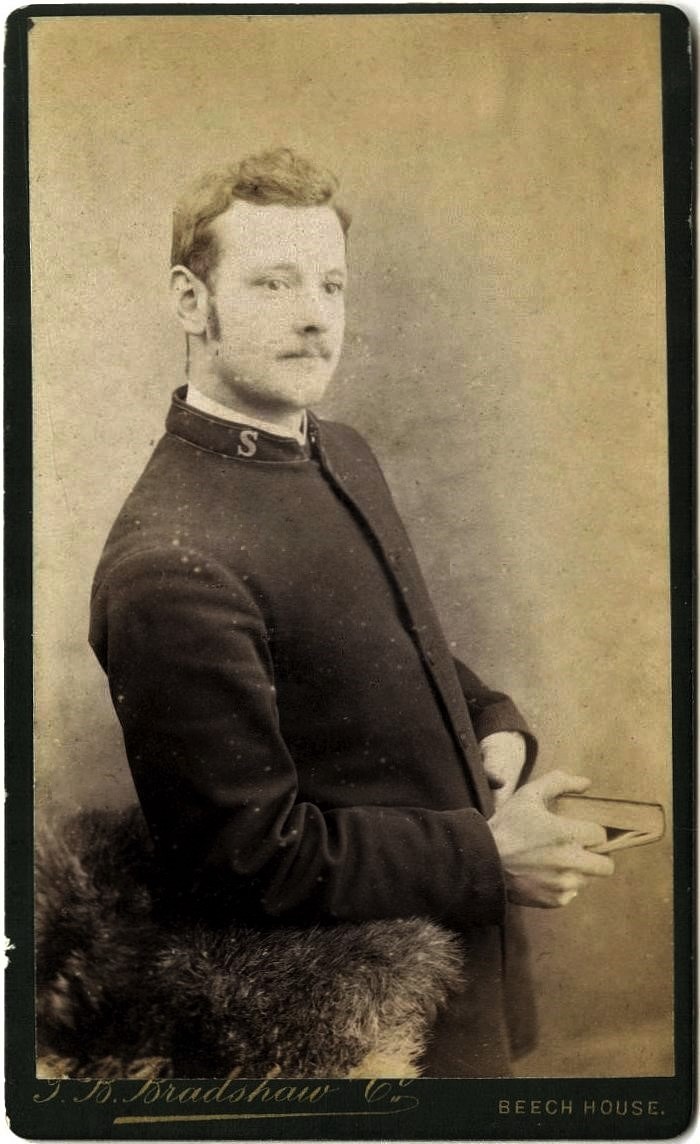
Altrincham: Member of the Salvation army, late 1880s
(George B. Bradshaw)
The engineer and philanthropist Francis W. Crossley had been living since 1874 up the hill in Bowdon, at Fairlie on Cavendish Road. He and his wife Emily built and managed two Preventative and Rescue Homes with schooling for a total of about 60 destitute young girls on Ashley Road, in nearby Hale. In 1882 he and his family signed the Pledge of Abstinence, pouring the contents of their extensive wine cellar down the drain. In the mid-1880s, Francis became very supportive of the Salvation Army, with Mrs Catherine and General William Booth staying at Fairlie several times. During the summers of 1888 and 1889, a tent was erected on the lawn to hold ‘‘holiness’’ meetings, with a variety of religious speakers. This young Salvation Army member may have been associated with this activity.
The photograph was taken at Bradshaw’s Beech House studio at 45 Oxford Road. On the back of the card it stated, ‘‘Any person who has been told they do not make a good Photograph should give us a trial as they are all taken by our own Instantaneous process and can be taken in any weather.’’
(Cabinet card by George B. Bradshaw, George B. Bradshaw and Company)
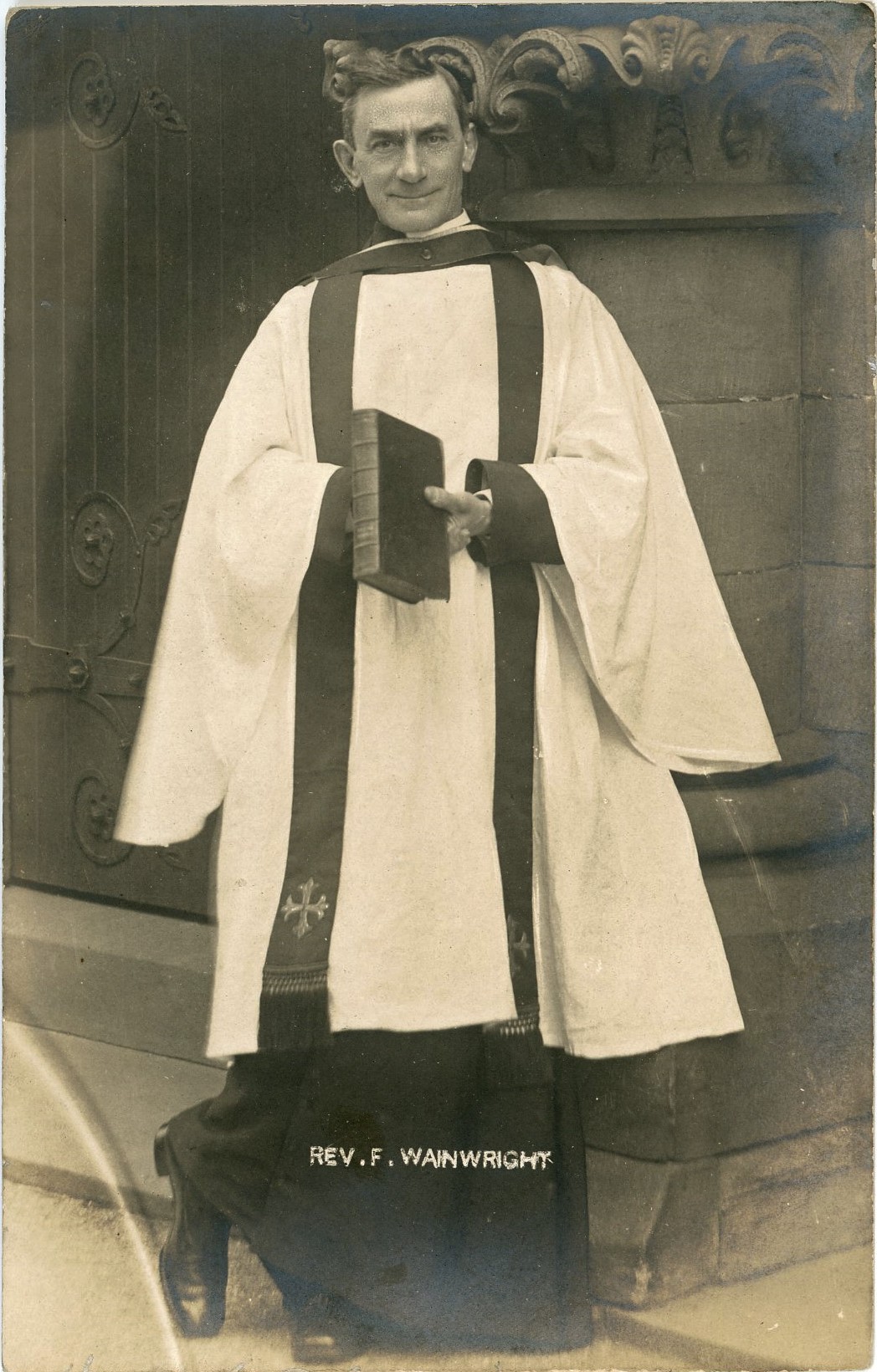
Altrincham: The Reverend Canon Frederick Wainwright M.A., early 1890s
(George B. Bradshaw)
This influential and charismatic vicar was born in London but went to school at Liverpool College, then in 1856 was at Trinity College, Cambridge. He became Curate at Saint Mary’s in Bowdon in 1864, before being made the first vicar of Saint John the Evangelist’s Church in Altrincham, when it opened in 1866. Renowned as a preacher, he drew on his love and wide knowledge of English literature. He was involved in the Altrincham Provident and Dispensary and Hospital and the Bucklow Union, aiding the poor. With his first wife Elizabeth and their children, the family lived at the Vicarage built in 1871, further up Saint John’s Road, beyond the School. Having married a second time, Wainwright retired in 1916 and was known locally as ‘the dear old Canon’. He then lived at The Cottage, Broomfield Lane in Hale, until his death on Hale bridge in 1921.
Behind him is the extravagant, squat column between the two doors at the west end of the Grade II Listed church of Saint John’s, designed by J. Medland Taylor. It was built to cater for the rapidly growing population of Altrincham, serving in particular, the poor area of Newtown, northeast of the church. Some of the stained glass windows were dedicated to members of Wainwright’s family, including his young daughter Maud, who had died from the effects of a scald in the bath in 1874. The main window in the south transept was to his wife, Elizabeth, who died in 1882. For more information about Saint John’s Church, see the Local History Publications page.
(Photograph reproduced on later postcard dating from 1907, George B. Bradshaw, George. B. Bradshaw and Company)
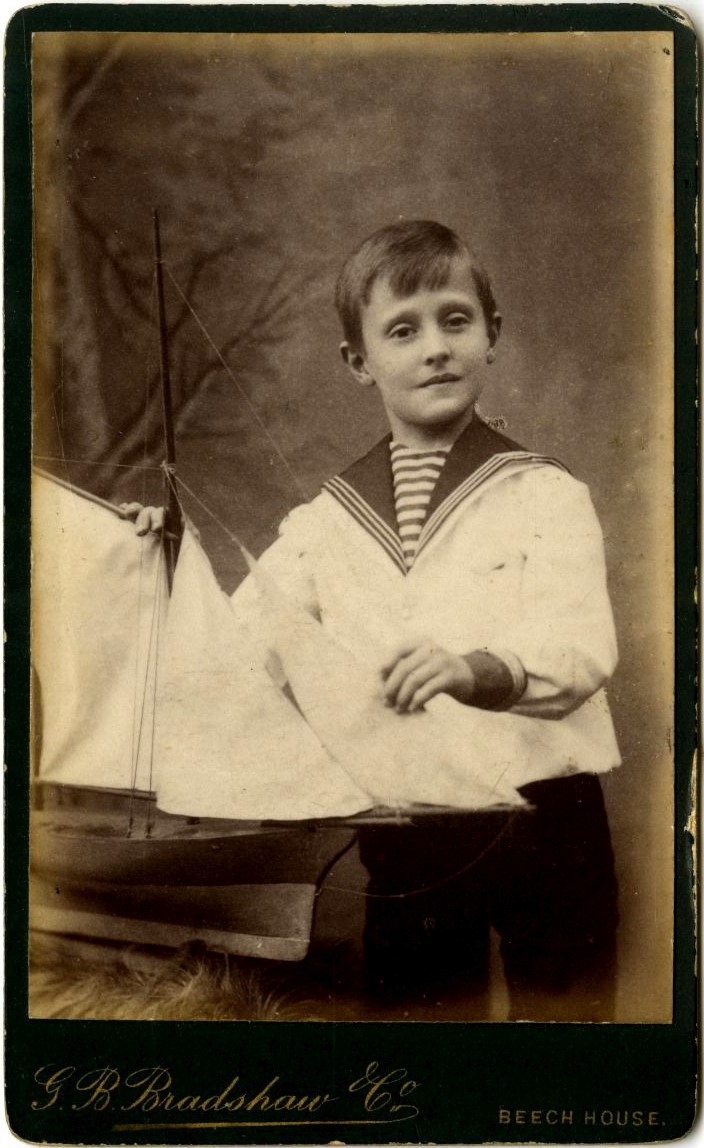
Altrincham: Boy with a model yacht, 1890s
(George B. Bradshaw junior)
The boy wears the highly popular fashion of a sailor suit and poses stiffly with the suitable studio prop of a model yacht.
(Cabinet photo by George B. Bradshaw & Company)
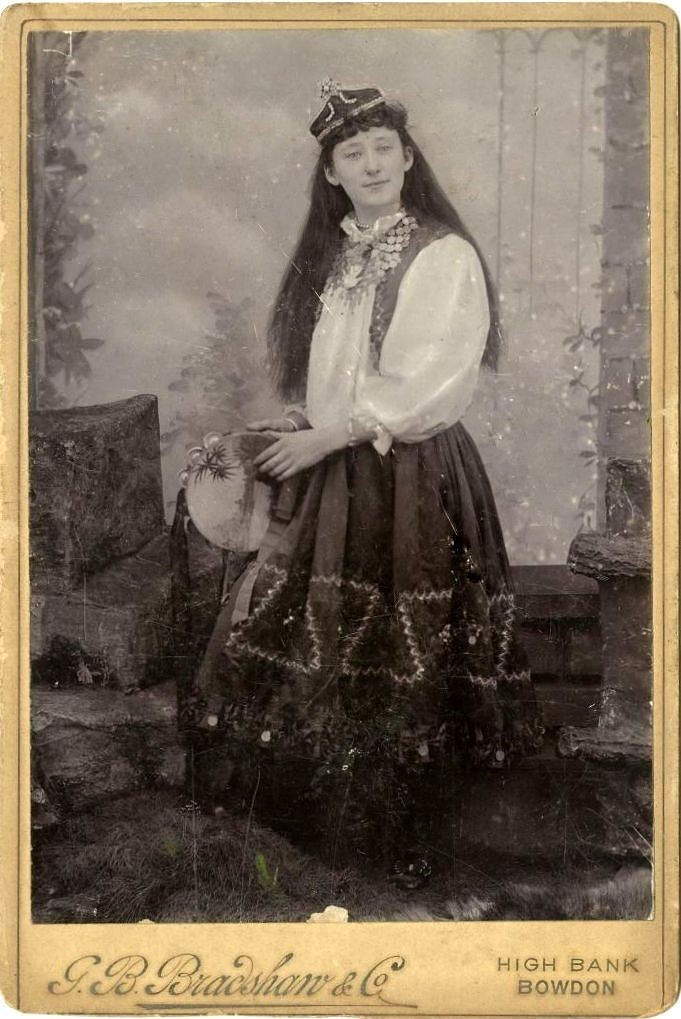
Altrincham: Girl in Gypsy costume, mid-1890s
(George B. Bradshaw junior)
Dressed in a fashionable gypsy costume, holding a tambourine, the photo of this girl was taken by George B. Bradshaw junior in his High Bank Studio. Despite the address on the card being given as upmarket ‘Bowdon’, which was to the to the south of Altrincham, the purpose-built daylight studio was actually situated to the north of Altrincham, near Sandiway. George’s wife Elizabeth was the manageress of the business, with his father of the same name having started the business in the 1870s in Cheetham, Manchester.
(Cabinet photo by George B. Bradshaw & Company)
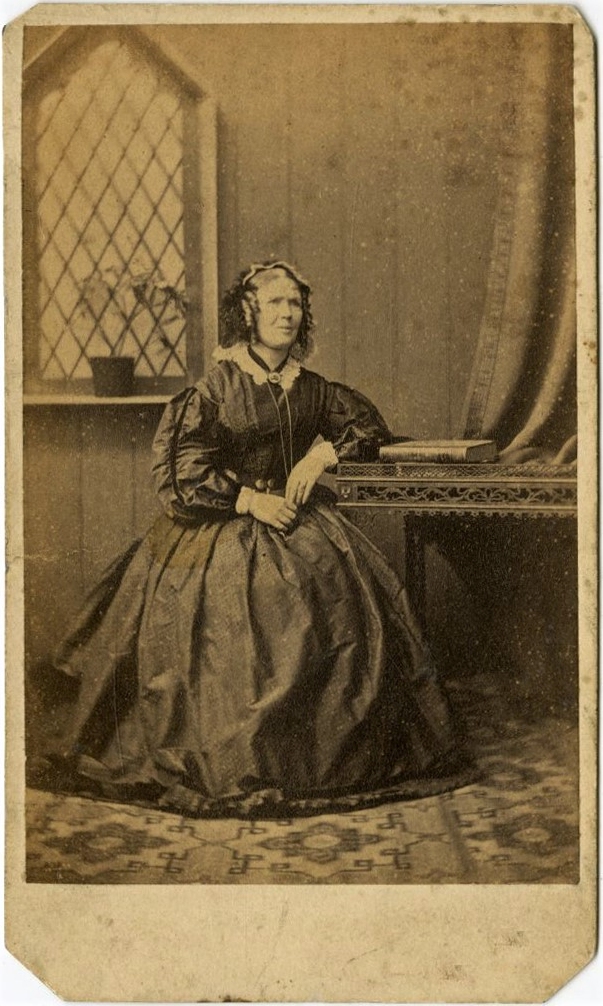
Altrincham: Seated woman, late 1860s
(William Harrison)
Born in Styal in Cheshire, William Harrison first appears in an Altrincham Directory in 1864 as a ‘photographic artist’. He lived and had his studio at 3 George Street, where this photograph was taken. Moving from nearby Chorley, he was listed there as a linen draper in the Census for 1861.
Seated in a panelled room with a gothic window, the woman wears a smooth shouldered dress with full sleeves, a tight waist and a fashionable full skirt over a crinoline. He hair has ringlets, which cover her ears.
The square corners of this carte-de-visite have been cut, in order to extract it from its album.
(Carte-de-visite portrait by William Harrison)
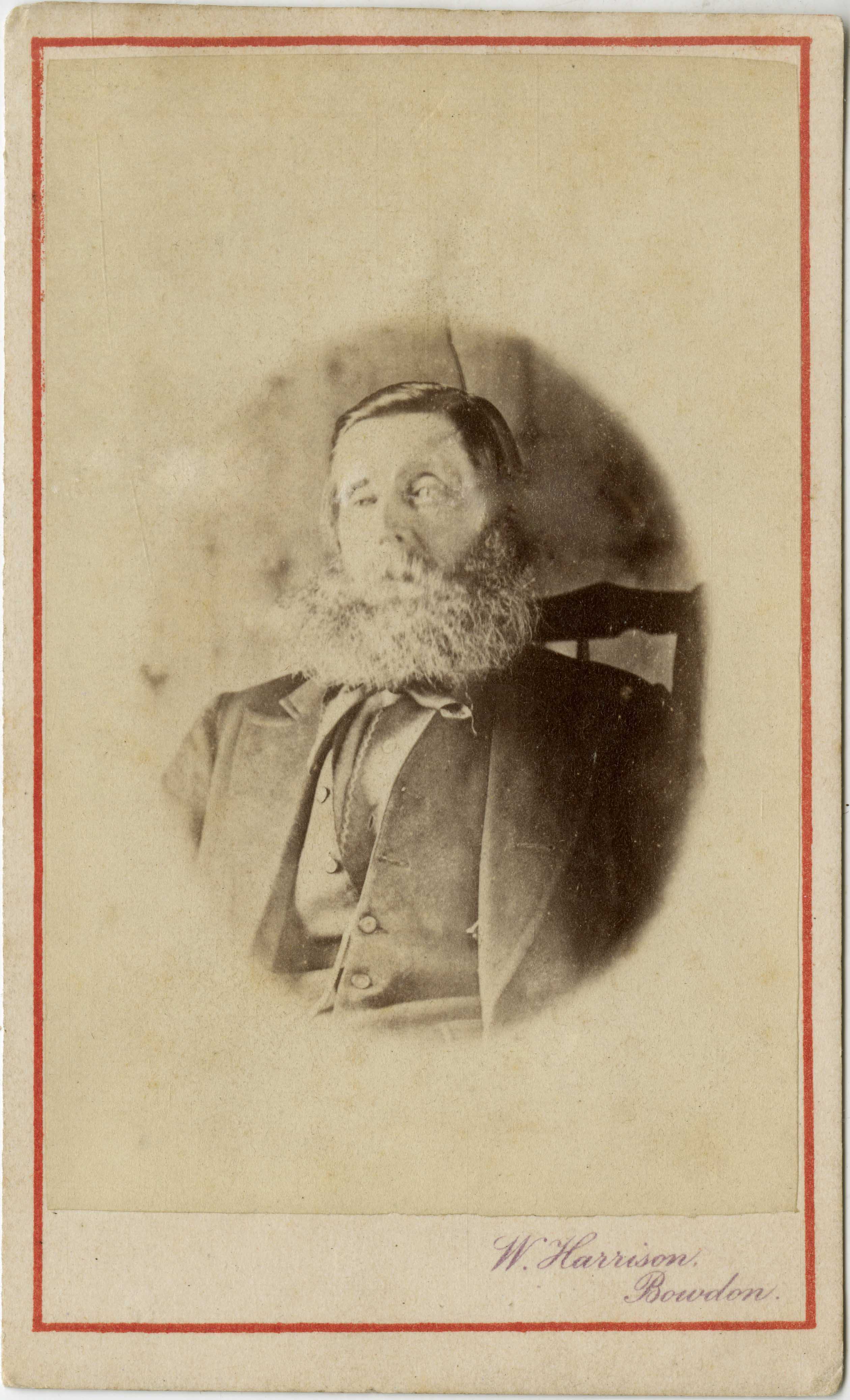
Altrincham area: Post-mortem photo of a bearded man, early 1870s
(William Harrison)
This photo was taken while William Harrison was based at his 3 Ashley Road studio in Altrincham, located at the bottom of Bowdon Downs, hence the reference to Bowdon, which was more upmarket.
This is a death portrait of the man, who was propped up for the photograph. The first time families thought of having a photo taken of a loved one, was sometimes only when someone died. It was their last chance to have a permanent likeness of them. The softness of the vignetting, adds to the ethereal air.
(Carte-de-visite portrait by William Harrison)
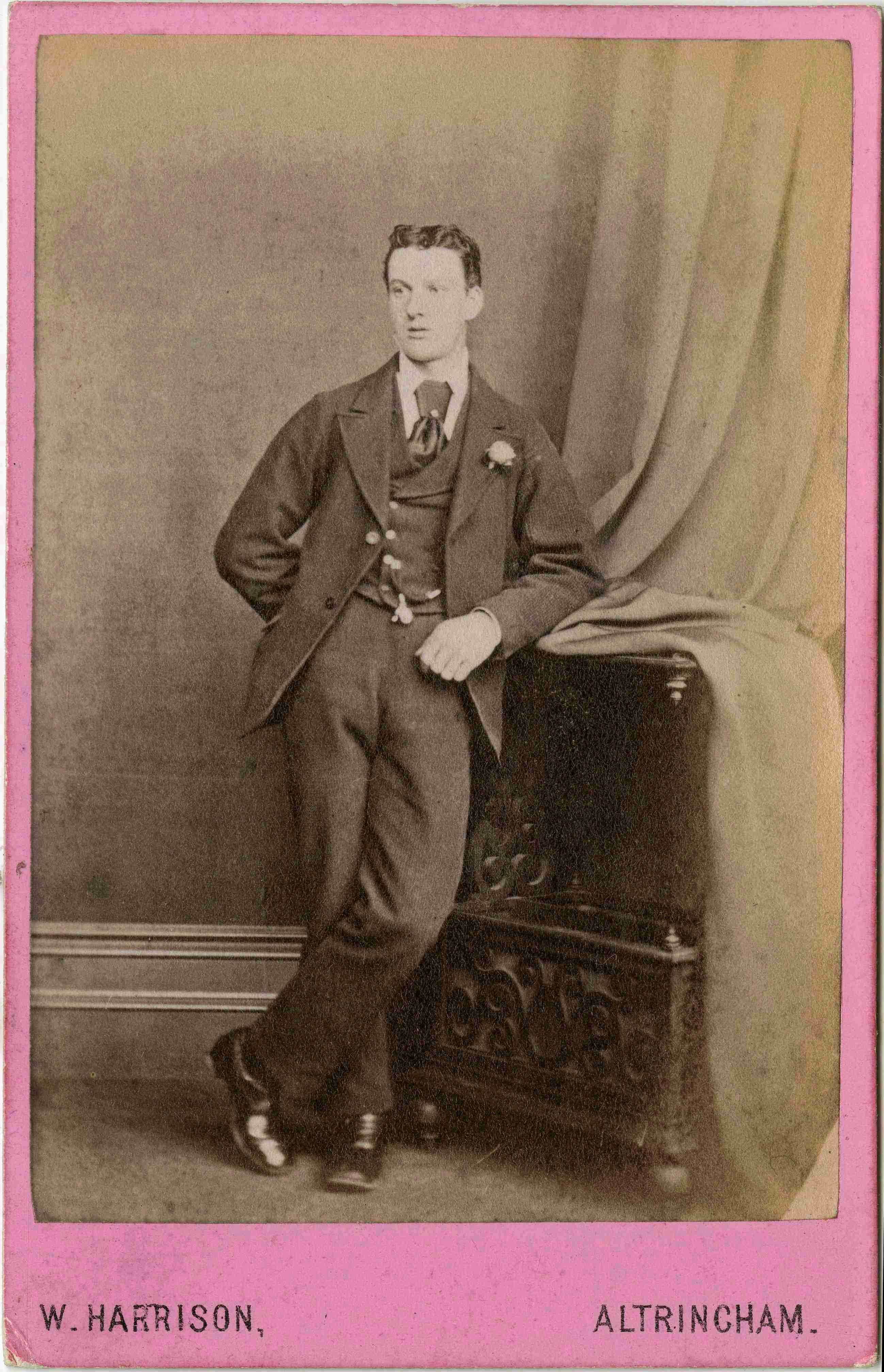
Altrincham: Young gentleman leaning on a cabinet, mid-1870s
(William Harrison)
This photograph of a smart young man with a rose in his lapel and the backdrop of a drawing room with high skirting boards, was taken at William Harrison’s studio at 22 British School Road (later Oxford Road). He also provided a picture framing service.
(Carte-de-visite portrait by William Harrison)
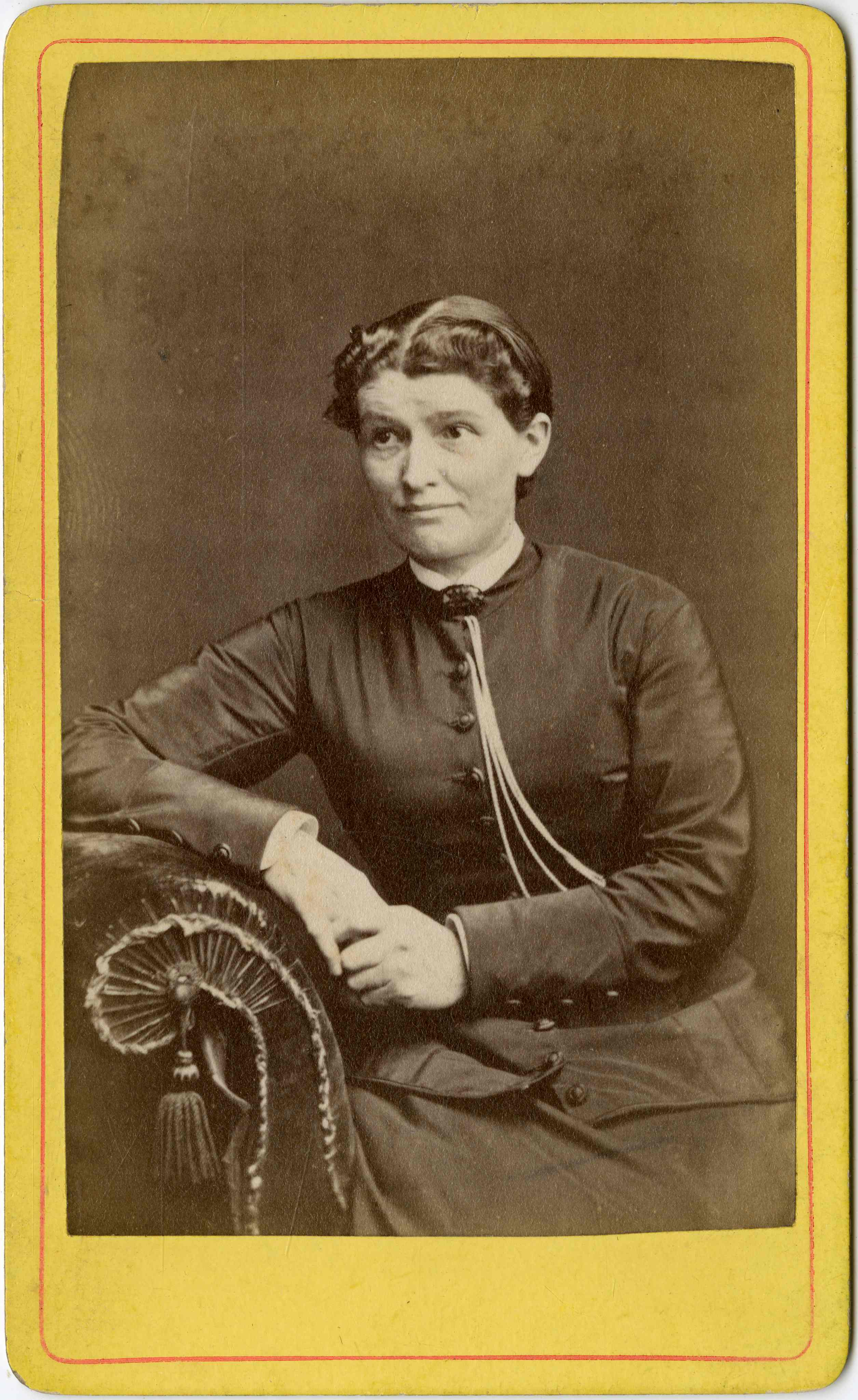
Altrincham: Woman on a chaise longue, late-1870s
(William Harrison)
This photograph of a woman in a modest outfit, was taken at the studio at what was known by the late 1870s, as 22 Oxford Road (formerly British School Road). As with many 19th century photographs, the partial finger print on the left from the negative, can be made out by the person making the print.
(Carte-de-visite portrait by William Harrison)
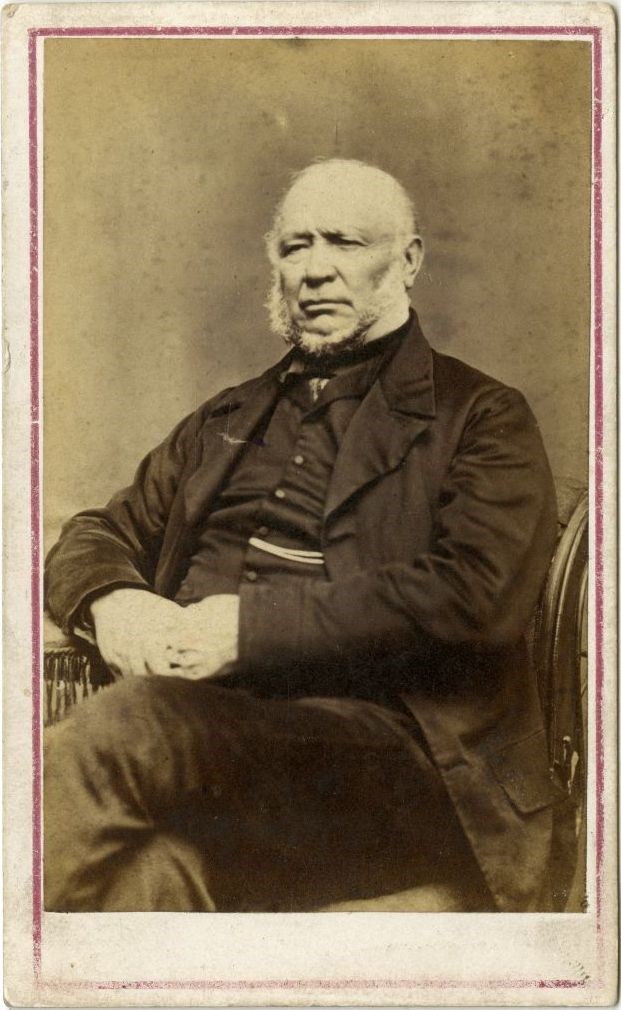
Altrincham: Portly man seated, early 1870s
(George Martin)
This carte-de-visite portrait was taken by George Martin at the time the full-length portrait, had started to give way to a closer in shot. It was taken when he was at his studio at 1 George Street, right in the centre of town.
For the 1861 Census in Gorton; the 1871 Census at 1 George Street, Altrincham and the 1881 Census at 26 Oakfield Road, also in Altrincham, George Martin is described as a ‘tin plate worker’, perhaps because he worked in tintypes. In the Directories at similar periods, he is listed under ‘Photographers’.
(Carte-de-visite by George Martin)
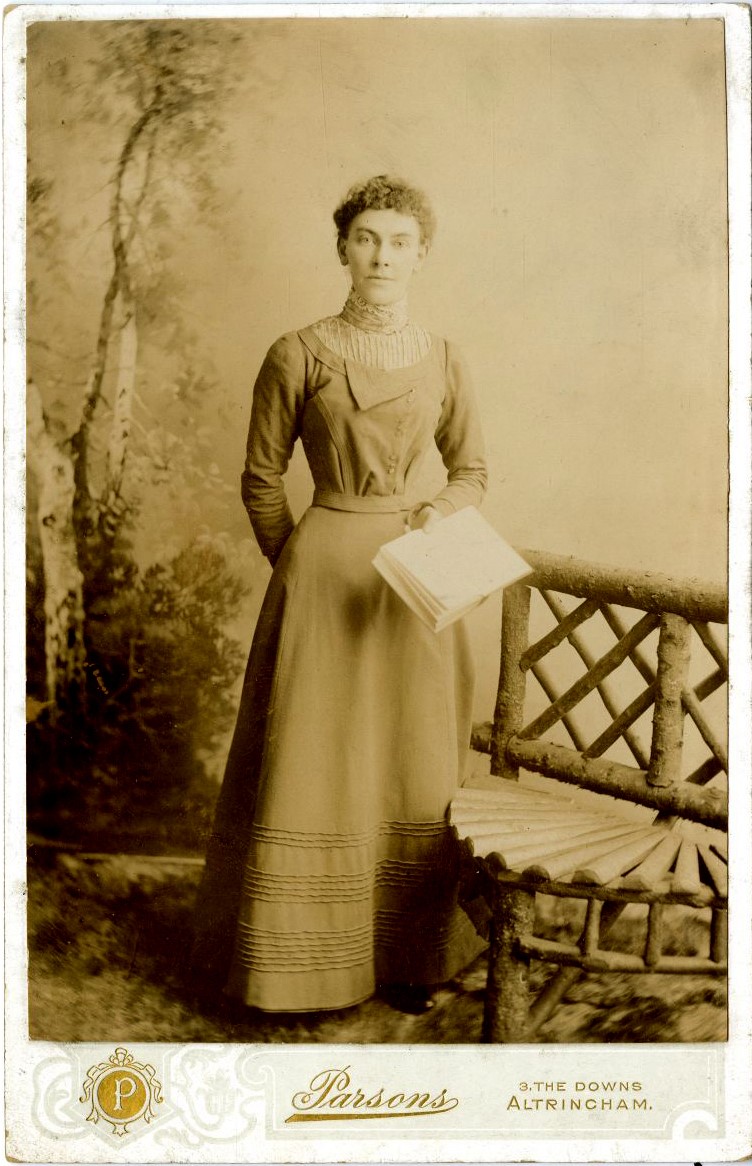
Altrincham: Woman by a rustic seat, 1890s
(William A. Parsons)
The modest dress and book may indicate that the sitter was a school teacher or governess. She is in front of the same woodland background as the girl with a hoop but the card mount is probably later, as it is more elaborate.
(Cabinet photo by William A. Parsons)
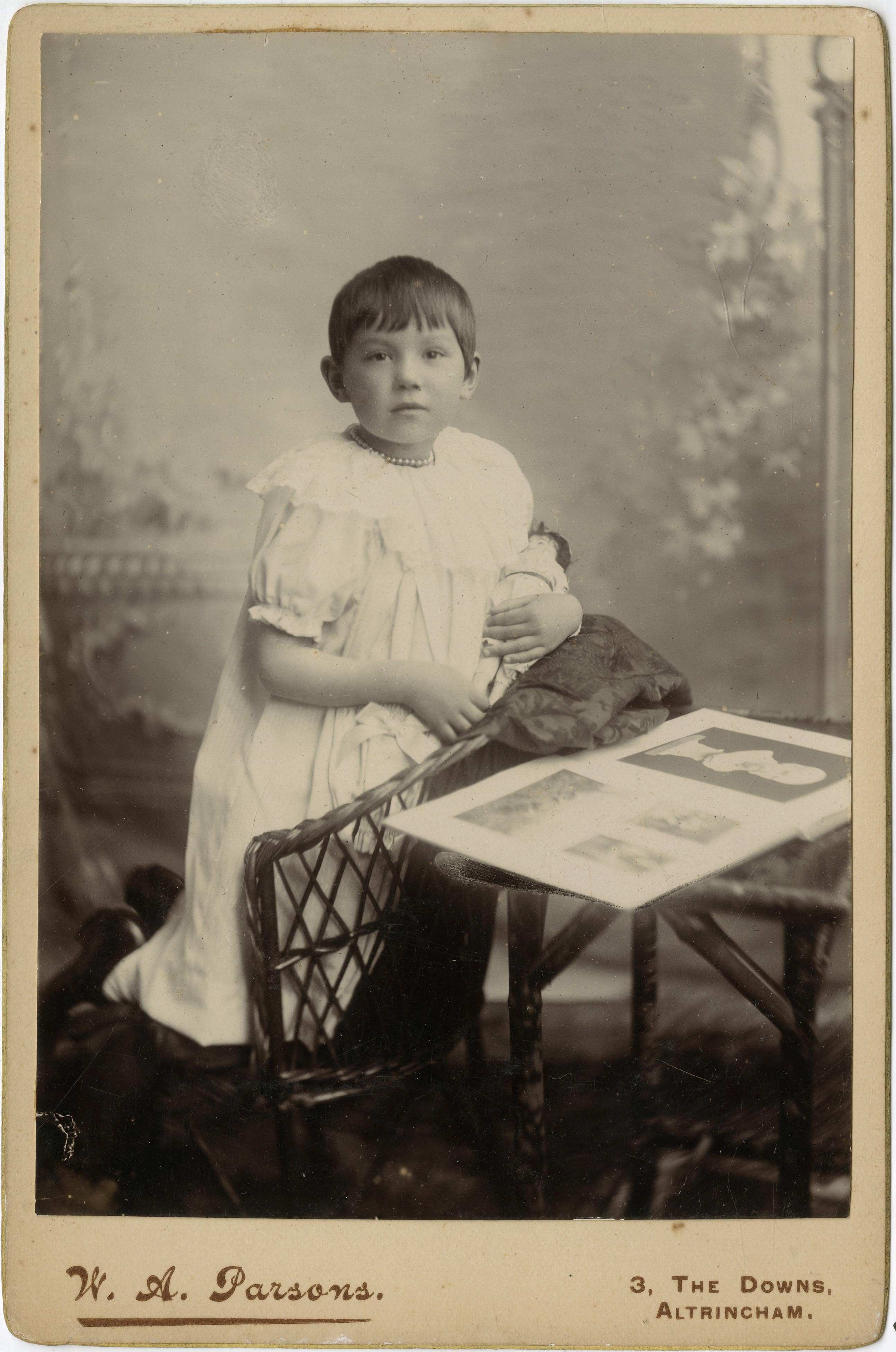
Altrincham: Young girl with a doll and book, late 1890s
(William A. Parsons)
Set against the a classical setting and with a book of illustrations of rather dry subjects, this young girl hugs her doll. The pearl necklace makes her look older than her years.
For the Census in 1901 aged 26, William Augustus Parsons who had been born in Bideford, Devonshire in 1876, was a boarder of Annie Sands at Victoria Villa on Hale Road, Hale. He was described as a photographer as he was in the Census in 1911, when he was living at 23 Broom Road in Hale, with his wife Harriet, sister-in-law Edith and daughter Vera aged 4.
William Parsons had taken over the photographer’s studio at 3 The Downs by the late 1890s when he used the name ‘W. A. Parsons’. He was there until around 1910, when he relocated across the road to 14 The Downs and at some stage shortened his name to the more distinguished ‘Parsons’. He was there until the early 1930s.
(Cabinet card by William Augustus Parsons)
Altrincham: Girl with a hoop and a stick, late 1890s or early 1900s
(William A. Parsons)
In a rather joyless pose, the girl grips the props of the hoop and stick against a background of a pile of shaggy grass and a woodland painted on a roll of canvas. Her ruffed neckline and sleeves were typical of the late 1890s.
(Cabinet portrait card by William Augustus Parsons)
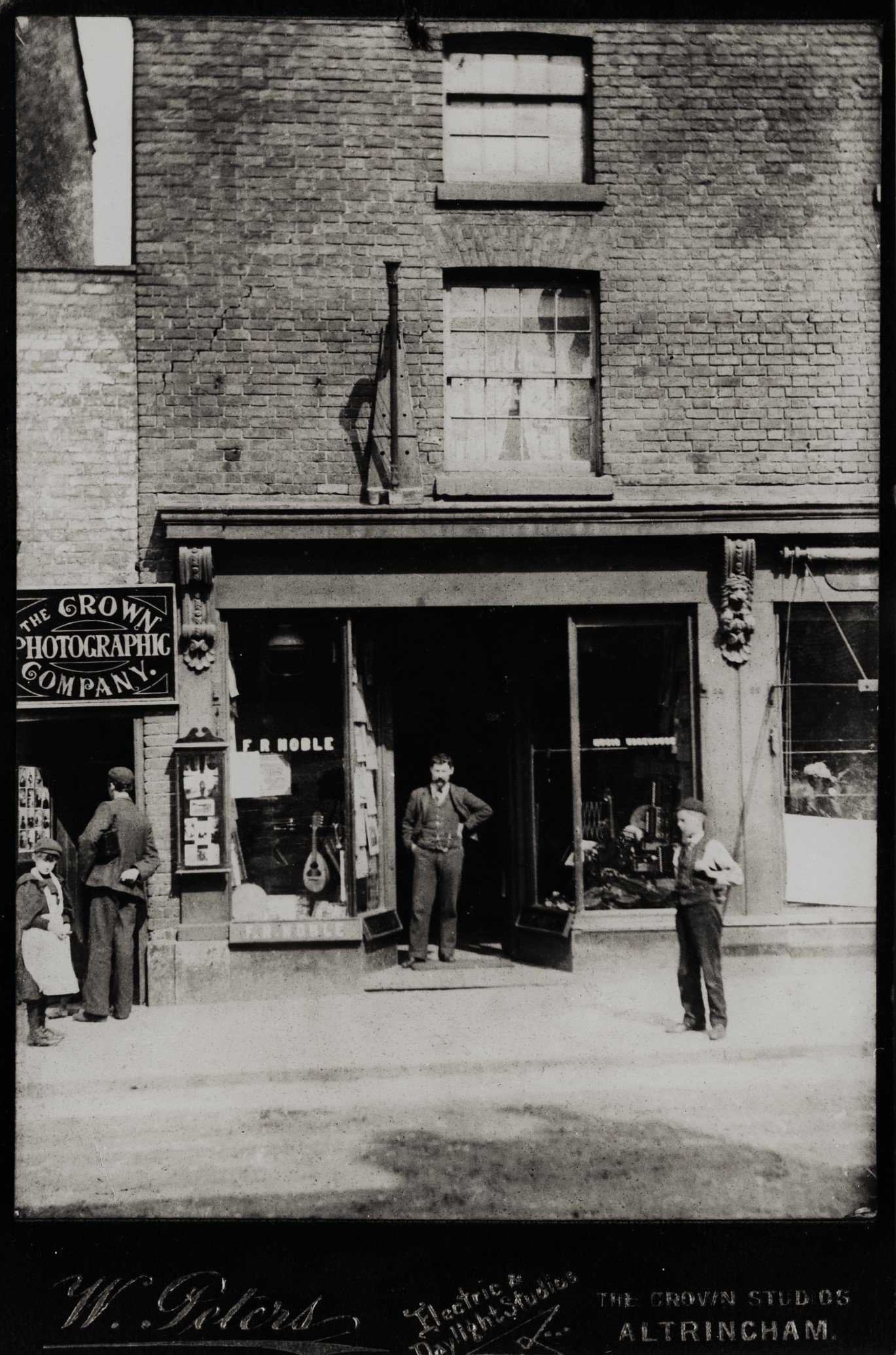
Altrincham: Studio and shop at 24 Church Street, mid 1890s
(William Peters)
From about 1895, William Peters had his electric and daylight Crown Studios at 24 Church Street in Altrincham, seen here in his photograph. Examples of his work can be seen either side of the entrance leading to his studio, to the left.
The studio shared the building with a musical instrument shop, with the owner Fryer R. Noble, likely to be the man stood in the doorway. He lived above the shop with his wife Sarah and their children. The projecting shop sign was a harp.
By 1897, both businesses had moved to 19 Railway Street, where Peters occupied a purpose-built photographic studio on the first floor, with a range of large north facing windows for an even and natural light.
He was followed by Ada M. Cavill between 1905 and 1907, who retained the Crown Studios name. After her came Jessie Barnes and Kate Dunsmuir under the trade name Barnes and Dunsmuir. They had the studio until World War II.
(Cabinet photo by William Peters, The Crown Photographic Company at the Crown Studios)
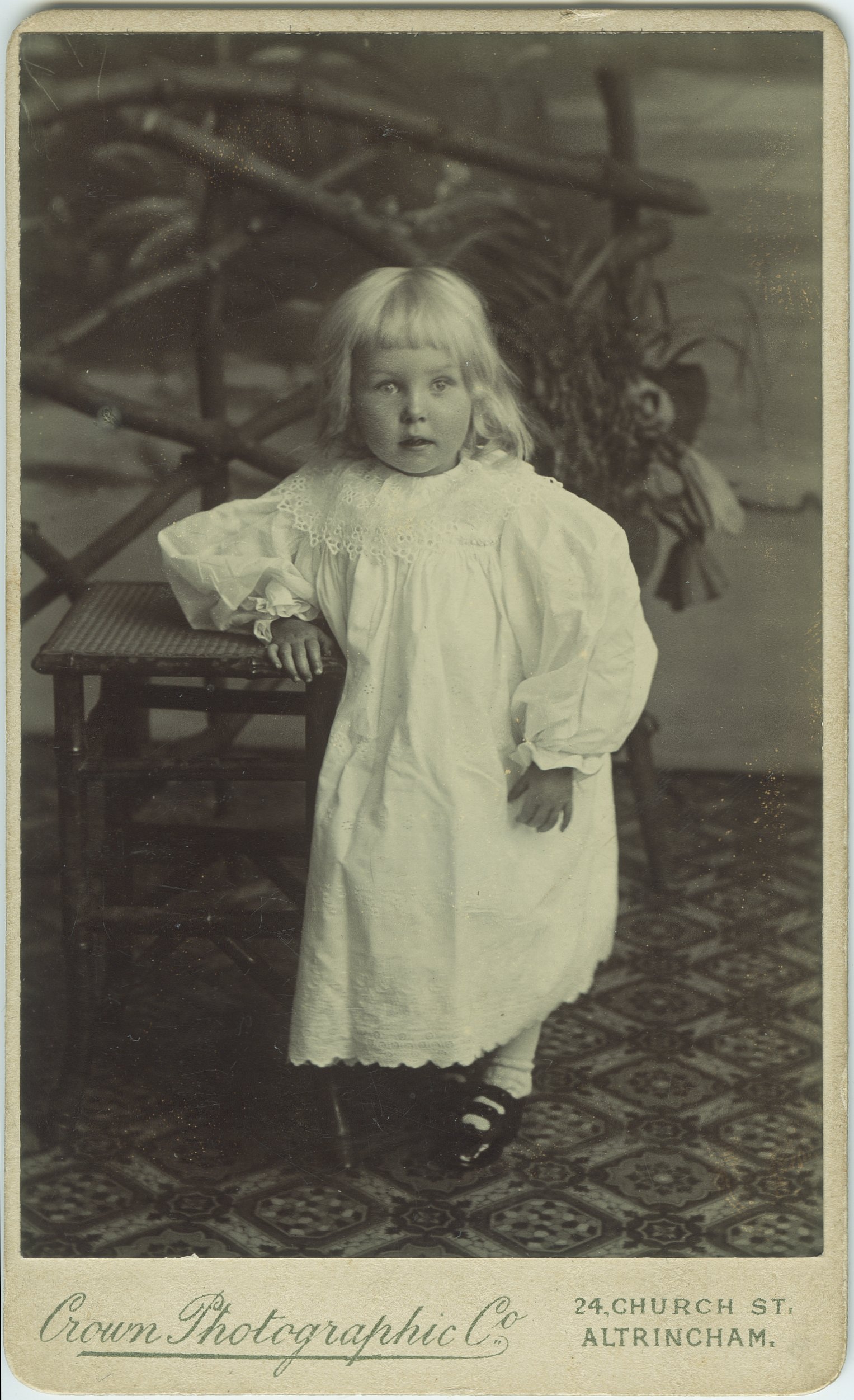
Altrincham: Small girl in a white dress, mid-1890s
(William Peters)
Fringes for both girls and boys were popular at this time. Behind her is an over-sized rustic fence with what appears to be a corn dolly, with the painted backdrop of a lake, creating the impression of a rural setting.
(Cabinet photo by William Peters, The Crown Photographic Company at the Crown Studios)
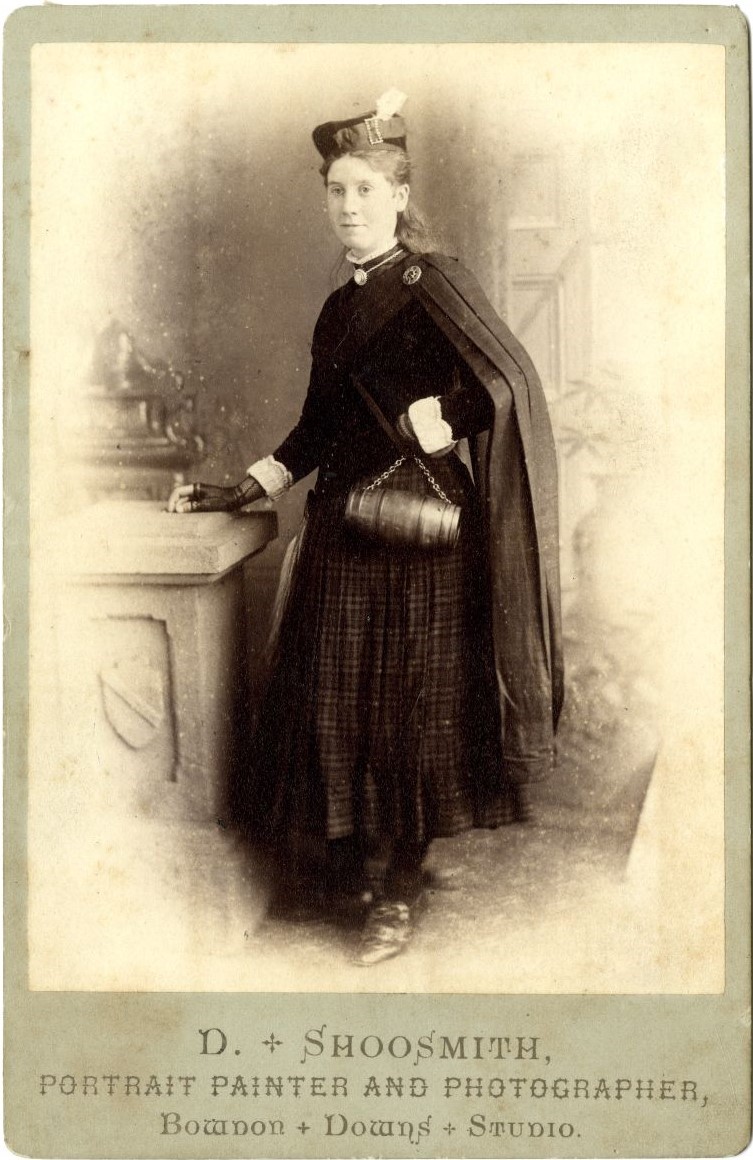
Altrincham: Young woman in highland dress, late 1880s
(Decimus Shoosmith)
This photo was taken by Decimus Shoosmith in his ‘best lighted studio in the neighbourhood’, purpose-built at the top of 3 The Downs. Having been a photographer in Hale for thirty years, he moved here in 1886. Situated on the main road leading up to Bowdon from Altrincham town centre, there would have been a brisk trade. He also took photographs of horses and cattle, as well as being a portrait painter from life or a photograph.
The highland outfit, along with its tartan skirt and accessories including what appears to be a metal whisky keg handbag, were most likely provided by the photographer, with the studio set resembling a Scottish baronial hall.
(Cabinet photo by Decimus Shoosmith)
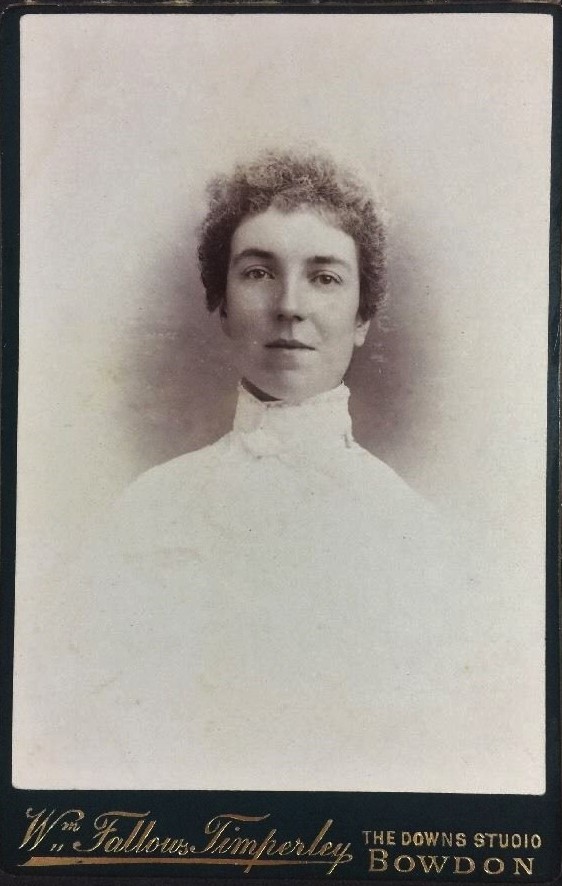
Altrincham: Vignette portrait of a woman, early 1890s
(William Fallows Timperley)
William Timperley was the second photographer to work at the purpose-built studio at the top of 3 The Downs, which he called The Downs Studio. He was there by 1890 until around 1894. He had been orphaned aged 10 and was adopted by his uncle, potato dealer James Fallows and his wife.
This simple vignette portrait shows a high, stiff neckline and a frizzy hairstyle, which had become the fashion.
(Cabinet card by William Fallows Timperley, The Downs Studio)
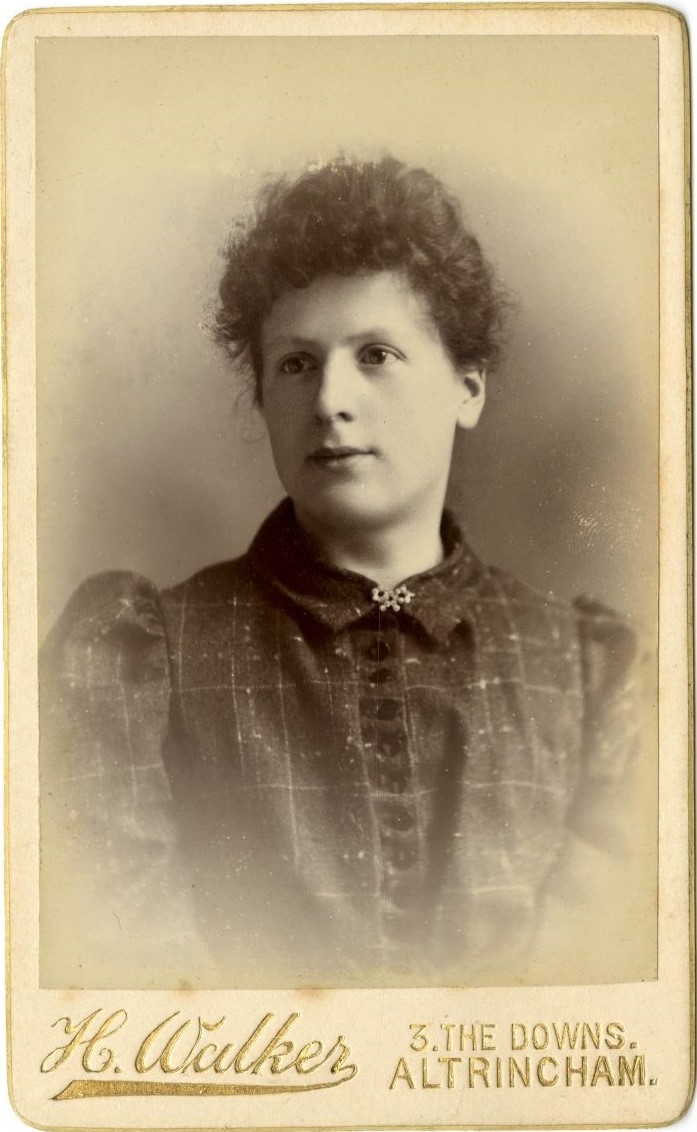
Altrincham: Young woman in a checked dress, mid-1890s
(Harry Walker)
The sitter’s dress although modest, still has fashionable leg of mutton sleeves. Her hair style is frizzy, which was also a trend at the time.
Harry Walker was the third photographer to take over the studio at 3 The Downs which was by 1894. He called it the Bowdon Downs Art Studio. Little else is currently known about him, although he may the same Harry Walker who was listed in trade directories of 1893 and 1894 as a photographer at 134 Town Street, Stanningley, Yorkshire.
(Cabinet card by Harry Walker, Bowdon Downs Art Studio)
Altrincham or Hale: Family group, late 1890s
(J. H. Ellis)
This family of modest means are probably wearing their best clothes for the portrait. They were perhaps photographed outside their home with its rambling rose and duck stones or it may have been a charming location found nearby.
The rather daunted young boy on his father’s lap holding a rose, is wearing a dress as he was yet to be ‘breeched’ (i.e. to wear trousers).
All we know so far about J. H. Ellis, is that they described themselves as a photo artist and were working from 32 Bold Street, Altrincham, as indicated on this cabinet card. There is an informality to their work, such the offset placing of the sitters in this photograph.
(Cabinet card by J. H. Ellis)
Altrincham or Hale: Two young sisters, late 1890s
(J. H. Ellis)
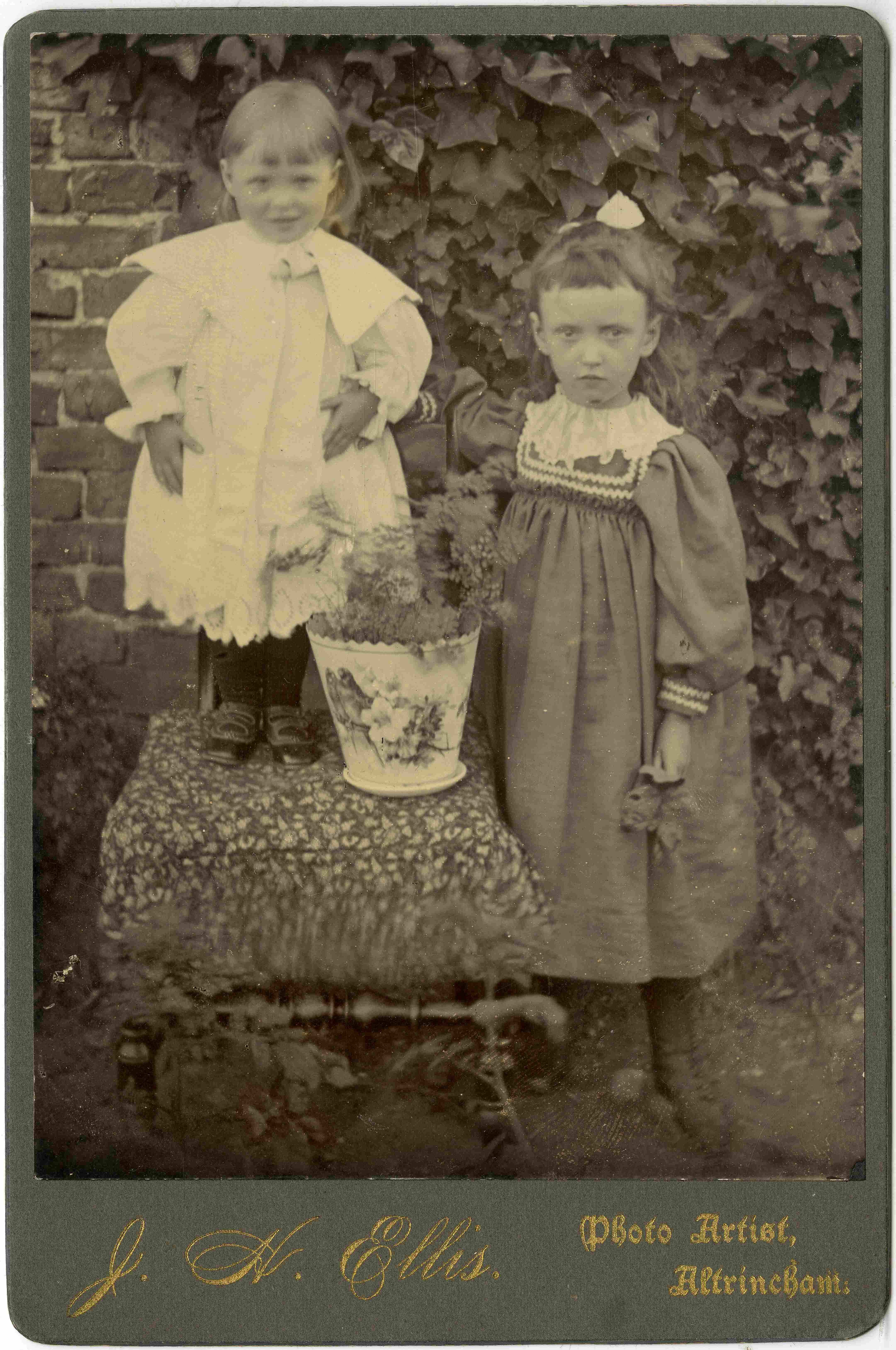
Again, photographed outdoors, on this occasion the picturesque backdrop is of a crumbling brick wall, covered in ivy. The chair and plant pot look like they have been plucked from the front room of the house for the occasion.
Although the photograph is presented on a formal cabinet card, the genuine background and props and pose of the sitters, gives it a charming informality, by comparison to the staged portraits with their painted backgrounds and studio props of the contemporaries of Ellis, like William A. Parsons.
(Cabinet card by J. H. Ellis)
Ashley: Children exploring Ashley Mill water wheel, 1899
(Unknown)
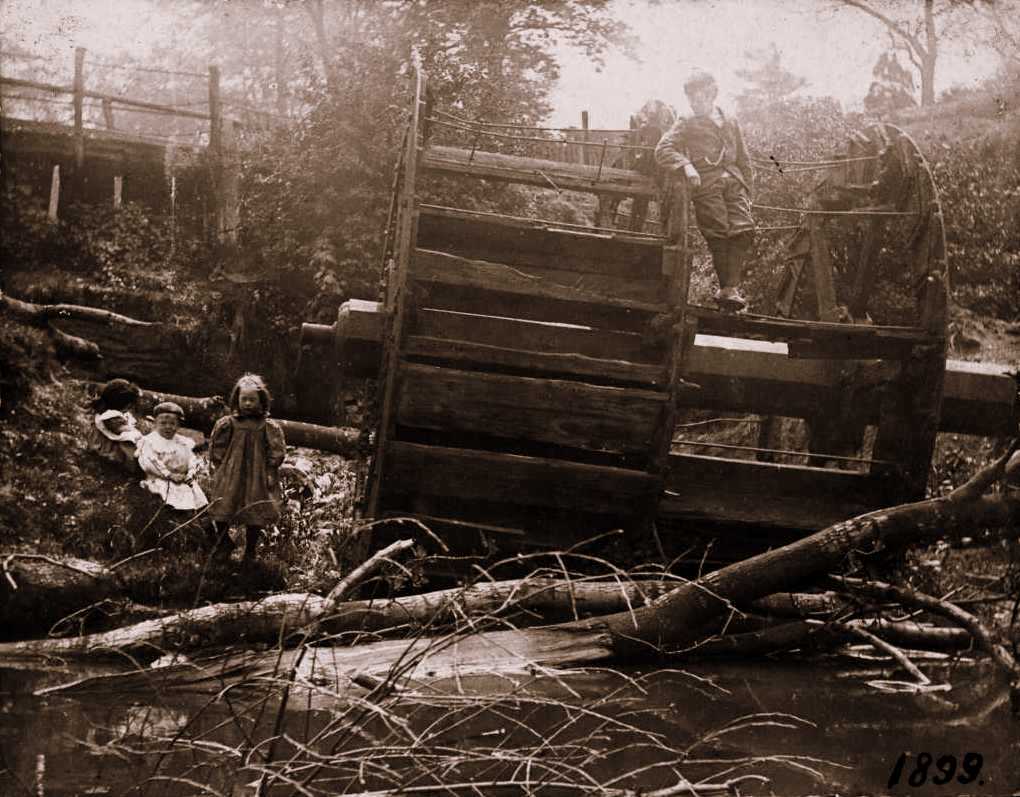
Ashley Mill was to be found in the valley on the southern, sandy banks of the River Bollin, west of Ashley Road bridge. It ground corn and oatmeal from the surrounding fields and beyond. The weir and mill itself were badly damaged during flooding starting upstream in Derbyshire, caused by the severe storms of 20th June 1872.
The external water wheel appears to be made of wood, with buckets fixed on iron rods on a hexagonal shaft, which were set upon a sandstone base. The remaining buildings, waterwheel and bridge over the Bollin, continued to be a picturesque and popular spot for bathing and picnics, accessed by several historic footpaths which used to service the mill. This legacy is still enjoyed by many today.
(Unknown photographer)
Ashley Heath: The Old House, 1890s
(Harry Wilkinson)
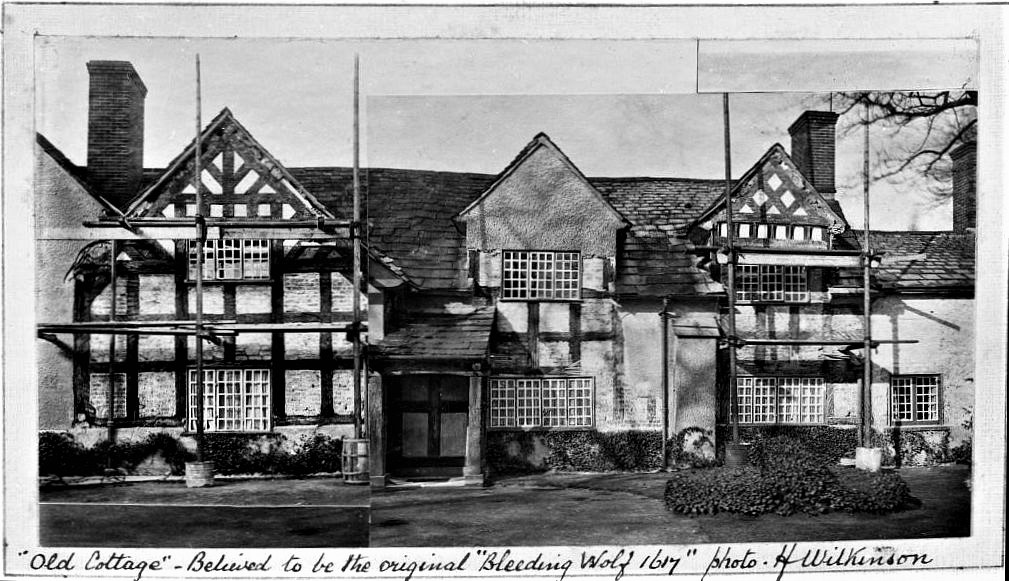
Harry Wilkinson was a plasterer by trade, as was his father. He had been born at Police Street in the centre of Altrincham and baptised at the Bank Street Wesleyan Church. By 1901, he was living at 13 Ashfield Road in Hale. Harry was well-known for his talks on ‘Old Altrincham’ illustrated with lantern slides, some of which were from his own photographs of the buildings of the area, as seen on this print. It seems to be a composite image made from two or three negatives.
Dating from the 17th century, the ‘Old Cottage’, now known as The Old House was at Ashley Heath on the winding lane now known as South Downs Road, coming from Ashley and Hale Barns to the parish church at Bowdon. Perhaps built as a farmhouse, it was also at one time the original Bleeding Wolf pub, dated here to 1617. The name and licence had been transferred by around 1842, when the farmhouse on the corner of South Downs Road and Ashley Road, can be seen marked on the Hale Tithe Map.
The Grade II Listed house seen here with scaffolding, still has its original stone flag roof, wood mullion casement windows and sturdy wooden porch. The timber frame of the historic three bays is exposed. It was later rendered, extended and refurbished in the early 1900s by local architect Frank Dunkerley.
(Composite photograph by Harry Wilkinson)
Ashton-upon-Mersey, Sale: Woman with a basket, 1880s
(John Ingham)
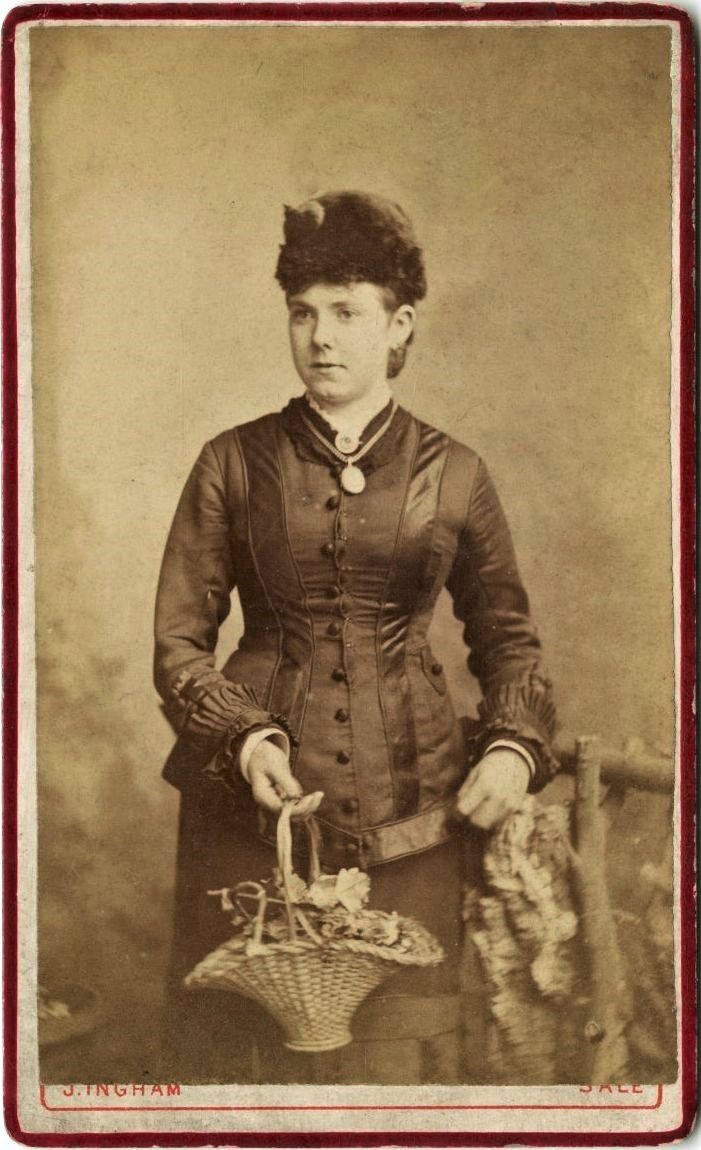
John Ingham took this photograph when he was at his home with a studio attached, called Winton House. It was on Ashton Lane on the corner with Washway Road in Sale, to the north of Altrincham. He was there for nearly 30 years, with his children gradually joining the business. By 1909, he had built a large, branch studio called Ashford Lodge at what is now 86 The Downs, up the hill from Altrincham town centre.
The woman wears an outdoor outfit with a fur hat and tight-fitting jacket, revealing her natural silhouette, albeit aided by a corset. The basket of flowers, rustic fence and hint of greenery, make it a rural setting.
(Cabinet card by John Ingham, Winton House)
Bakewell: A Peep at Haddon Hall, early 1860s
(Helmuth Petschler)
The fine medieval manor of Haddon Hall had been left almost deserted since the early 1700s and as result, had been unmodernised during the Georgian and Victorian periods. It became a popular tourist destination from the 1830s, much admired for its original features, terraced garden and air of a romantic ruin. Along with many other photographers, Helmuth Petschler took several photos of the house and gardens, as well as this distant view across the River Wye and the ancient parkland, dramatically framed by the branches of a tree.
(Stereoview card by Helmuth Petschler, H. Petschler and Company)
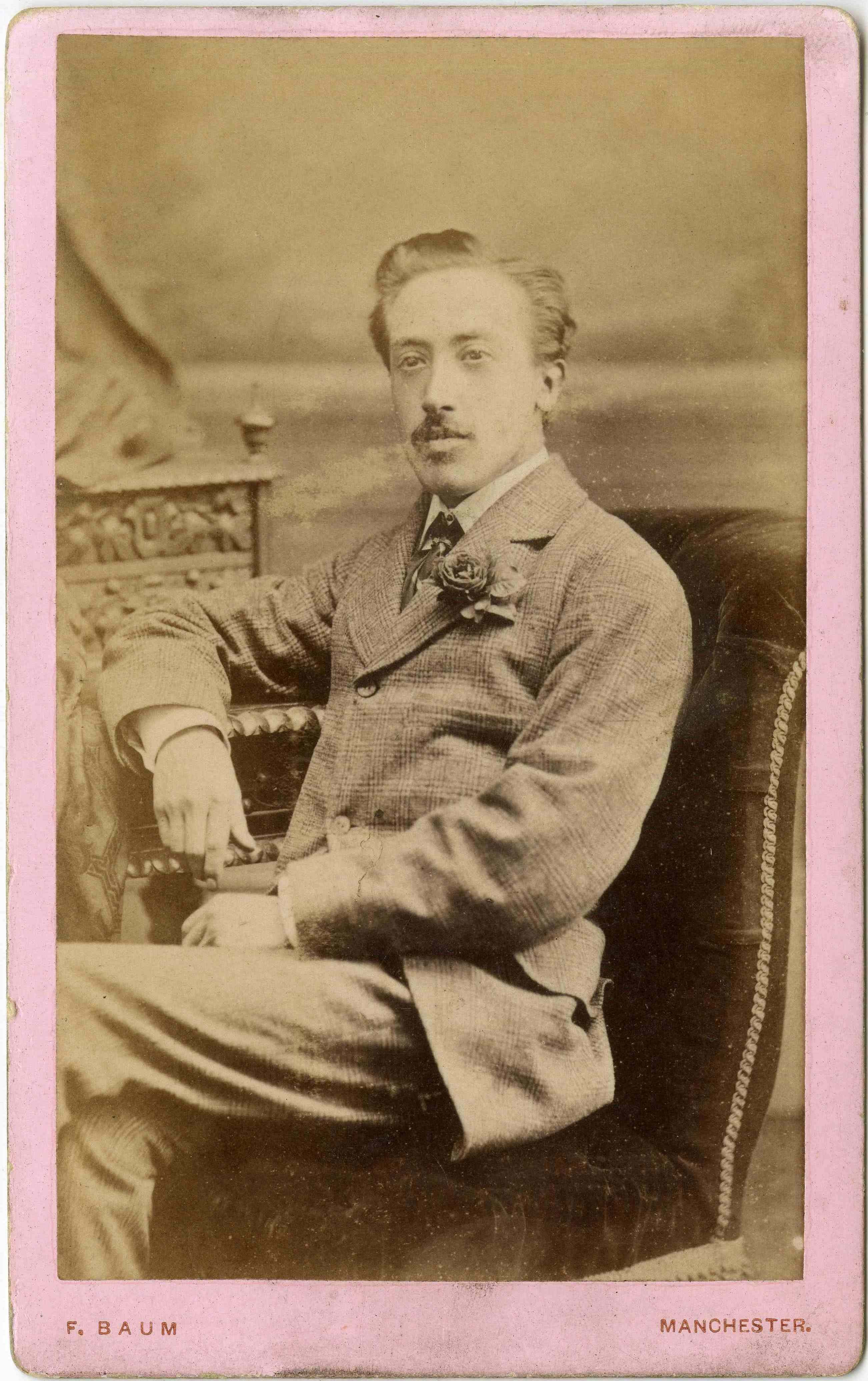
Bowdon or Manchester: Young man with a rose in his lapel, mid-1870s
(Franz Baum)
Franz Baum captured this young man sporting a casual lounge suit in plaid material at either his Egerton Studio in Bowdon or that at 6 Saint Ann’s Square, where he had his Manchester Studio from the early 1870s until around 1878, before moving to Victoria Buildings. In addition to the names of the two studios, there is also a depiction of the medal awarded to him at the International Exhibition of all Arts Industries and Inventions, of either 1873 or 1874.
Franz Baum also had a studio in Altrincham town centre by 1874, located on Stamford Street, opposite the original Altrincham Railway station. By 1876, he was living with his wife Margaret, who had also been a photographer, at Sunnybank on Stamford Road in Bowdon. By 1878 they were at Church View on Richmond Hill. Then in 1880, the couple were living at Winton House on Winton Road, again in Bowdon, which they had newly built. It had a large studio which took the name Egerton from the previous locations and was capable of taking equestrian portraits.
(Cabinet photo by Franz Baum)
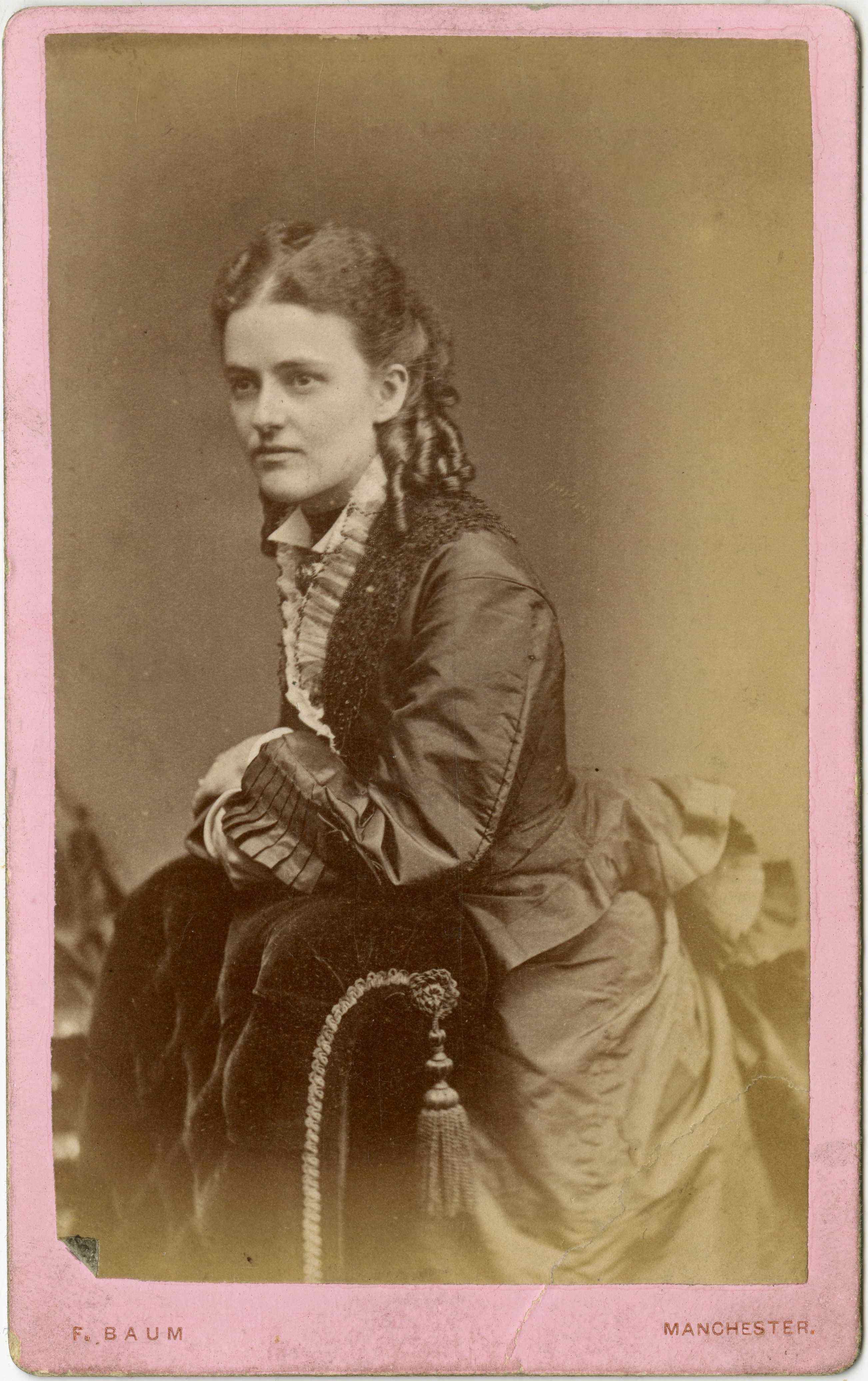
Bowdon or Manchester: Young woman with ringlets, early 1880s
(Franz Baum)
This young woman posing on a velvet chaise longue, wears a dress with a bustle. The back of the card is the same as that of the young man with a rose in his lapel, giving it a similar date.
(Cabinet photo by Franz Baum)
Bowdon or Manchester: Girl in a fur trimmed jacket, mid-1870s
(Franz Baum)
Although dressed in a hat and jacket for the outdoors, the girl has the background of a cabinet and high skirting board, suggesting a drawing room. She leans on the same studio prop of a velvet chaise longue, which can be seen in the photograph of the young woman in the previous photo. The back of the card is also the same.
(Cabinet photo by Franz Baum)
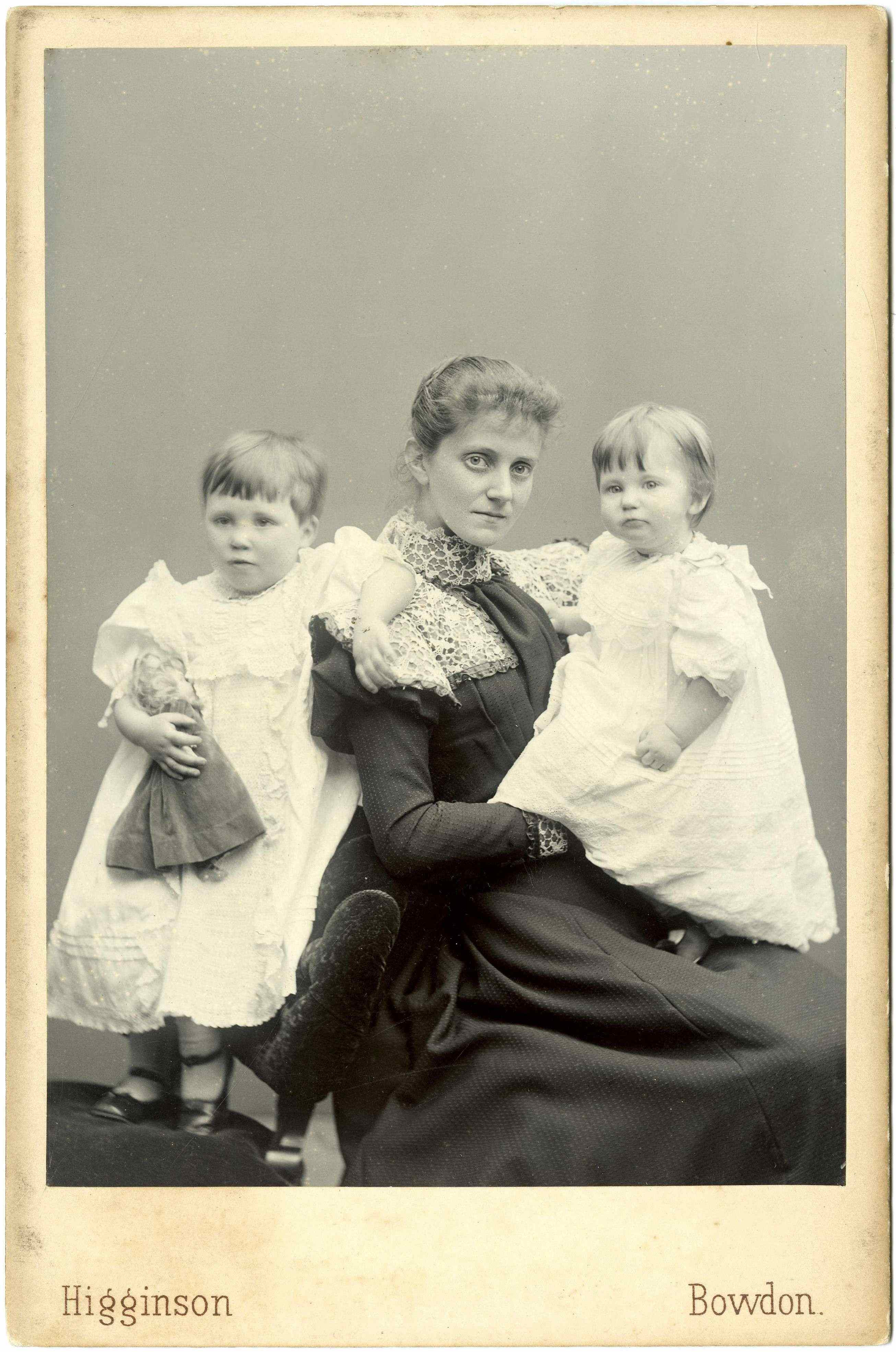
Bowdon: A young mother with her two children, early-1890s
(George Higginson)
Acting as a base for five photographers over 5 decades, the commercial building of The Polygon at the top of Stamford Road in Bowdon, incorporated a purpose-built studio on the top floor. It had north-facing windows allowing plenty of even, natural light. The first to occupy it was George Higginson in 1881 who lived locally in Bowdon. He was there until 1902, sharing it with Joseph Whitehouse in 1896. The subsequent photographers were William A. Varley, George Estelle and Joseph Thompson, until the end of World War I.
This relaxed group, who seem unaware of the photographer, are set against a plain background. The small girl standing on the chair holds a doll, which may have been a prop to keep her engaged, rather than it belonging to her.
(Cabinet card by George Higginson, The Polygon Studio)
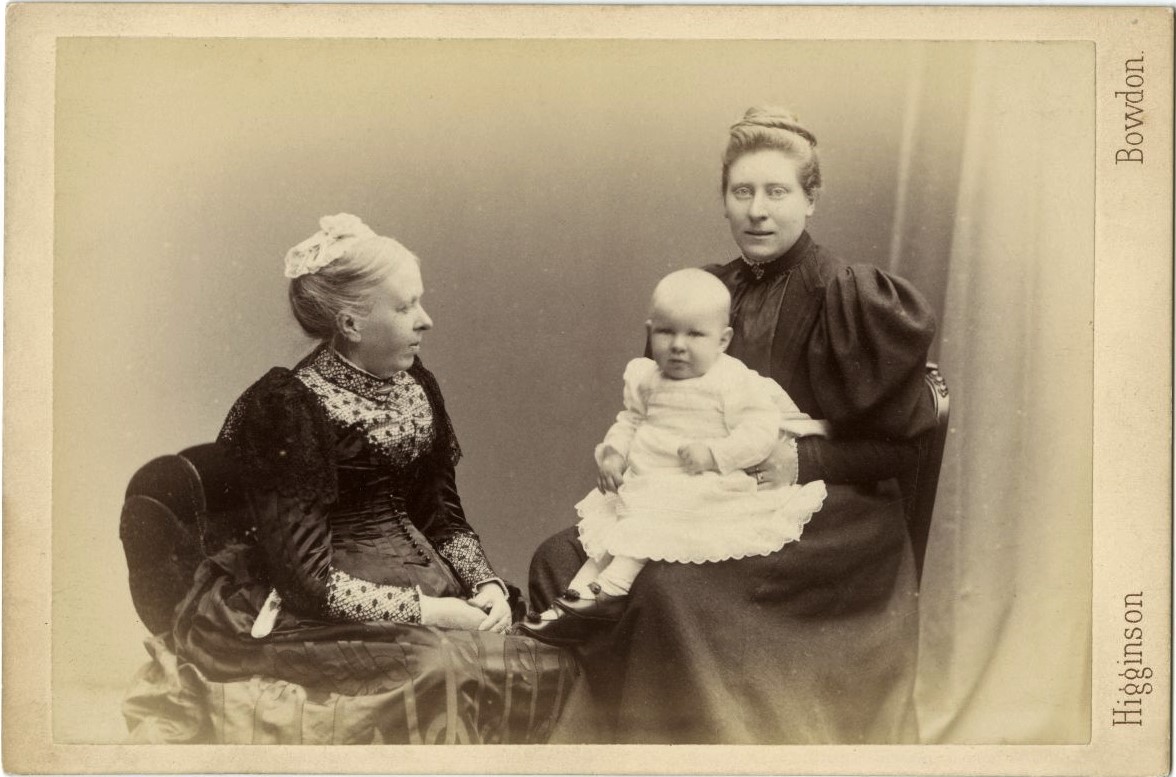
Bowdon: Three generations, mid-1890s
(George Higginson)
The pronounced ‘leg of mutton’ sleeve, with upper section puffed up with padding or stiffening, was the height of its fashion in the mid-1890s.
(Cabinet photo by George Higginson, The Polygon Studio)
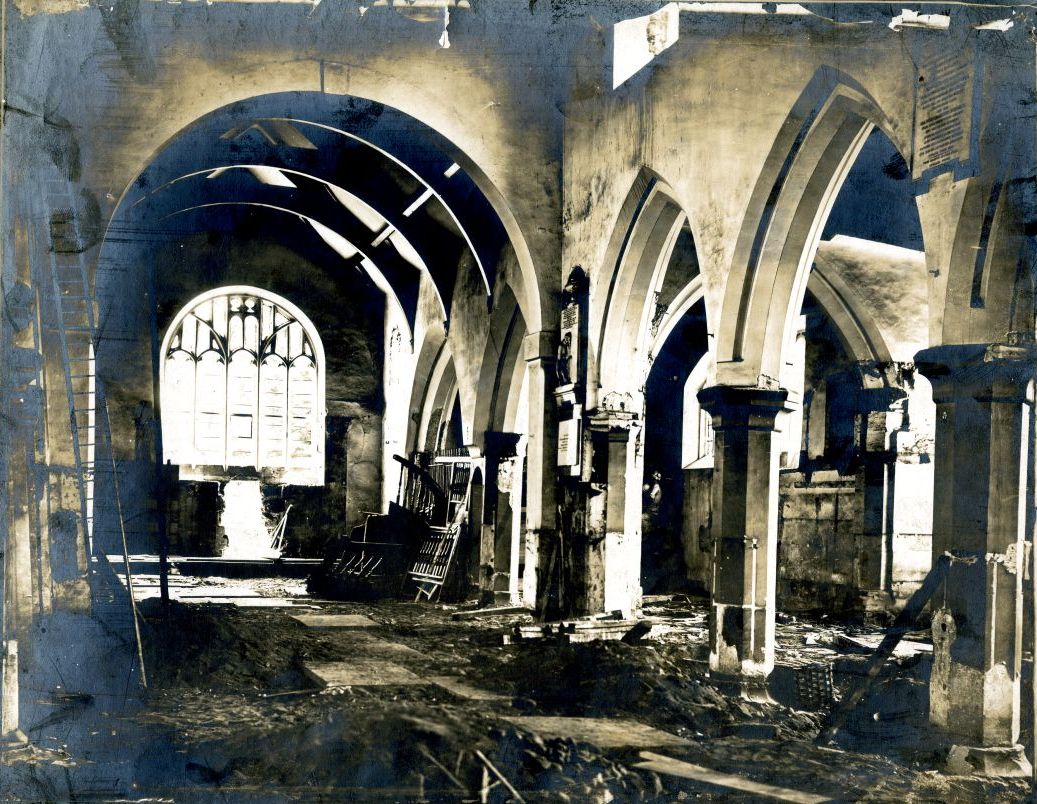
Bowdon: Interior of the old church, 1858
(Joseph Sidebotham)
Despite opposition from the Earl of Stamford and enthusiasts of the Gothic such as Sir George Gilbert Scott, the 13th century church at Bowdon with its Tudor extensions was mostly demolished. This photo showing the start of the work which was taken by Joseph Sidebotham, before he moved to the Bowdon area. The old church just before its demolition was a popular subject for topographical photographers.
A much enlarged and more elaborate church took its place to the designs of William H. Brakspear, in part funded by the local wealthy residents. It was embellished with stained glass memorial windows. The existing memorial sculptures and reliefs were retained and some more were discovered in the foundations during the excavations.
(Photo by Joseph Sidebotham)
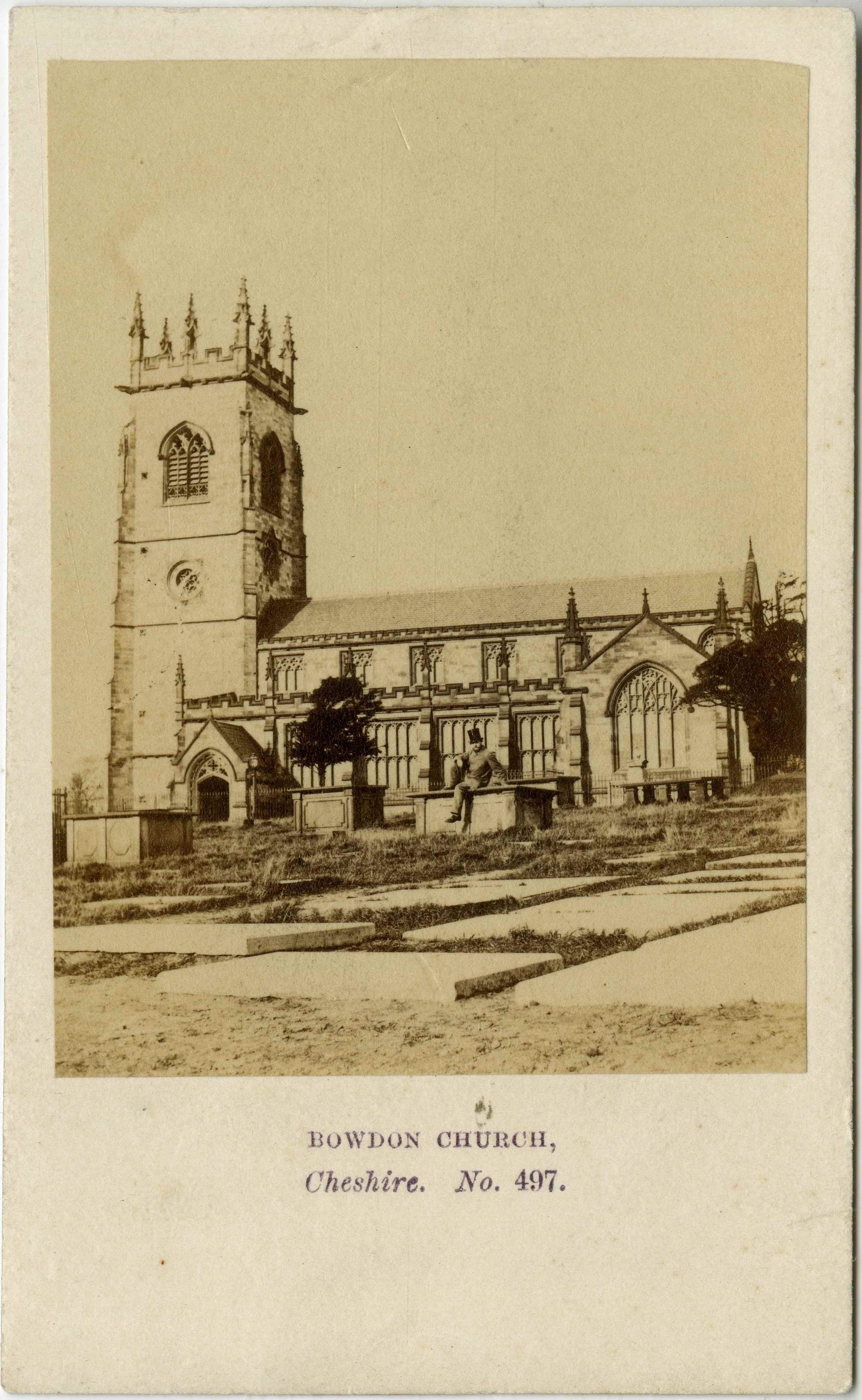
Bowdon: The Churchyard with the Old Yew Tree, mid-1860s
(Helmuth Petschler)
It was said that the Yew tree seen in the far right of this photo, was Saxon and acted as the centre for the calculations of the Domesday Book. The 1086 entry for the small settlement of Hamon de Massey’s Bowdon (Bogedone), described it as having a church and a grinding mill. It was supported by a hide of land with two ploughlands and one men’s plough team. There were only three households, one of the priest and two of some Frenchmen.
The estate had previously been held by Alweard, a Saxon lord and freeman who owned a herd of deer. He was ousted in 1070 by the Norman Baron Hugh D’Avranches who then granted the estates of Bowdon and Dunham to Hamon.
(Carte de visite by Helmuth Petschler, H. Petschler and Company)
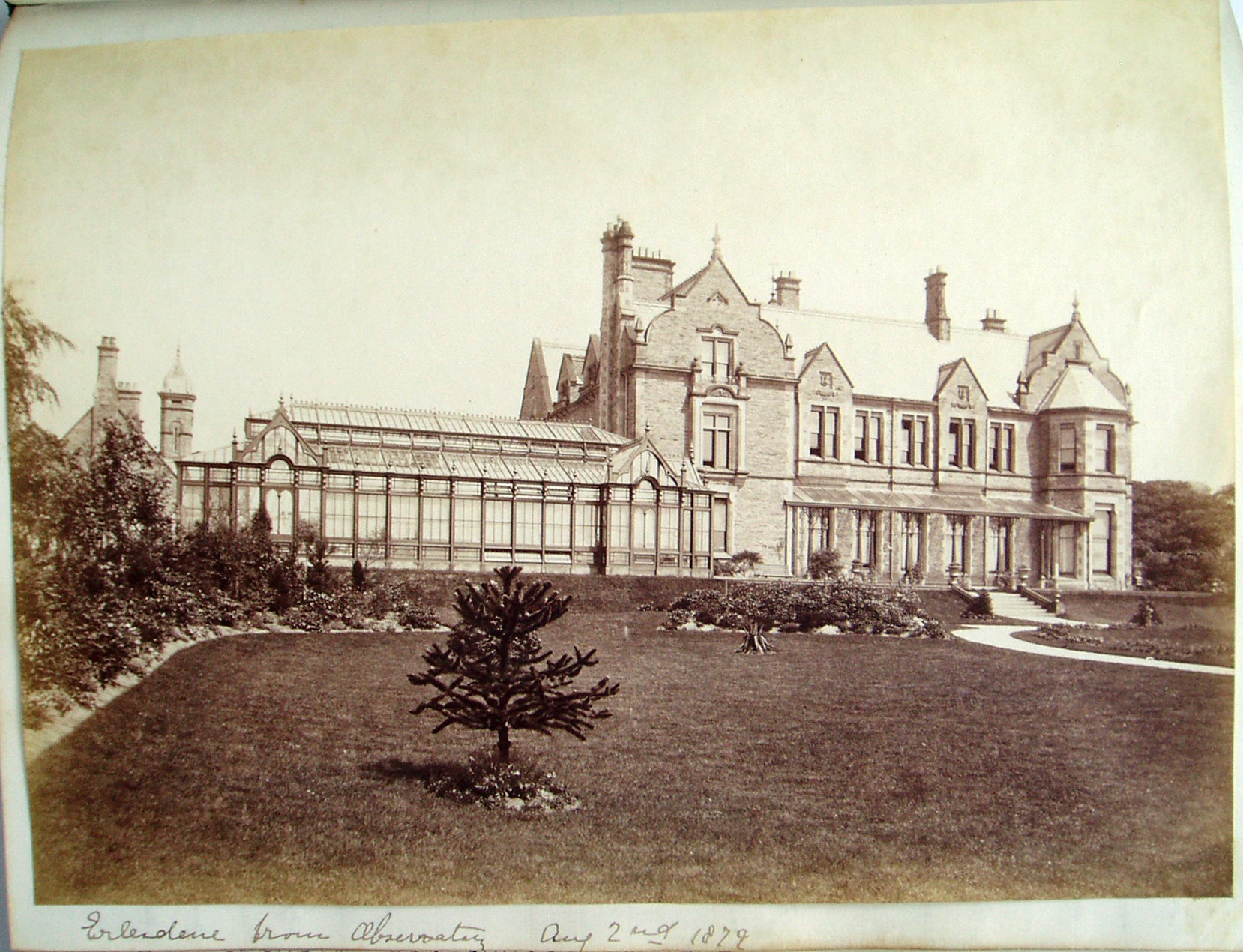
Bowdon: Erlesdene, Green Walk on 2nd August 1879
(Joseph Sidebotham)
Green Walk was a new coach route created in 1760 for Lady Stamford, to travel more directly from the park at Dunham Massey Hall to the Church at Bowdon. When land was gradually released for sale either side of the route, the size, rental income, type of materials and density were specified in the sale documents, to ensure that only the well-to-do would be the closest neighbours to the Stamfords. Erlesdene was built by 1874 by Thomas Jones (whose initials were carved into the stone building), to the designs of Mills and Murgatroyd of Manchester. It is now Grade II Listed.
By March 1879, it had become the home of Joseph Sidebotham and his family who with their botantical interests, enjoyed the large greenhouse and extensive gardens with views over the Cheshire plain and beyond to Derbyshire. The monkey puzzle tree is still in the grounds.
(Photo by Joseph Sidebotham, Sidebotham ‘Family Diary’ no.6, 1878-79)
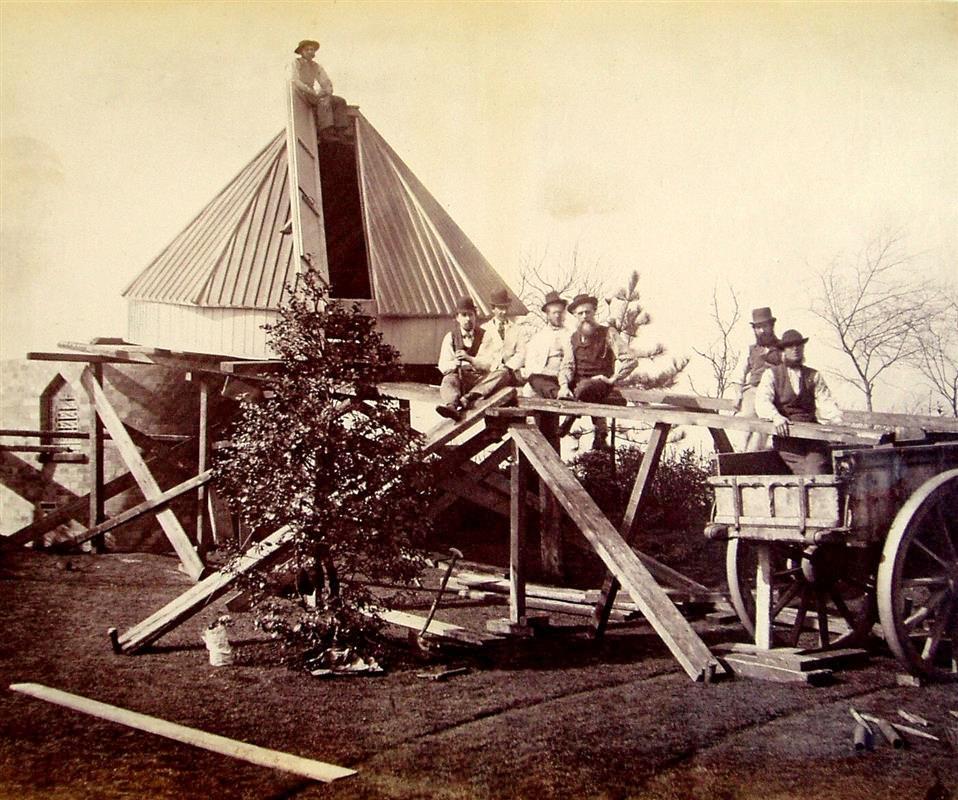
Bowdon: Rebuilding of an observatory at Erlesdene, 19th March 1879
(Joseph Sidebotham)
The white brick, circular observatory had been purpose-built for amateur astronomer Joseph Sidebotham, in the grounds of The Beeches on Woodville Road, Bowdon (which became St Anne’s Home in 1884). It was relocated brick by brick when he and his family moved to the mansion of Erlesdene on Green Walk, near Bowdon Church.
(Photo by Joseph Sidebotham, Sidebotham ‘Family Diary’ no. 6, 1878-79)
Bowdon: The old church from Church Brow, about 1858
(Unknown)
This is a photograph of the church of Saint Mary’s at Bowdon, seen in the form when it was when last extended in 1510, during the time of Henry VIII. Despite opposition, the historic building was mostly demolished and rebuilt in 1858-60, to the plans of W. H. Brakspear. It needed to be enlarged to cope with the dramatic increase of wealthy residents who lived in the newly-built villas on the top of the hill in Bowdon and Bowdon Downs, south of Altrincham. They commuted from the two stations in Altrincham, there since 1849, with another called intially Peel Causeway in Hale, anticipated to start service to Chester in the early 1860s.
On the left were the ancient cottages on what was technically part of Park Road but was known as Church Brow. Some of them such as Jackson’s, were coffee and eating houses, which served those using the cab service to and from Altrincham and the local railway stations or else to provide refreshments for the many tourists visiting the area. The Church Brow cottages; the old and the new church with its extensive views over the Cheshire plain from the churchyard; the grounds of Dunham Massey Park and the walks in the Bollin River valley were all very popular with day trippers from Manchester. They had been arriving by passenger canal boat since the late 1770s.
The photograph is taken with a high quality camera and may be by a professional photographer such as James Mudd, who was living just on the other side of the church, or else by an amateur tourist photographer, who could afford the necessary equipement. Professional photographers in Manchester supplied pre-prepared photographic plates and instruction in landscape photography.
(Photograph by an unknown photographer)
Bowdon: Tennis tournament at the Bowdon Lawn Tennis Club, 1893
(Unknown)
Bowdon Lawn Tennis Club was founded in 1877 on land on the Devisdale, off Green Walk, which was owned by the Earl of Stamford. It was the second club in the area, with Bowdon Bowling and Lawn Tennis Club having been established in 1873, on land off Saint Mary’s Road bought in 1875, also off the Earl of Stamford. Both clubs remain very popular and active, as do Bowdon Cricket Club and Bowdon Hockey Club in Bowdon Vale, also founded in the 19th century.
In the background, can be see the octagonal water tower and its Italianate staircase styled as a campanile, which had been built in 1874 by the North Cheshire Water Company, on land leased from the Earl of Stamford. Water was pumped from the Manchester Corporation Works and the reservoir served the higher area of Bowdon as well as lower areas, such as Hale. Previous to this, rainwater was collected in box gutters with lead pipes leading to slate water tanks in roof spaces or else water came from the sparsely located pumps; the occasional natural spring or the River Bollin.
(Unknown photographer)
Bowdon: Corner of Langham Road and Vicarage Lane, 1890s
(Unknown)
The house on the corner called Yew Bank, was built in the mid-1840s of a large buff-coloured fire brick, unique to the Bowdon and Altrincham area. It was lived in by William Hayward Brakspear, the architect of both Bowdon Parish church rebuilt 1858-60 as well as the enormous ‘Dome’ Methodist Church and its Schools on Enville Road, built 1874-1880 for the prosperous dissenters of Bowdon.
A porter and delivery boy can be seen going about their business on the wide route, still free of traffic.
(Unknown photographer)
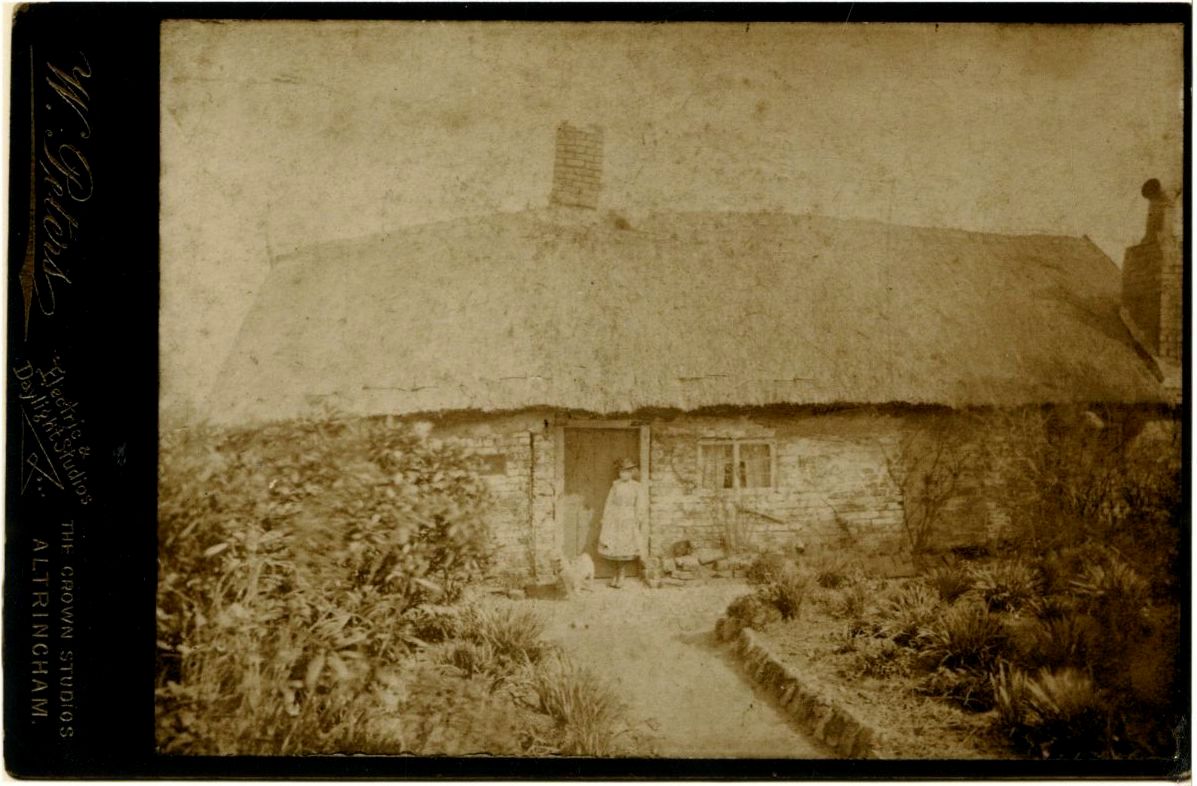
Bow Green, Bowdon: ‘The Old House’, mid-1890s
(William Peters)
This ancient, thatched cottage was home to Joseph and Sarah Chester and their children from at least 1881 until the early 1900s. They then moved to the farm house next door, which they renamed West Bank.
In 1881, Joseph was a ”bathman” at the Bowdon Hydro on Langham Road and Sarah like many women in the area towards the Bollin, was a laundress. Joseph was listed as market gardener in 1891 and by 1901 had expanded his enterprise to become a successful dairyman and porter.
(Cabinet card by William Peters, The Crown Studios)
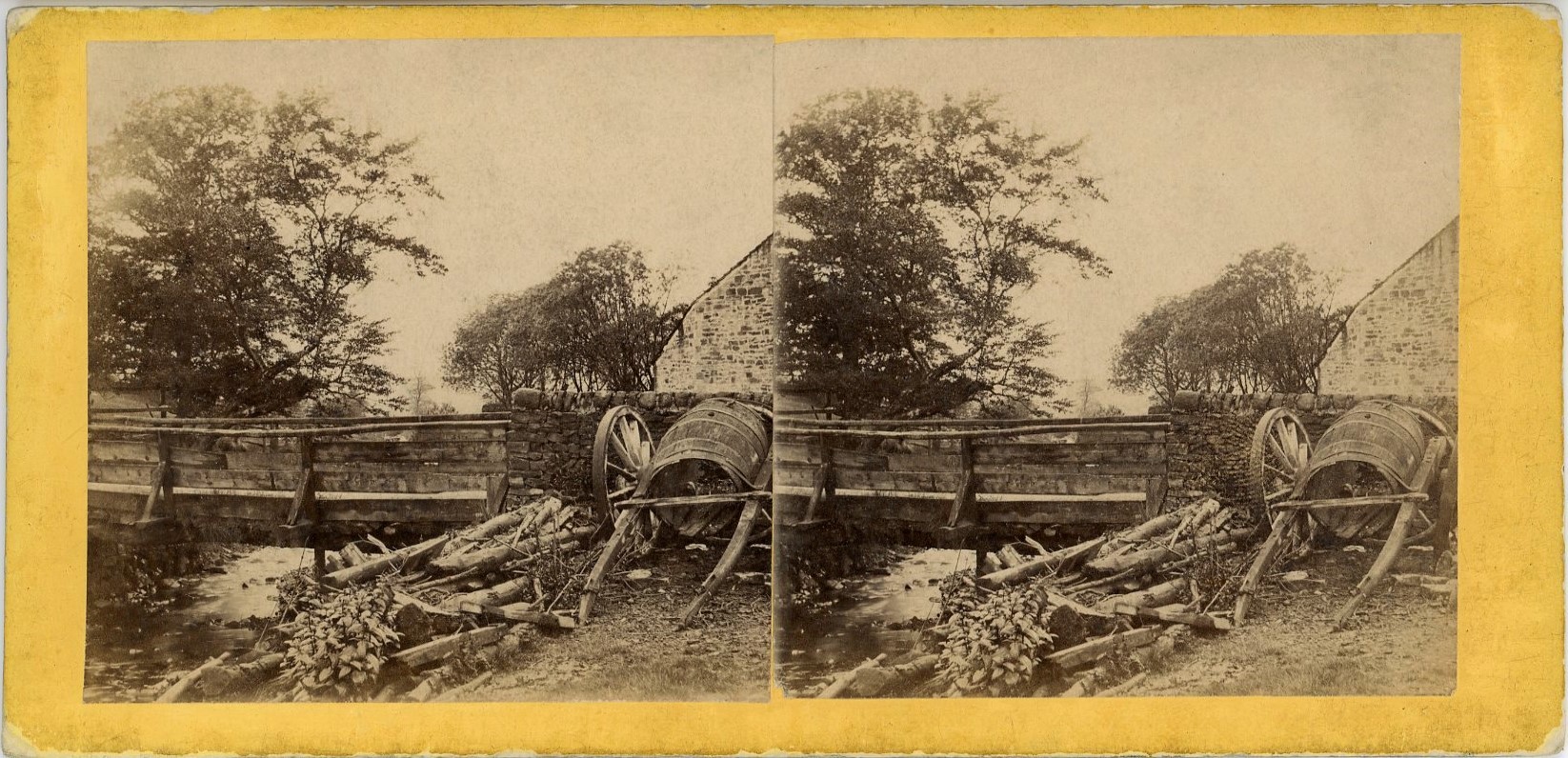
Cowbrook, near Glossop: Bridge over Hurst Brook, early 1860s
(Helmuth Petschler)
Nearby was the Cowbrook cotton spinning mill, established by the Hadfield family who also had lived in Cowbrook. They were ancestors of Alice Hadfield Petschler (nee Bennett), Helmuth Petschler’s wife. In addition to photographing romantic landscapes and ancient buildings, rustic scenes such as this wooden footbridge and portable barrel caught the eye of the photographer.
This is from a collectable set of stereoview cards called ‘The Land we live in’, with this one being no. 278 of Derbyshire.
(Stereoview card by Helmuth Petschler, H. Petschler and Company)
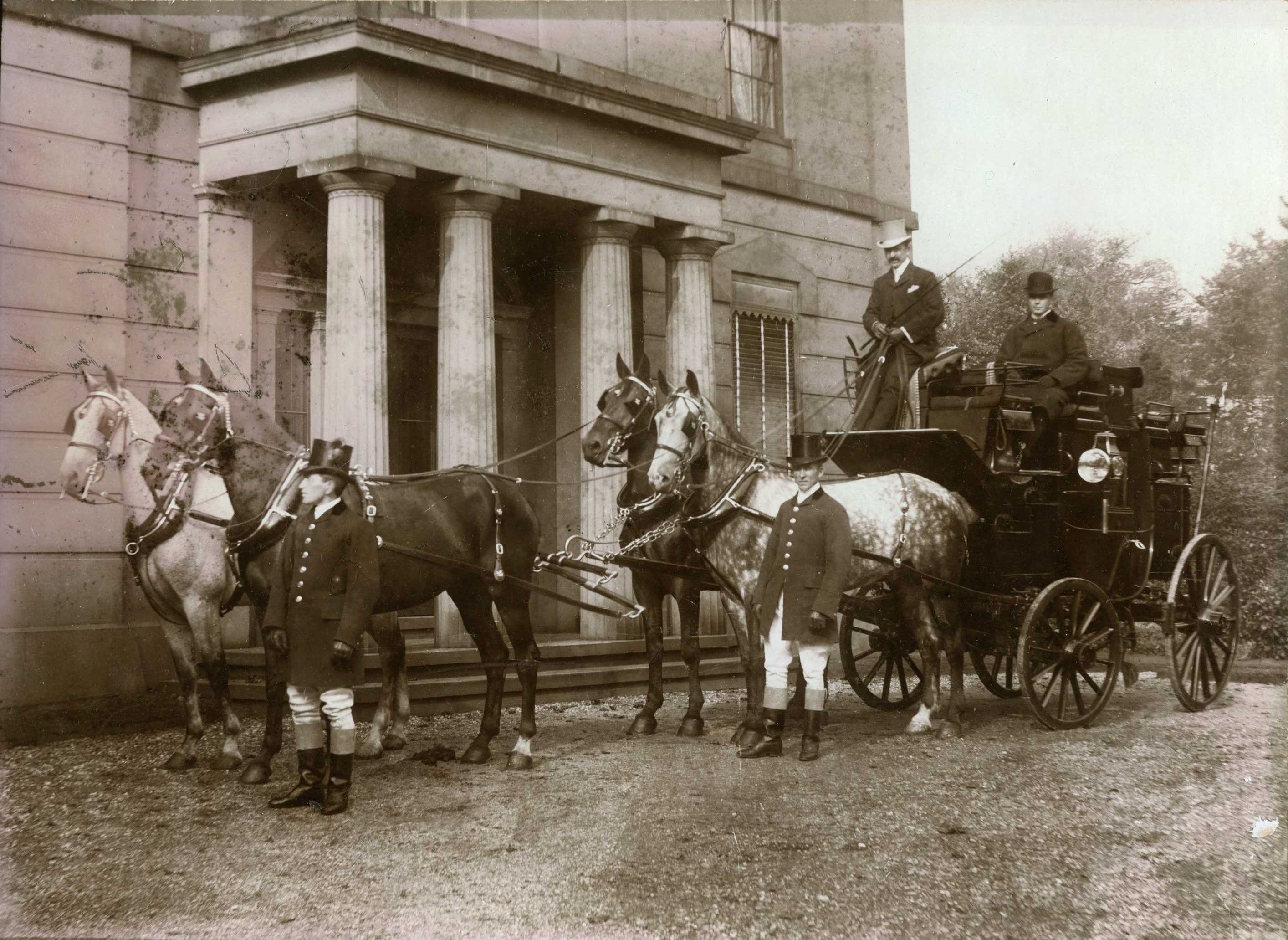
Dunham Massey: Bowdon Lodge, early 1890s
(George B. Bradshaw)
This fine carriage and set of four horses, is at the front porticoed entrance of Bowdon Lodge. It was set in landscaped grounds off Cavendish Road (formerly Warrington Road), in Dunham Massey Township until 1920, when it was incorporated into Altrincham. The grand Georgian mansion built in stone in the neo-classical style, was there in the 1830s and lived in by Benjamin Williams at the time of the 1839 Dunham Massey Tithe Map (Plot 773). He was described as ‘Independent’ in the 1841 Census, living with a modest number of servants. He appears as the owner and occupier on the Electoral Roll until 1849.
By the 1851 Census, Bowdon Lodge was lived in by Scotsman John Finnie aged 58 and his young wife, local girl Hannah Perkins, born in Dunham. They had married in Albrighton, Shropshire in 1850, by which time John had already moved into Bowdon Lodge. They never had any children. John had retired from being a very wealthy cotton merchant with Finnie Brothers in Rio de Janeiro, Brazil. In 1864, he paid for a grand street which was named after him, to be built in his birthplace, Kilmarnock, Ayrshire. He was philanthropist in other ways, including being a great supporter of the Swedenborgians. John lived at Bowdon Lodge until his death in 1875.
In his Will, he specified that he should be buried in Bowdon Churchyard and that the monument be made of Aberdeen granite with a strong iron railing, up to the cost of £500 ‘or a little more if necessary’. The Celtic cross was sculpted by J. S. Westmacott (son of Henry Westmacott), in 1877. His funeral, however, was specified to be in a ‘simple and unostentatious manner’, costing no more than £200. Finnie also left a bequest of £1,000 to the National Lifeboat Institution, for stations in Ayr.
His widow Hannah continued to live in Bowdon Lodge until September 1881, when she put it up for sale and moved away to The Abbey in Malvern Wells. The ‘mansion’ was described as having, ‘3 good entertaining rooms and library, spacious hall, butler’s pantry, kitchen, scullery, etc; six bedrooms, three dressing rooms, bath, w.c., etc; and two good servants bedrooms. It is cellared throughout. There is stabling for five horses, good coach house, harness room, and a large billiard room adjoining; In addition to which there is a good substantial lodge.’ It did not sell and was advertised for auction at The Unicorn in Altrincham in August 1883. It added that the house and coachhouse were fitted through out with gas and a good water supply. There were piggeries at the coachhouse and a kitchen garden with fruit trees. There was also a ‘pretty carriage ride from the entrance lodge to the house’.
Hannah was also a philanthropist. She died in 1905 at Malvern Wells, leaving substantial legacies to several charities and medical institutions in her Will. She was buried with her husband back in Bowdon. Find out more about the couple from the Friends of Bowdon Churchyard web site.
Soon after 1883, the corn-factor and managing director of the Manchester Carriage and Tramways Company, Joseph Walker, lived at Bowdon Lodge until his death in 1898, after which time, the house became empty. In the Census for 1891, he was listed with his wife Betsey, who died in 1892 along with their two young grandsons and a cook, waiter and housemaid.
It was bought in 1907 by the Altrincham Education Committee and the house demolished by 1909 to build Altrincham County High School for Girls (now AGGS), despite local residents’ opposition to the new educational use for the site. The architects of the new building were Messrs Sankey and Cubbon, Manchester. The original red brick stables, in which this splendid carriage and the horses seen here would have been kept, is however still there, running along Bowdon Road.
(Photograph by George B. Bradshaw, G. B. Bradshaw and Company)
Dunham Massey: A family outing, late 1890s
(William Peters)
The most likely setting for this informal group portrait in an outdoor setting, arranged around the natural prop of a fallen tree, is in Dunham Massey Park. It was taken when William Peters was based at his brand new and purpose-built studio at 19 Railway Street.
(William Peters, Crown Photo Company)
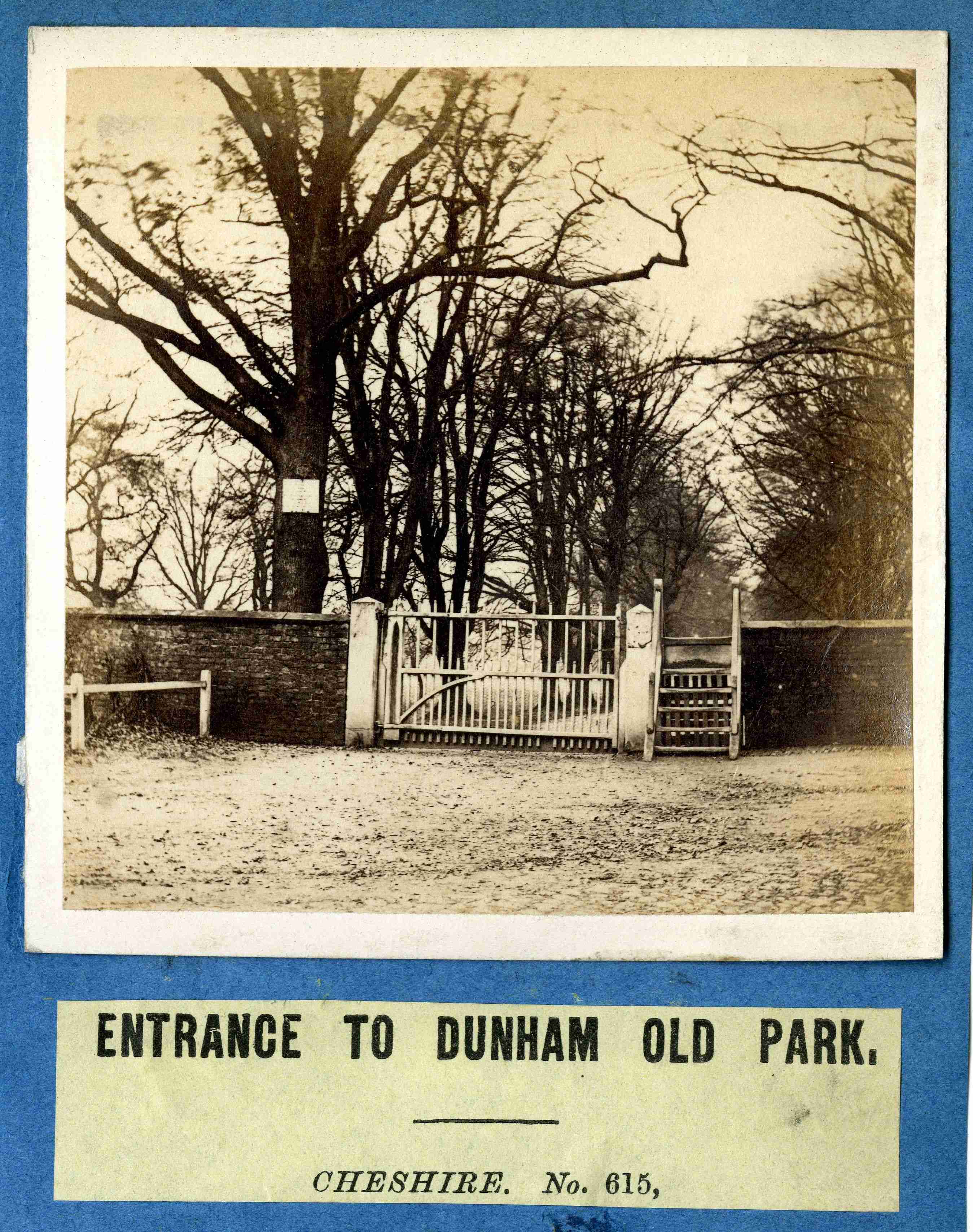
Dunham Massey: Entrance to Dunham Old Park, mid-1860s
(Helmuth Petschler)
Dunham Massey was handed over to the Norman family of de Massey after the Conquest. It has had a deer park from at least 1353. It had passed to the Booth family by 1453 and George Booth, 2nd Earl of Warrington, is said to have planted the large numbers of oak, beech and elm trees in the park, following his succession to the title.
This is a photograph taken in the winter time, of the well-known gate and steps on what became Charcoal Road, looking beyond to the formal layout of Beech Avenue. Charcoal Lodge would be built later, on the left-hand side. The Old Park and also the New Park, on the other side of the road, had been open to the public since the 18th century and were very popular destinations for day trippers, seeking relief from the dense and dirty city of Manchester, coming at first by canal boat, then the railway from 1849.
(Stock photograph by Helmuth Petschler, Manchester Photographic Company Limited)
Dunham Massey: The Cottage on Dunham Road, mid-1860s
(Helmuth Petschler)
Known as Nursery Cottage by the 1960s, this cottage orné with its well-shaped thatched roof, Gothic gates and rusticated fence, was found within the Earl of Stamford’s Nursery when the photograph was taken. Around it were greenhouses and an extensive tree plantation, which appears on maps until the 1950s. The area was shown as a cricket ground in the 1960s and now forms the woodland area of the green and open space called The Devisdale. At the time of the photograph, the cottage and most of the nursery, were in the Township of Dunham Massey.
This is one of many photographs featured in Helmuth Petschler’s company’s stock book, which were in a square format suitable for stereoviews and slides. He also sold the stereoviewers and other photographic apparatus.
(Stock photograph by Helmut Petschler, Manchester Photographic Company)
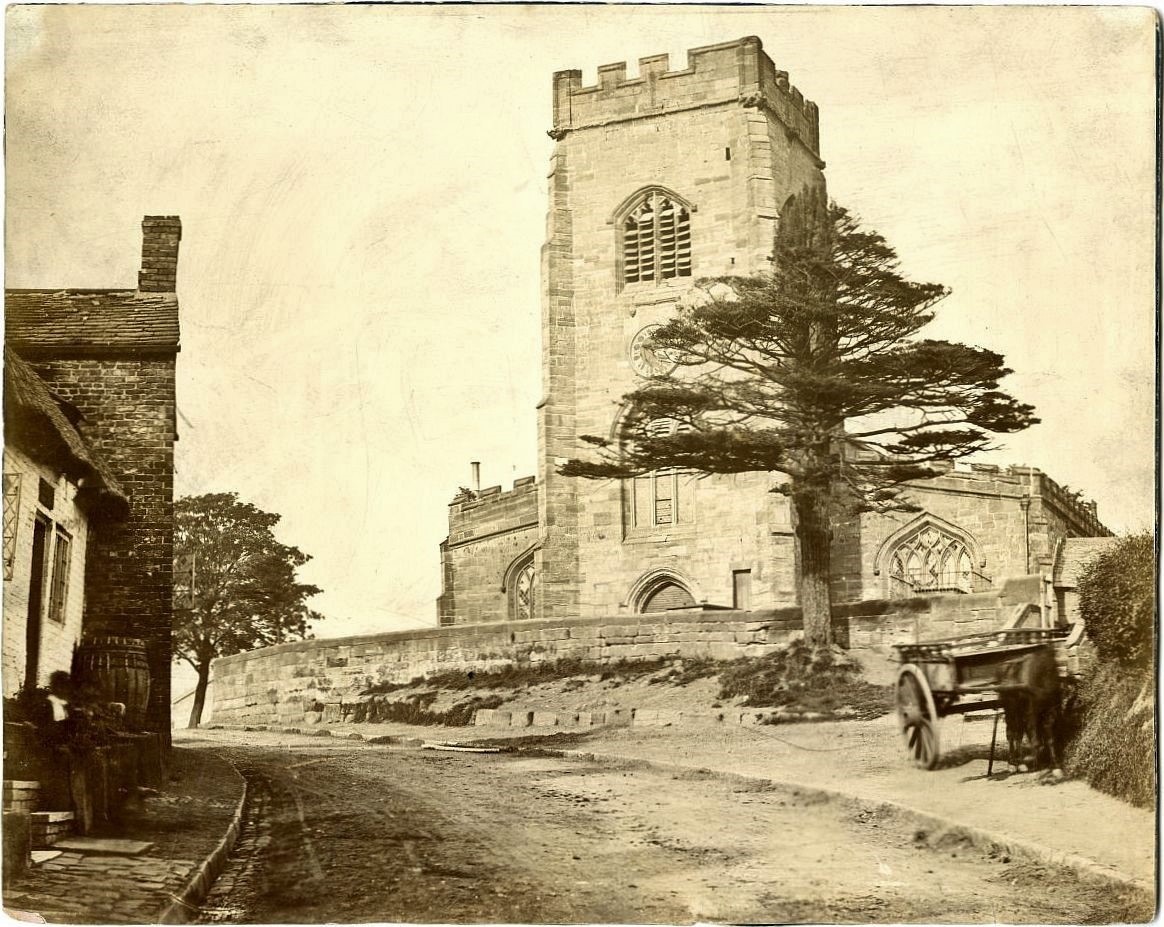
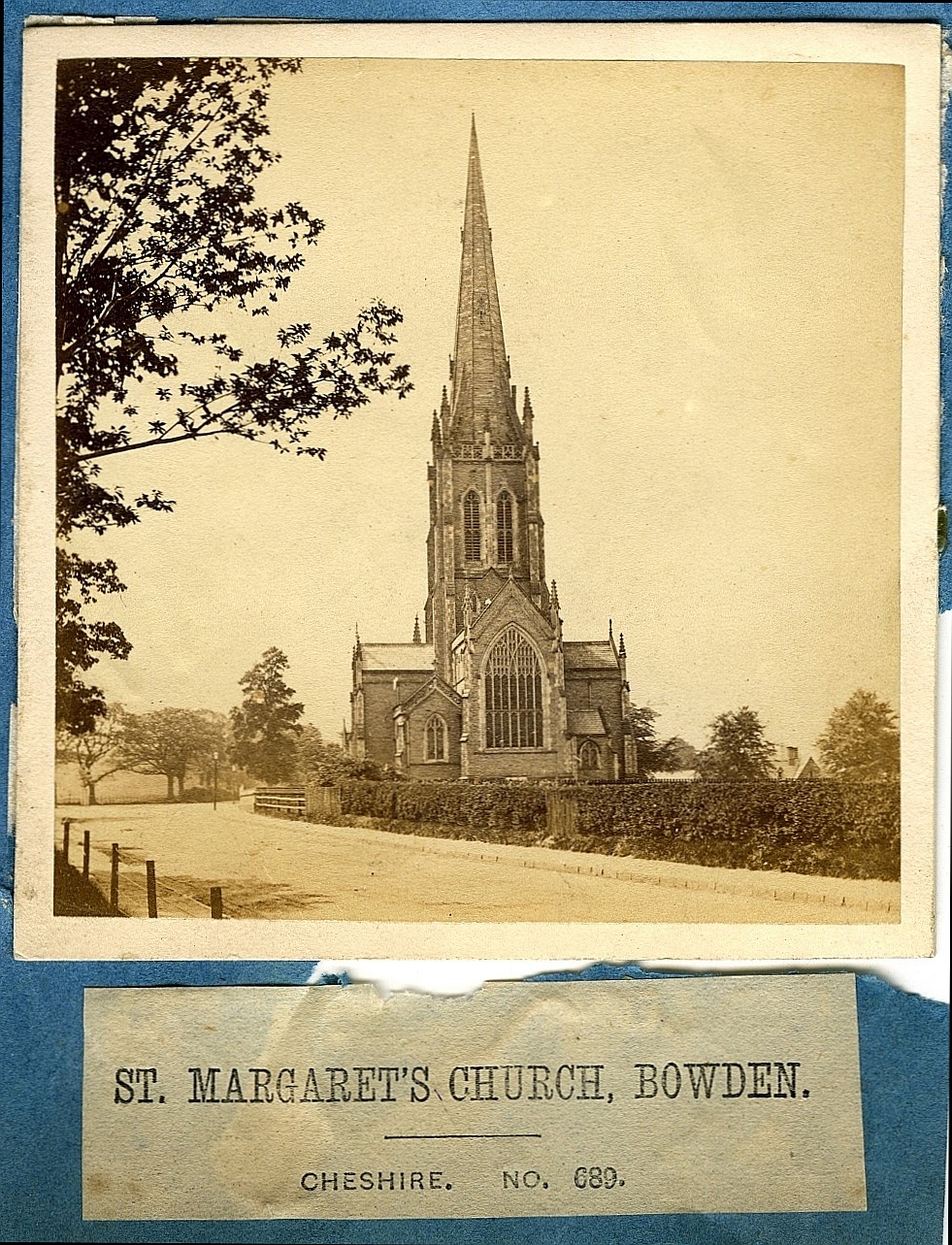
Dunham Massey: Saint Margaret’s Church, mid-1860s
(Helmuth Petschler)
Saint Margaret’s Church was initiated and financed by George Harry Grey, 7th Earl of Stamford of nearby Dunham Massey Hall. The location was already in Dunham Massey Township but a new parish of the same name was created around it, carved out of the extensive parish of Saint Mary’s church in Bowdon. It was specifically built to serve the new commuter suburb of Italianate villas many in white brick, laid out on former Stamford agricultural land, set back from wide, tree-lined streets like Saint Margaret’s Road and Groby Road.
Following a competition, building work on the church started in 1851 but was paused after a change of architects and also materials, from white brick to Yorkshire wall-stone with ashlar dressings of Hollington stone. The final design in Perpendicular style was by the Manchester architect, William Hayley. The slender spire, which had a gilded cross seen for miles around, had to be dismantled in 1927 as it had become unstable.
After a falling out with the congregation of Saint Mary’s Church, containing the original Stamford Chapel with its significant Booth and Grey monuments, a new Stamford Chapel was built within Saint Margaret’s, seen here to the left of the east window. Like that at Bowdon, it had its own private entrance. However, as it turned out, soon after the church was completed in 1855, the 7th Earl moved away with his second wife Catherine Cox, to newly built Bradgate House in Groby, Leicestershire. No member of the family came to live at Dunham Massey Hall until 50 years later in 1906. By then it was William Grey, the 9th Earl who through a convoluted inheritance, came to what was the only remaining family seat. He was responsible for appointing Hewlett Johnson firstly as curate, then as vicar to Saint Margaret’s. He was known as the Red Dean for his socialist views and activities, when he was later at Canterbury.
(Stock photograph by Helmuth Petschler, Manchester Photographic Company Limited)
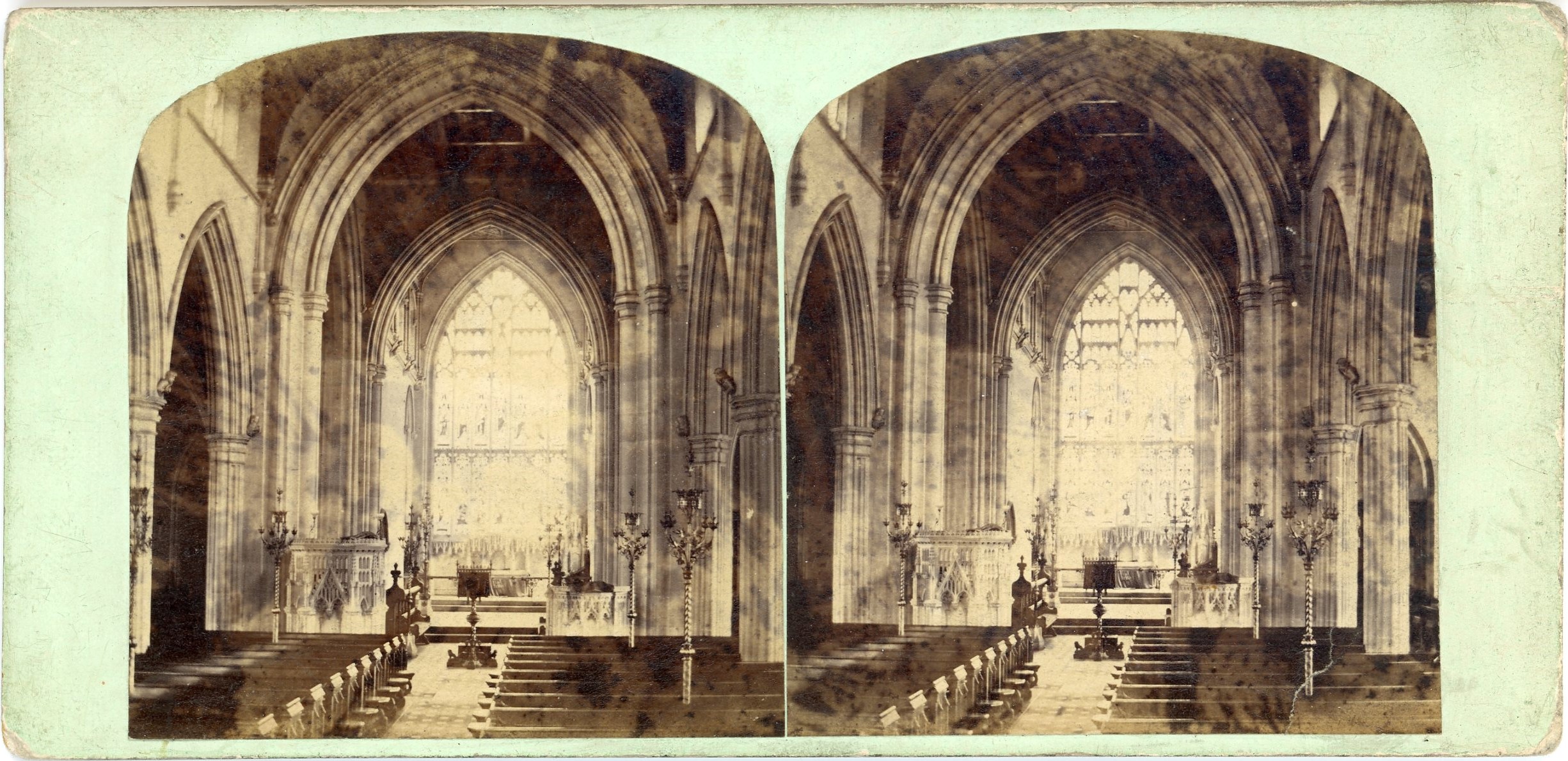
Dunham Massey: Interior of Saint Margaret’s Church, mid-1860s
(Helmuth Petschler)
Saint Margaret’s Church was dedicated to the 7th Earl of Stamford’s sister, Margaret, who had died in 1852. When Helmuth Petschler took this photograph, the church had been opened for just 10 years. The east and west windows by T. Willemont of London, depicting men and women of the Bible were in place but later memorial windows such as those to the Reverend John Kingsley; the parents of Joseph Sidebotham of The Beeches and to John Allen of Oldfield Hall, were added after this photograph was taken, so the interior was still filled with natural light. The west window was taken out after World War I, when the church was extended but never finished due to a promised legacy never being made, leaving the unfortunate bare brick exterior.
The pillars of the church are of stone but the arches are made of brick, covered with plaster and painted to resemble stone. There are angels playing musical instruments over the capitals. The hammer beam roof which can just be glimpsed, resembled that of the Westminster Hall. Fine wrought iron gas light fittings can be seen in the pews. The pulpit made of Caen stone is to the left and there is a matching reading desk is to the right. The lectern was made of brass on a cast iron base.
(Stereoview card by Helmuth Petschler, Manchester Photographic Company Limited)
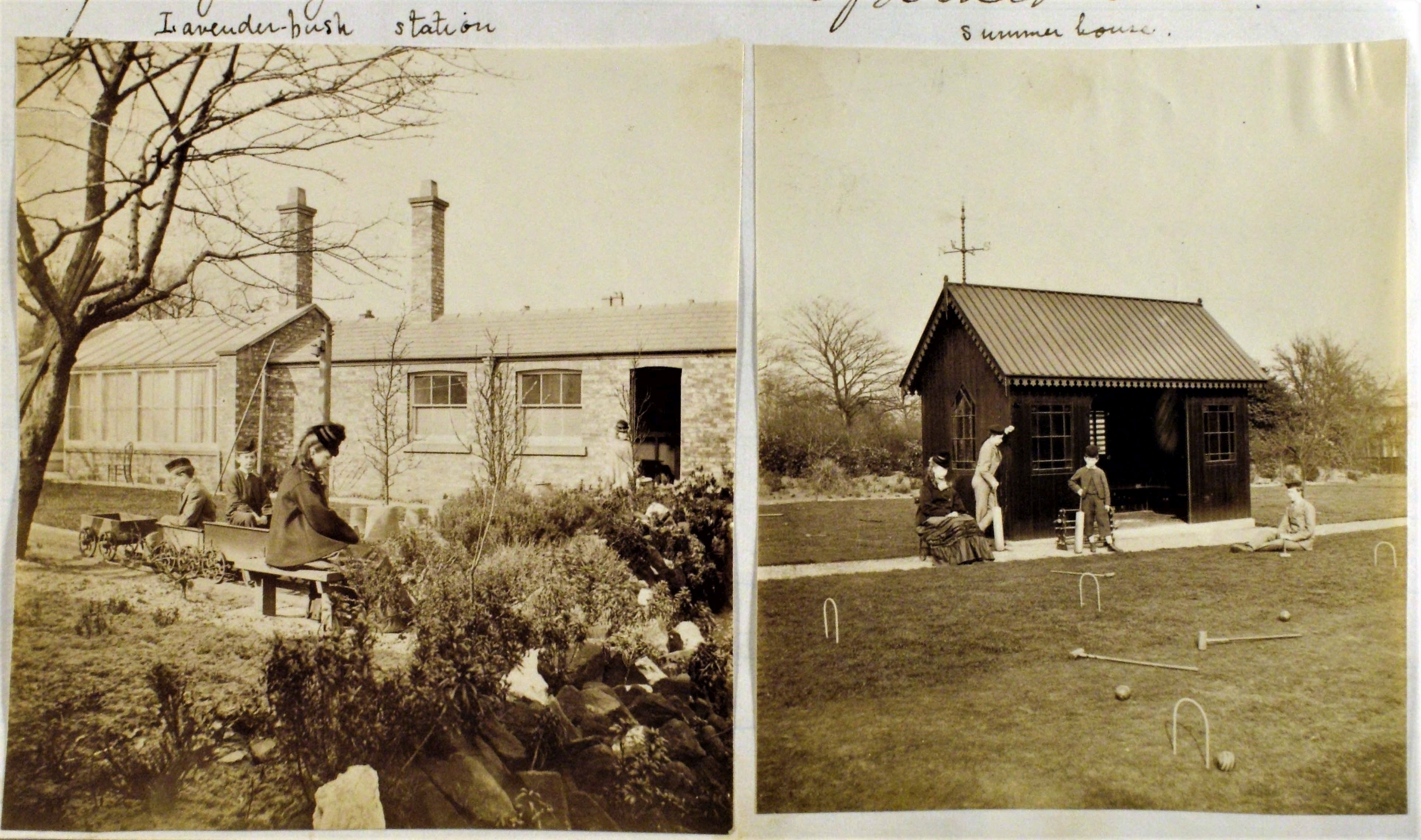
Dunham Massey: Lavender-bush Station and a game of Croquet, April 1874
(Joseph Sidebotham)
These are two prints pasted into the ‘Family Diary’, taken of his family by Joseph Sidebotham. They show the regular leisure time activities at their home with its extensive grounds called The Beeches. The plates were prepared and the photographs printed in the single storey brick workshop, seen in the photo to the left.
Like many other suburban villas in Bowdon and Dunham Massey seen on the OS Plans surveyed in 1876, there was a purpose-laid lawn for the popular and social game of croquet. It was a sport played relatively easily by women and girls, without their cumbersome attire hindering them too much. Two of the boys by the picturesque wooden ‘Badminton house’, hold cricket bats.
(Photograph by Joseph Sidebotham, Sidebotham ‘Family Diary’ no.1, 1873-74)
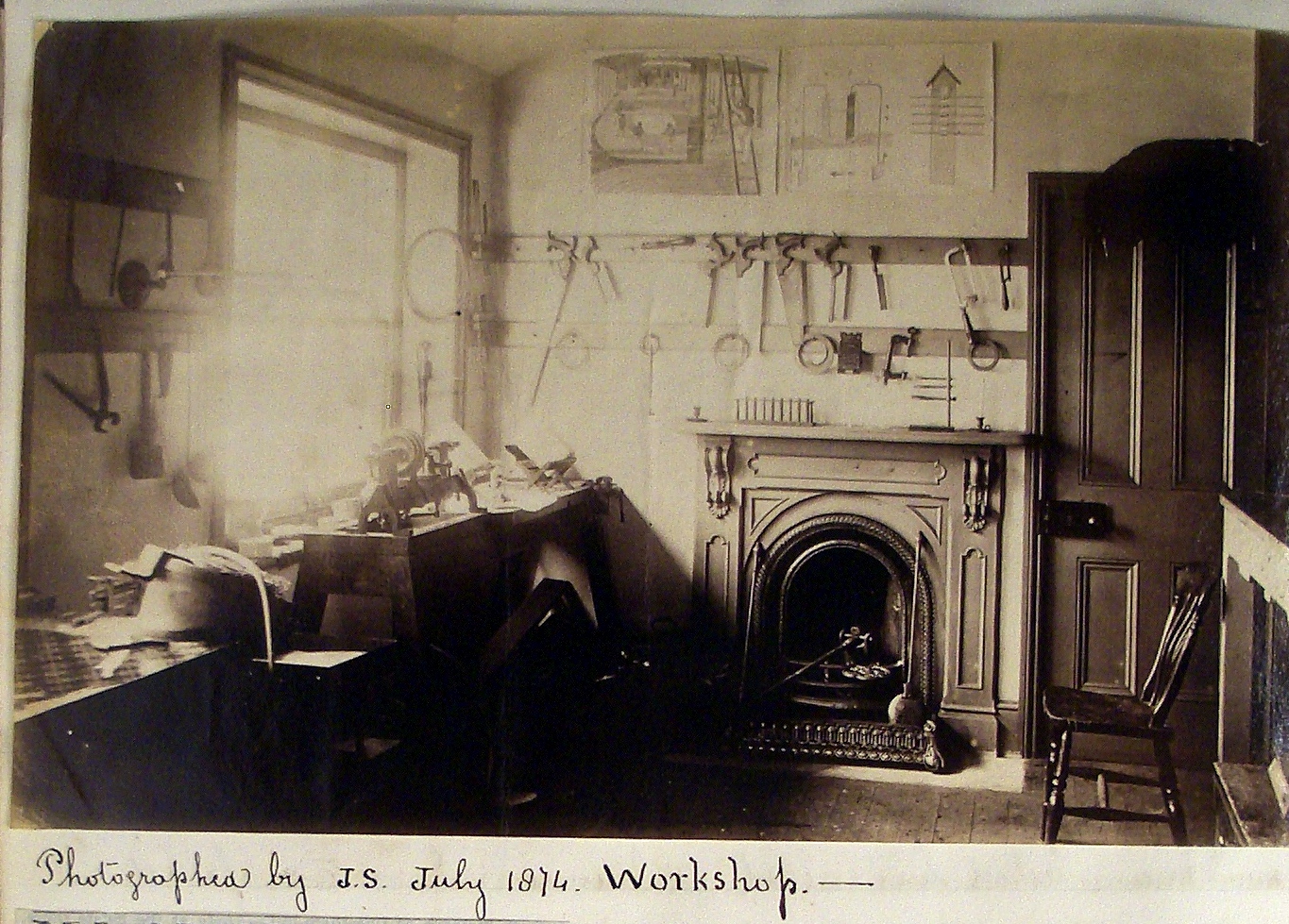
Dunham Massey: The workshop at The Beeches, July 1874
(Joseph Sidebotham)
A ground floor room at the Sidebotham family home called The Beeches (formerly Beech Grove) in what was in Dunham Massey Township until 1920, was turned over to a workshop. It was used for the preparation of photographic plates and making prints, as well making sun dials. This print was pasted into the ‘Family Diary’.
The diary also recorded that on 3rd November 1874 that one curious member of the family young Joe, ‘Has been trying to make an explosive bubble this evening but the workshop gas went out and he could not finish it.’
(Photograph by Joseph Sidebotham, Sidebotham ‘Family Diary’ no.1, 1873-74)
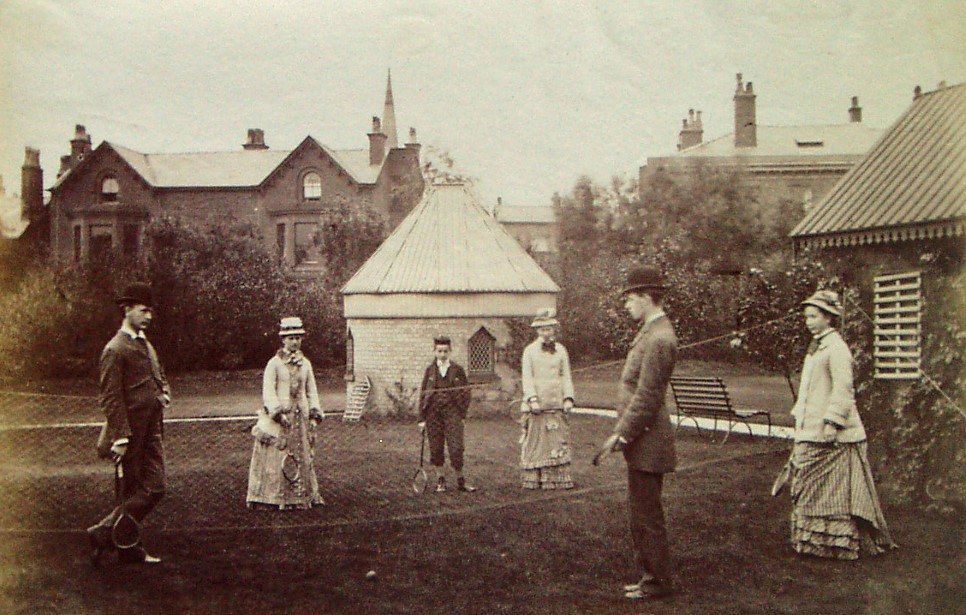
Dunham Massey: Game of tennis at The Beeches, 10th September 1877
(Joseph Sidebotham)
This photograph taken by Joseph Sidebotham of his family and their governess Miss Fanny Linton (second left), was pasted in the ‘Family Diary’ at The Beeches, on Woodville Road. The first English Lawn Tennis Championships with newly standardised rules, had been played earlier that summer in 1877, at Wimbledon.
The houses seen in the background are some of those on Higher Downs, being the ancient route from the Lower Town in Altrincham up to Bowdon Church. They were built in 1851 on parcels of former agricultural land released for sale specifically for speculative housing by the 7th Earl of Stamford, after he came of age in July 1848. In the distance can be seen the spire of Trinity Presbyterian Church, newly opened in 1872.
(Photo by Joseph Sidebotham, Sidebotham ‘Family Diary’ no.5, 1876-78)
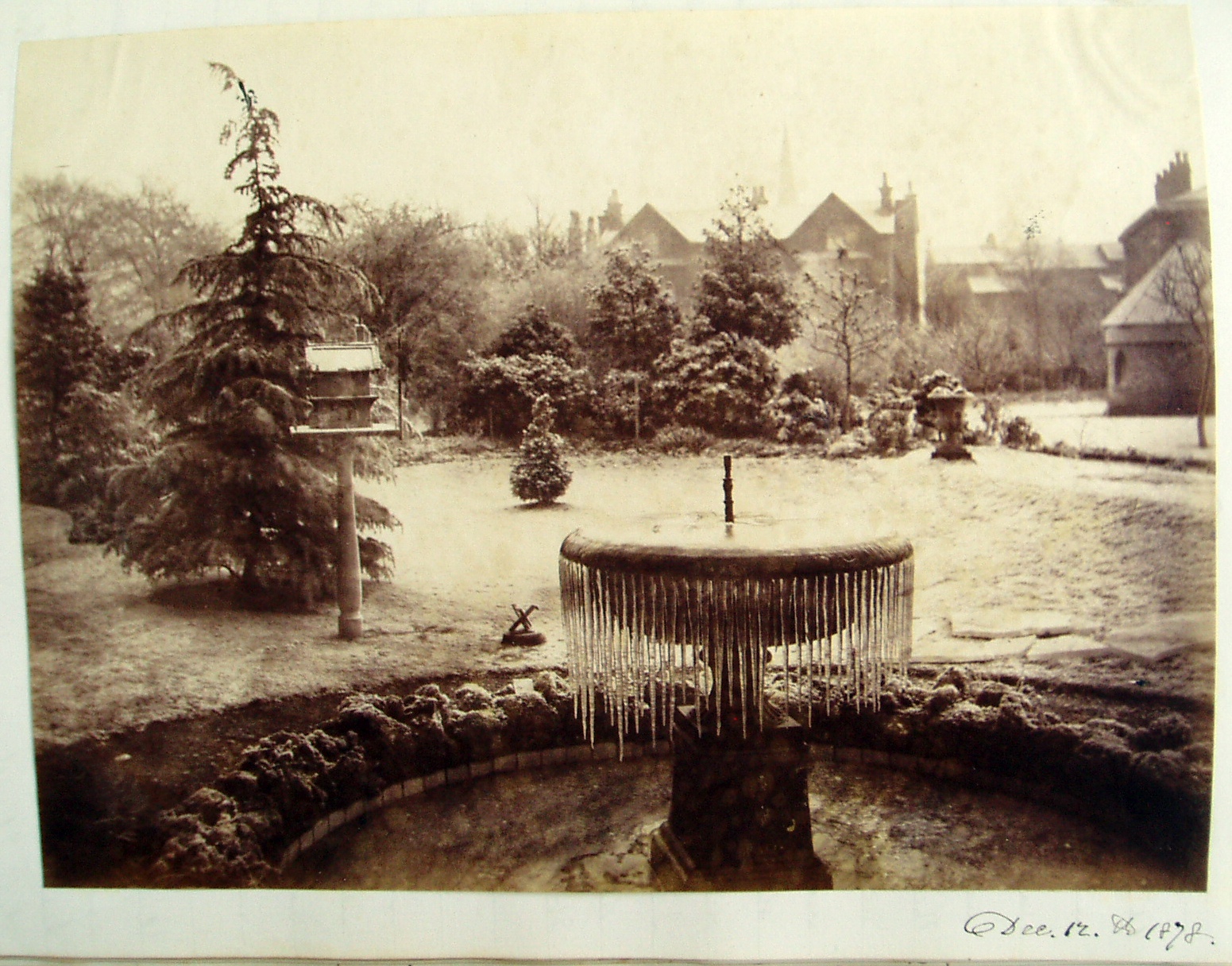
Dunham Massey: Frozen fountain at The Beeches, December 1878
(Joseph Sidebotham)
This photograph reveals several of the family’s interests in the natural world and beyond. Recordings of rainfall and temperature were taken recorded on a daily basis in the ‘Family Diary’. The icicles on this frozen fountain and bird bath, must have delighted them. A bird house is to the left and on the ground is one of several sun dials they made in the workshop. There are specimen trees in the garden. In the distance to the right, is the white brick observatory, which had a high-quality telescope installed. Joseph Sidebotham wrote articles on his findings with microscopes, with regards to both botany and entomology. He was in contact with the great minds and inventors of the day, including naturalists Charles Darwin and Leo Grindon and the astronomers Professor Piazzi Smyth and James Nasmyth.
In the distance are the houses on Higher Downs, which all started to be built in 1851 on former agricultural land bought from the 7th Earl of Stamford. In the tall semi-detached house to the left at 7 Higher Downs, lived Edward and Alice Coward, the parents of Joseph’s wife Anne, nee Coward. In the other half at 8 Higher Downs, her bother Thomas was living. He like Joseph, was a calico printer and also a naturalist friend. He was married to Sarah Grafton, daughter of Joseph S. Grafton, who had built the four houses at Beechfield, built at the same time as Higher Downs. Thomas and Sarah’s son was the famous Cheshire naturalist and author, Thomas A. Coward, who was born at 8 Higher Downs in 1867, the year after the Sidebotham’s had moved in The Beeches (then known as Beech Grove).
(Photograph by Joseph Sidebotham, Sidebotham ‘Family Diary’ no.6, 1878-79)
Dunham Massey: Bowdon Downs Congregational Church, Beechfield, 18 February 1892
(Unknown)
Built on field purchased in 1847, up the hill to the south of Altrincham town centre, this fine Grade II Listed Church in Perpendicular Gothic style, was dedicated in June 1848. It became the new home for the congregation, who had outgrown their Chapel down the hill at 12 & 14 The Downs. The members also did not want to be located near the forthcoming Bowdon railway railway terminus due to the noise and smoke, which started after the service began in 1849.
To the left are the gateways to the four houses at Beechfield and to the right was St Anne’s Home, previously a merchant’s house called Beech Grove (later The Beeches). It had been built in 1837 and lived in by a Deacon of the Church, Ibotson Walker. The original cast iron gates to Beechfield can be glimpsed, set upon the still extant grand stone entrance pillars of the carriageway. The photo was taken before the WWI Memorial porch was built in 1921.
(Unknown photographer, Album of 1890s Photographs)
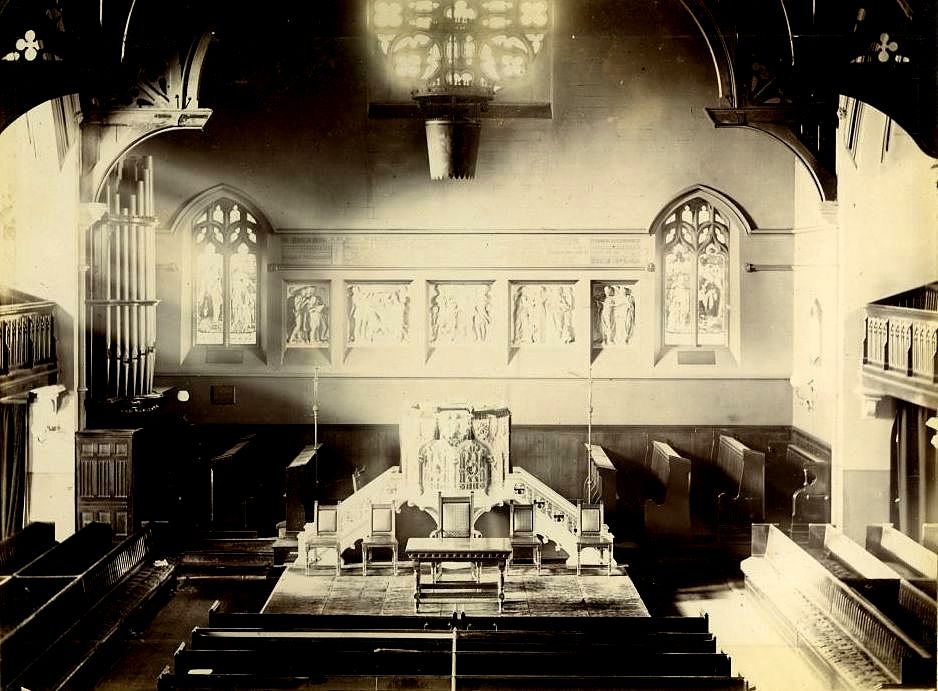
Dunham Massey: Bowdon Downs Congregational Church interior, 7 February 1892
(Unknown)
This shows the Church after its nave had been extended in 1868, with galleries and transepts added, featuring early cast iron columns. The handsome hammer beam roof was retained.
The finely carved stone pulpit had been designed for St George’s Chapel, Windsor but when Queen Victoria saw it, she rejected it. It found its way to Bowdon instead and has been admired ever since. The frieze at the back is a plaster cast of some of the marble panels of Luca della Robbia’s marble Cantoria in the Duomo in Florence, reflecting the Italianate taste of the Bowdon merchant class.
(Unknown photographer, Album of 1890s Photographs)
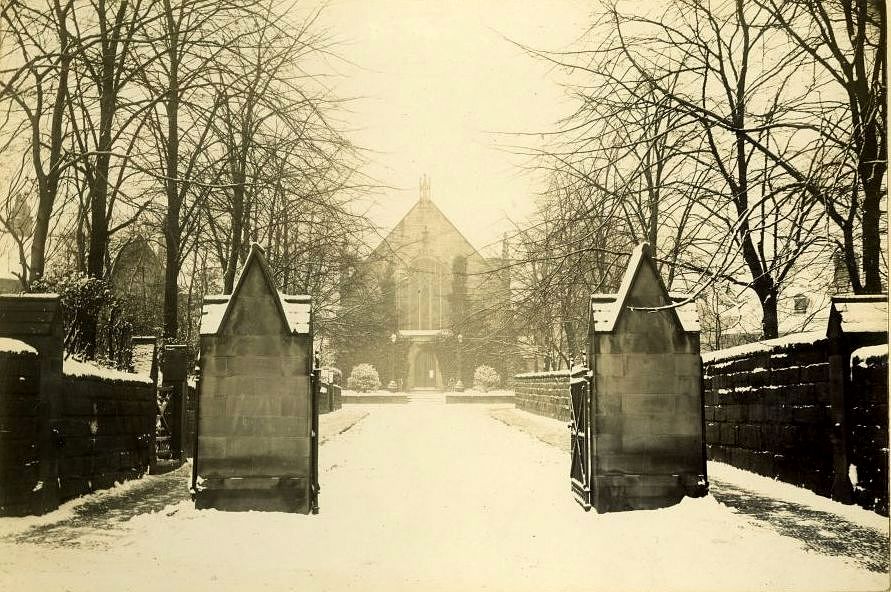
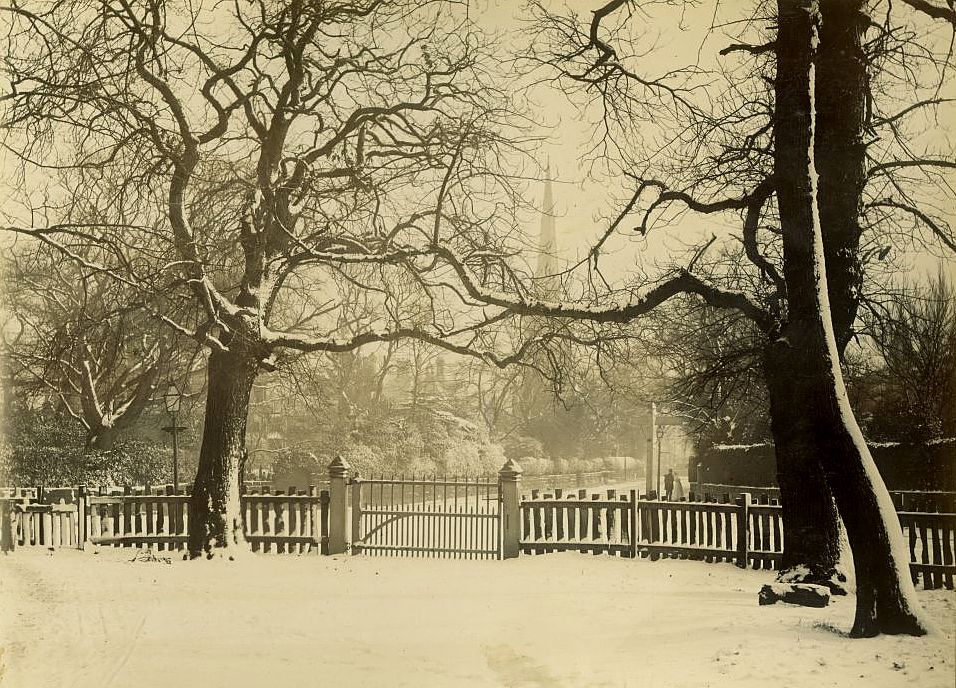
Dunham Massey: Entrance to Dunham New Park, early 1890s
(Unknown)
In a striking snow scene, one of several distinctive sets of wooden gates and posts to Dunham North and South Parks, can seen at the corner of Dunham and Bradgate Roads. They are still there today. In the distance is the spire of Saint Margaret’s Church. An example of the unique cast iron lamp posts, giving the name of the street is also in shot. Some of these can still be found in the gardens of local residents who rescued them, when the Council made modern lamp post replacements.
(Unknown photographer, Album of 1890s Photographs)
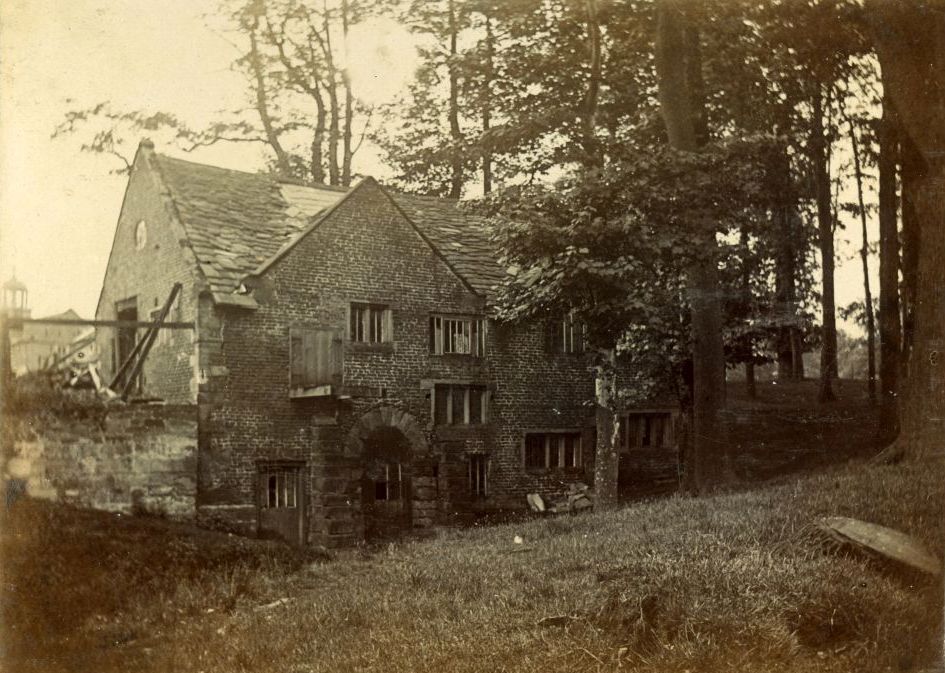
Dunham Massey: Dunham Mill in the grounds of Dunham Hall and Park, early 1890s
(Unknown)
The corn-grinding mill was built in 1616 and powered by water coming from ‘The Fleam’ through open and underground culverts, all the way from springs drained from Hale Moss to the east, which despite what would be expected from its name, is at slightly higher ground level. This system also supplied water for a cistern and hand-pumps for Dunham Hall.
The mill was given a new water wheel in 1814. It not only ground the toll corn, but also wheat, oats, barley, oats and malt including some for local maltster, grocer and property developer John Barratt. In 1860, it was converted into a saw mill producing wood for the increase in demand for building material and fuel. Servants and labourers also lived in the building. With the Park open to the public since the 18th century, the Mill and its setting had long been admired for its picturesque quality.
(From the K. S. Whittaker Album)
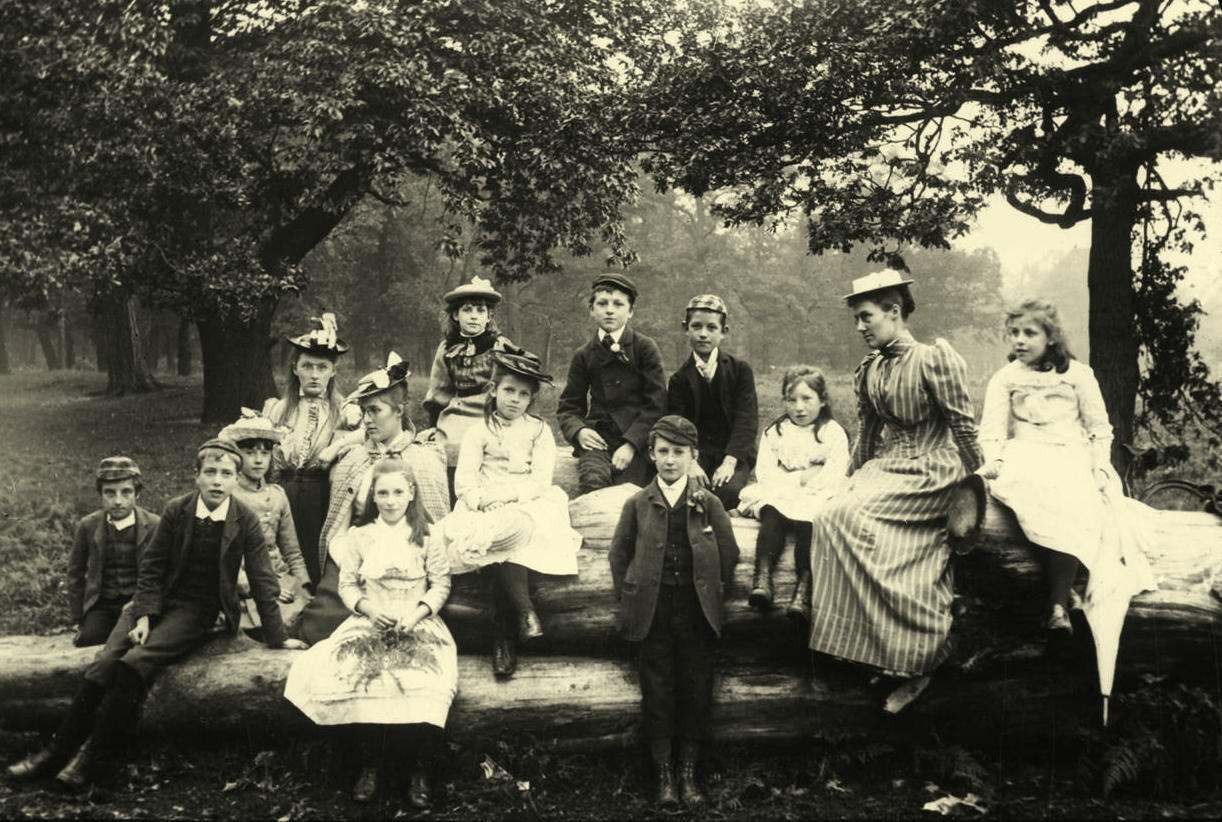
Dunham Massey Park: Children on a fallen tree trunk, 1890s
(Arnold H. Wolff)
This outing may have been to Dunham Massey New or Old Park, both of which had been open and free to the public for decades. They were popular not only with local residents but also with the many day trippers from Manchester coming by canal since the 1780s, long before the arrival of the railway in Altrincham in 1849. Elizabeth Gaskell describes a visit by canal boat to its ‘ancestral trees’ and ‘grassy walks’ in her short story Libbie Marsh’s Three Eras (1847).
(From a negative by Arnold Harold Wolff)
Dunham Massey: Axe and Cleaver pub, 1890s
(Unknown)
This shows the Axe and Cleaver when it was a tied house licensed to Harry Meadowcroft who sold beer and wine. Previous to this, there had been a beer sellers from the Lingard family who had used the Axe and Cleaver name since the 1850s.
It was replaced in the early 1900s by a purpose-built public house in Cheshire black and white style. It is just as popular today with locals, visitors, walkers and cyclists, as it had been in previous times.
(Unknown photographer)
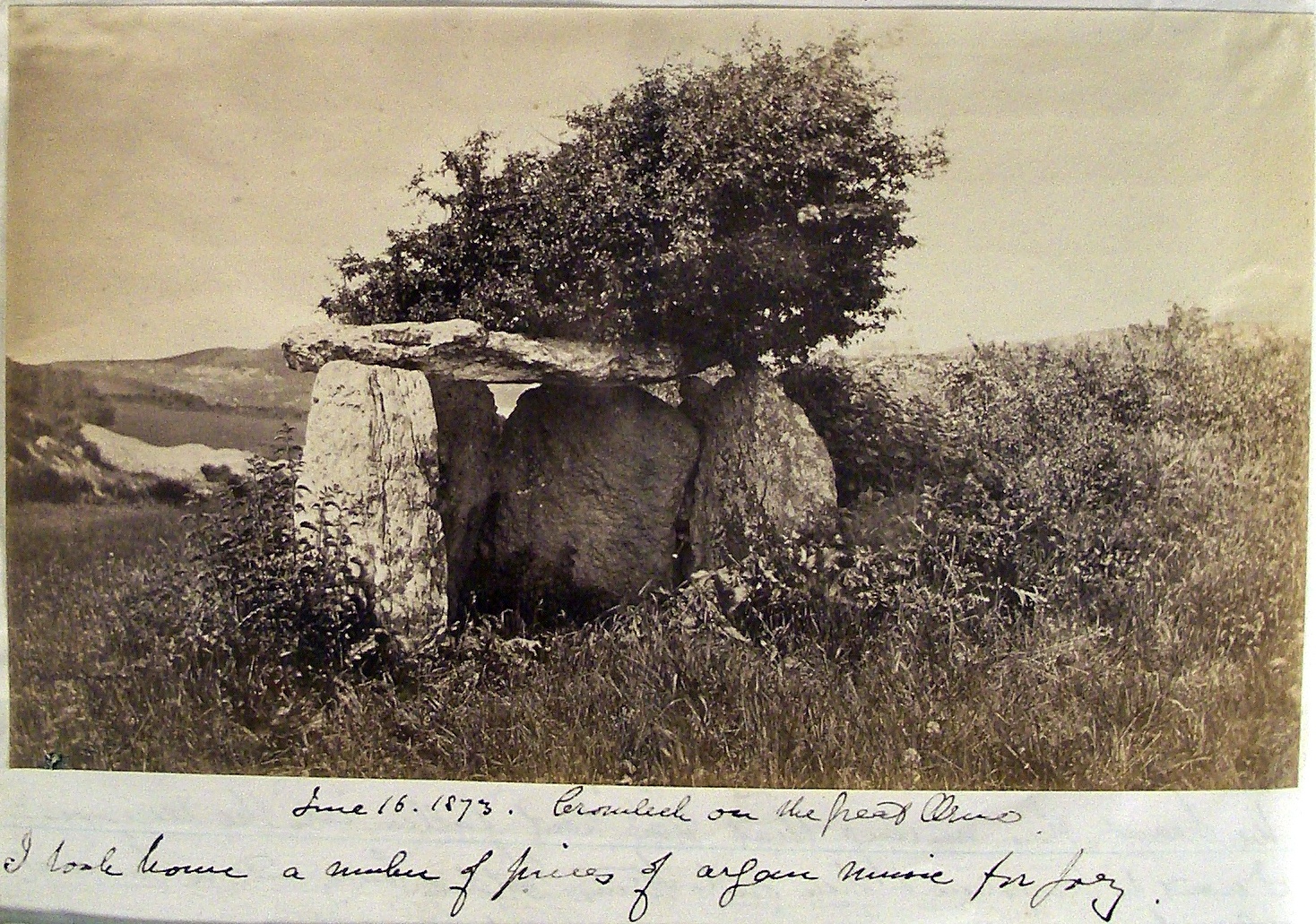
Great Orme Head, Llandudno: The Cromlech, 1873
(Joseph Sidebotham)
This photograph of the Neolithic burial chamber or cromlech (‘crooked stone’) was taken by Joseph Sidebotham on 16th June 1873, during an extended family holiday to Llandudno. The cromlech would have originally been covered by a mound of earth and indicates a more settled community in ancient times.
(Photograph by Joseph Sidebotham, Sidebotham ‘Family Diary’ no. 1, 1872-73)
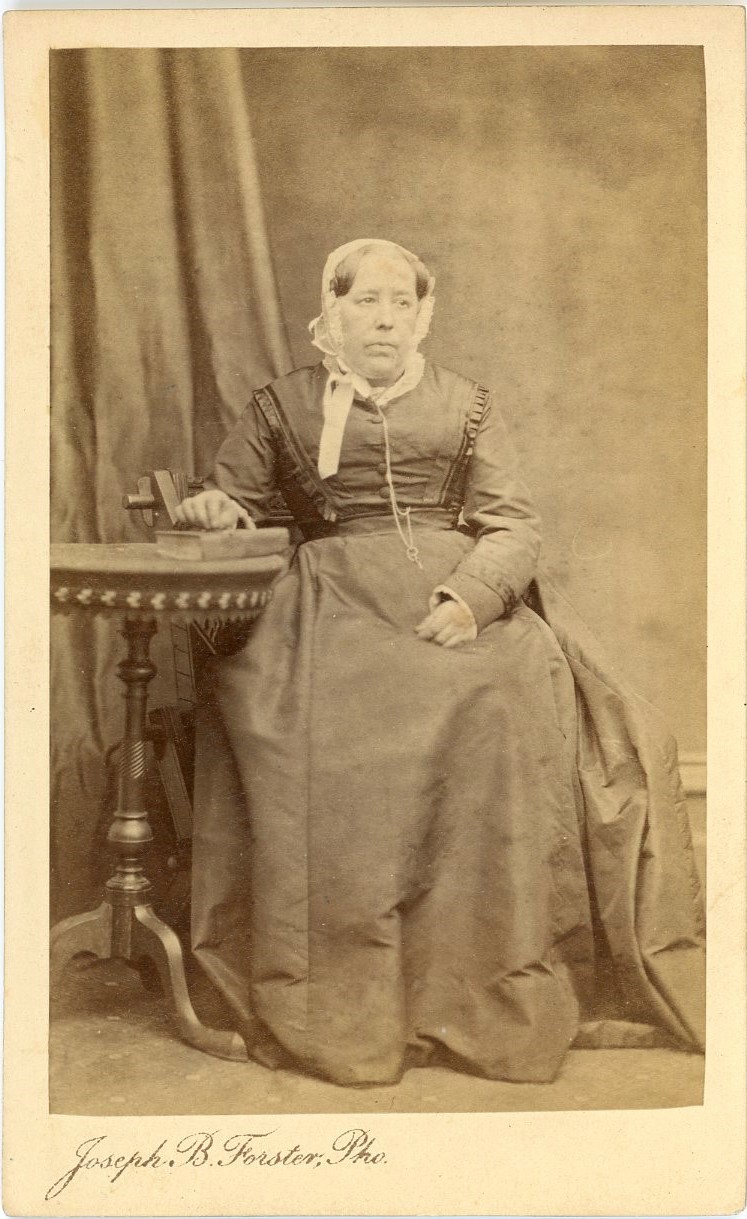
Hale: Quaker woman seated, mid-1870s
(Joseph B. Forster)
Joseph Binyon Forster was the managing director of sugar refiners and jam makers Fryer, Benson and Forster in Chorlton in Medlock, Manchester, with interests in Antigua. He had an active interest in freedom of thought and exploring modern ideas like Darwinism within the Quakers, writing pamphlets and a book on the matter. He also collected numerous 18th and early 19th century tracts against slavery, now held by the Library of the Religious Society of Friends, London.
From around 1875 until 1877, he and his family were living at a large house called Ford Bank, which was on the right-hand side of Ashley Road in Hale, just before the road bridge over the Bollin River.
Along with his signature and printed initials surrounded by the words ‘Truth and Light’, Joseph gave the address of ‘Ford Bank’ on the back of his cartes-de-visite made during that time, such as this one of a Quaker woman. She has a typical cloth bonnet and modestly trimmed dress, with her bible to hand. The photograph may have been taken some years before the carte was made up.
(Carte-de-visite portrait by Joseph Binyon Forster)
Hale: Demolition of The Bleeding Wolf public house, 1898
(Unknown)
Originally part of a farm, the building was demolished soon after 1897, when the then publican and lessee Edward Bailey, bought the freehold from the Stamford Estate Trustees. He replaced it with a grand mock tudor building, complete with turret, completed by 1902. Part of the new pub was built on the foorprint of the old one, so that the Licence could be retained. In 1901, his sons William and Edward were employed as barmen.
The pub sign showing the dying wolf, had been painted by local artist Tom Colley and was reinstalled at the new pub. In an article in the Altrincham Guardian, he wrote that a wolf had been killed here in about 1470. Note the rails outside to front for tying up horses and to the right, the small ‘C’ size wall letterbox by W. T. Allen (1881 and after).
(Unknown photographer)
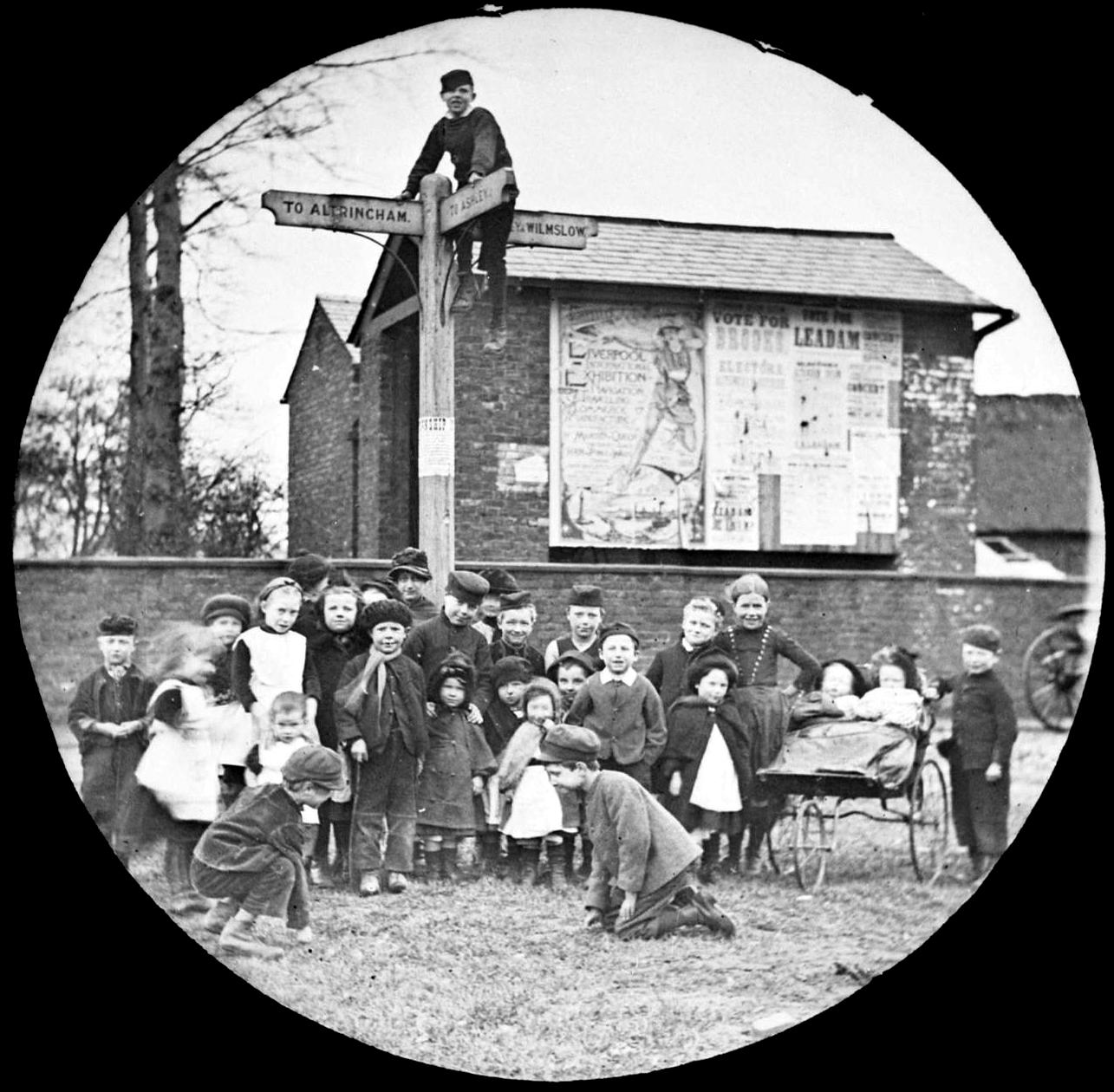
Hale Barns: Children on Hale Barns Green, March 1886
(Unknown)
Local children gather and pose to have their photo taken by the finger post in the centre of Hale Barns, now the site of the WWI Memorial. The posters behind on Dial Farm date the photo to Altrincham By-election of March 1886, between J. S. Leadham (Liberal) and Sir William Cunliffe Brooks (Conservative), with the latter winning this and the subsequent General Election. A very large poster for the International Exhibition of Navigation, Commerce and Industry which opened in Liverpool on 11 May 1886, can also be spotted.
(Lantern slide, unknown photographer)
Hale Barns: Ladies from Ancoats visiting The Clough, 1894
(Arnold H. Wolff)
The imposing and detached house of The Clough was built in 1873 by Arnold Wolff’s parents, Charles Henry Wolff and Annie Marie nee Harrop. The latter was descended from the influential Non-conformist minister of Hale Chapel, the Reverend Robert Harrop. The house was built on a field of the Harrop Estate, just south of Barrow House, which was renamed The Clough Farm.
It is not known what brought this group of over 80 women with a wide age range and several small children to The Clough. It may have been to visit the gardens at The Clough and to go for walks in the nearby Bollin Valley.
The five young women to the right are dressed in the modern ‘Gibson Girl’ style, based on the illustrations of American artist Charles Dana Gibson, seen from the 1890s right through to the 1910s. The clothing was less restrictive, with a simple shirt and a mannish necktie with a plain, flared skirt. A straw hat sat upon on a mass of upswept curls. It gave the impression of a confident, athletic and independent ‘new woman’.
Arnold Wolff’s dog called Trap, posed at the front of the group.
(From a glass negative by Arnold Harold Wolff)
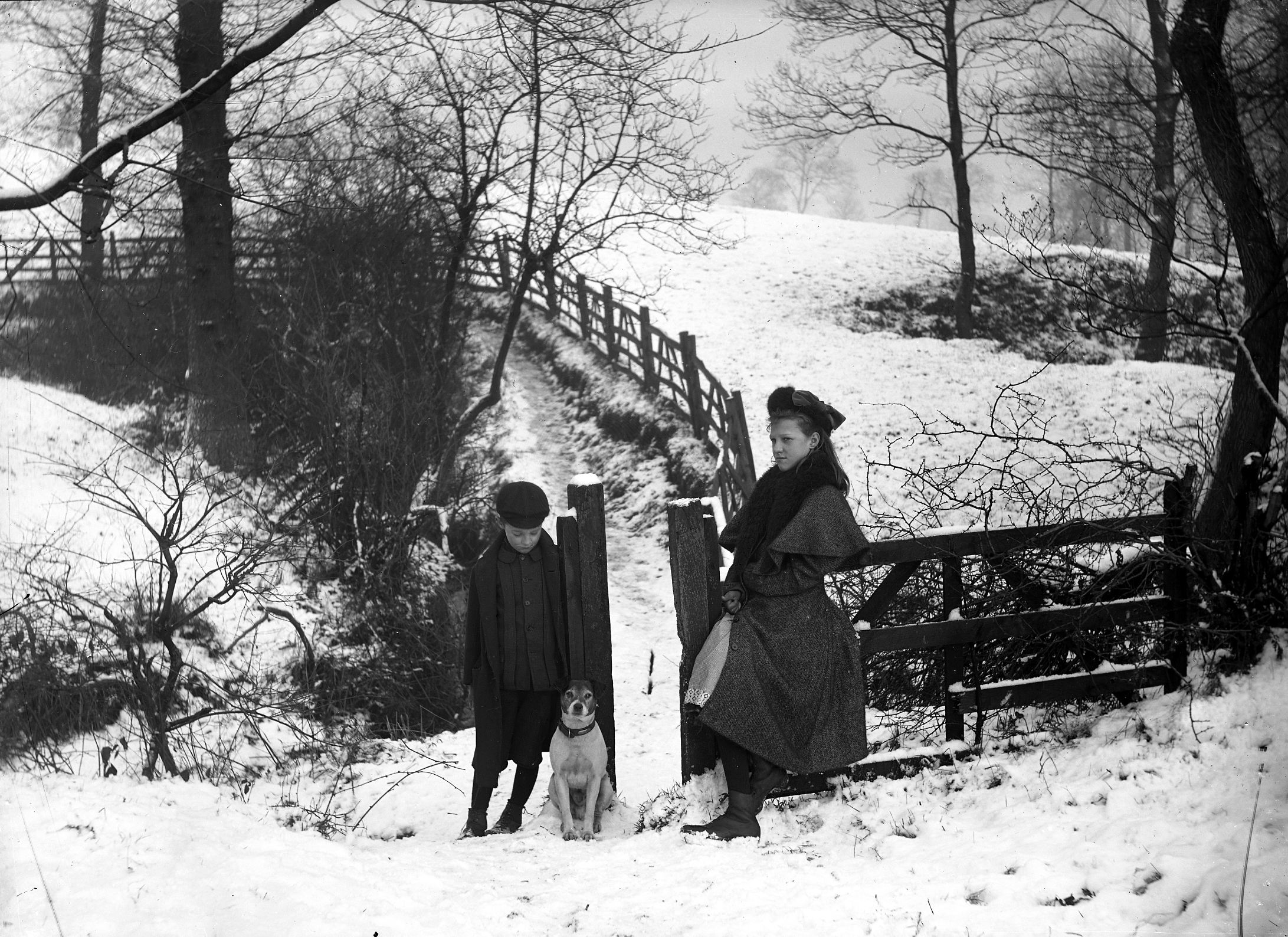
Hale Barns: Bollin valley with two of the Wolff family children, 1890s
(Arnold H. Wolff)
Trap the dog accompanied the children on their walk in the snow.
(From a glass negative by Arnold Harold Wolff)
Hale Barns: Farm worker near Hill Top Cottage, 1890s
(Arnold H. Wolff)
The farm worker holds a rake, which was used for gleaning the loose straw. The corn stooks were made up with 8 sheaves, with 2 on top to protect the lower ones from the rain. Hill Top Cottage with its thatch and stone flag roof is in the distance, now long gone and replaced with grand mansions on the wide road of the same name.
(From a glass negative by Arnold Harrop Wolff)
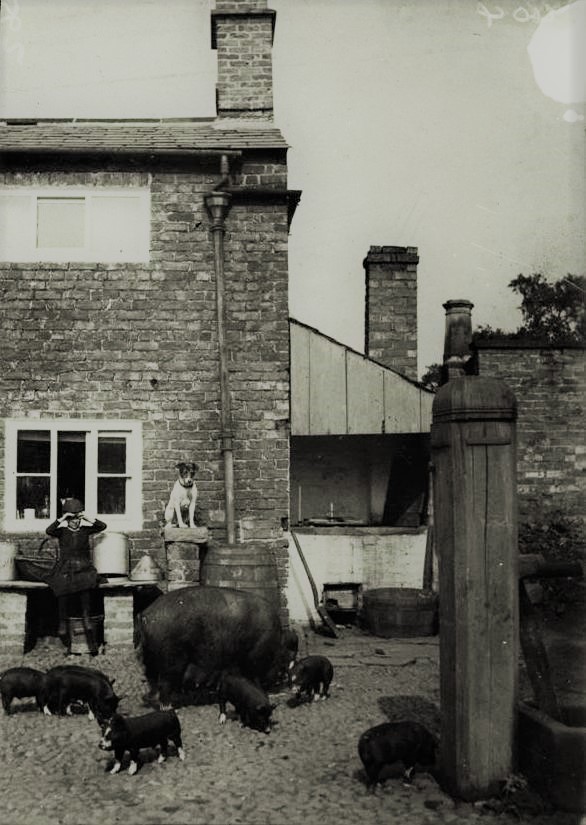
Hale Barns: House and yard at The Clough Farm, late 1890s
(Arnold H. Wolff)
Called Barrow House in the 1842 Hale Tithe Map, this farmhouse on the Harrop Estate, was located at the end of Barrow Lane, on the right-hand side. It was to the north of the grand house built in 1873 by Arnold Wolff’s father, Charles called The Clough, after which the farmhouse was renamed.
Water from the gutters is collected in a barrel for the use of the household and the farm.
To the right of the house is the copper, which had its water heated to boiling point from underneath, for the washing and whitening clothes and linen. What looks like the washing dolly for agitating the clothes is on top to the left.
A sow and pigs happily roam over the duck stones, overlooked warily by Arnold Harrop’s dog called Trap.
The hefty post to the right supports a water pump, with a stone trough to the right of it.
(From a glass negative by Arnold Harold Wolff)
Hale Barns: Storing corn at The Clough Farm, 1897
(Arnold H. Wolff)
Corn is being put into storage through the pitching eye of the barn at The Clough (formerly Barrow) Farm, at the end of Barrow Lane, to the south of Hale Barns village. Thrippers were added to the cart to the front and rear, so that more sheaves could be carried.
(From a glass negative by Arnold Harrop Wolff)
Hale Barns: Man on the threshold, with a cat, 1897
(Arnold H. Wolff)
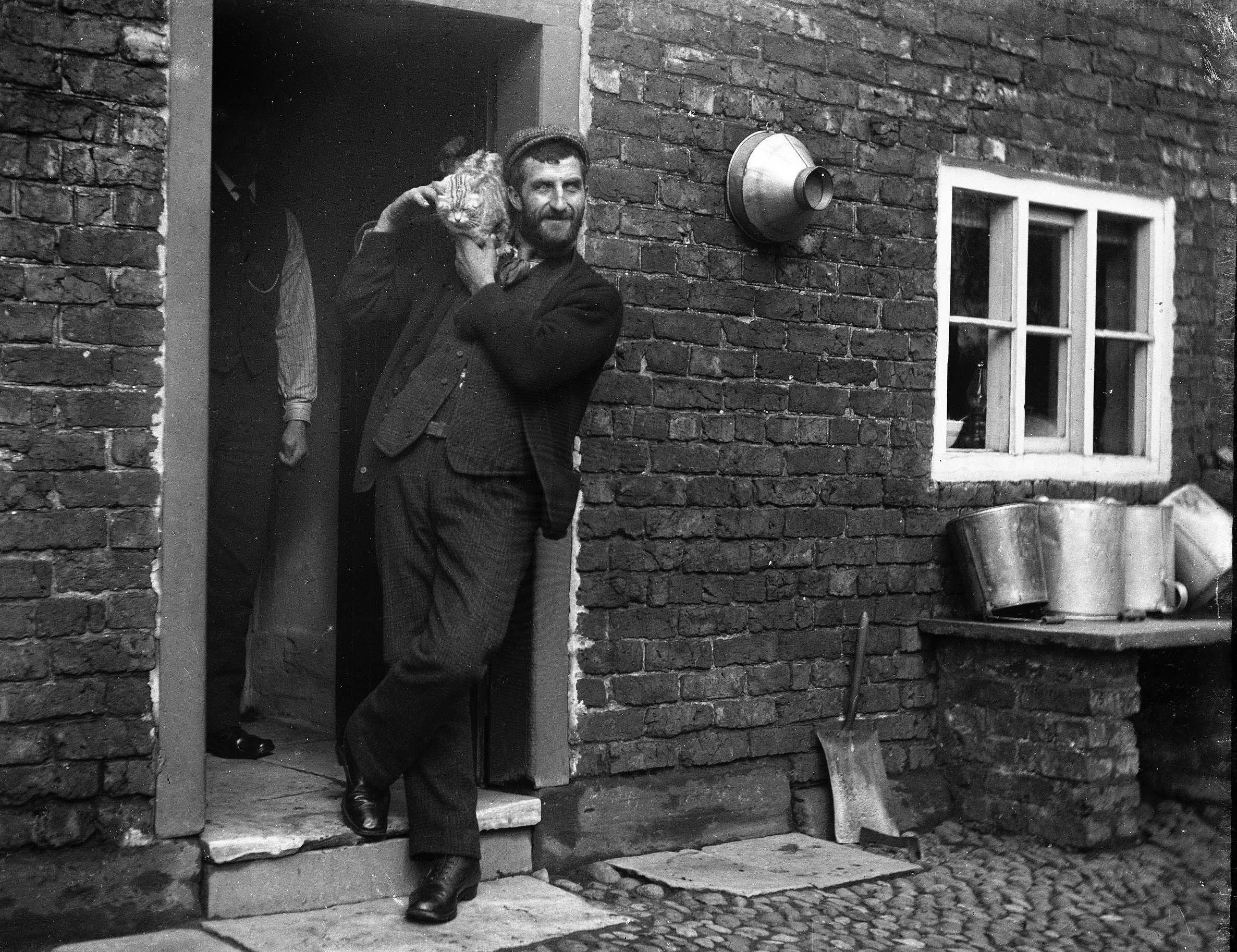
This was at the farmhouse at The Clough Farm, known as Barrow House before the 1870s. It was at the end of Barrow Lane.
Note the shovel for the coal hole to the right and also the foot scraper. The stone slab could have been used for slaughtering chickens. The metal ware is milk churns and lids, with a sieve hung on the wall.
(Digitisation of a glass negative by Arnold Harold Wolff)
Hale Barns: The Smithy, about 1898
(Arnold H. Wolff)
The Barker brothers blacksmiths found in the centre of Hale Barns, are kitted out with leather aprons preparing to shoe a cart horse. To the right are wooden cart wheels, needing a new iron banding to be heated, fixed and hammered and then cooled with water, to shrink it into place.
The replacement high quality smithy building and cottages, seen to the rear, had been built in 1883 by local M.P., landowner, barrister and banker Sir William Cunliffe Brooks. Acting as a grand patron to the area, he also planted trees on the Green. The buildings can still be seen today.
(From a glass negative by Arnold Harrop Wolff)
Hale Moss: Gypsy camp, mid-1890s
(Unknown)
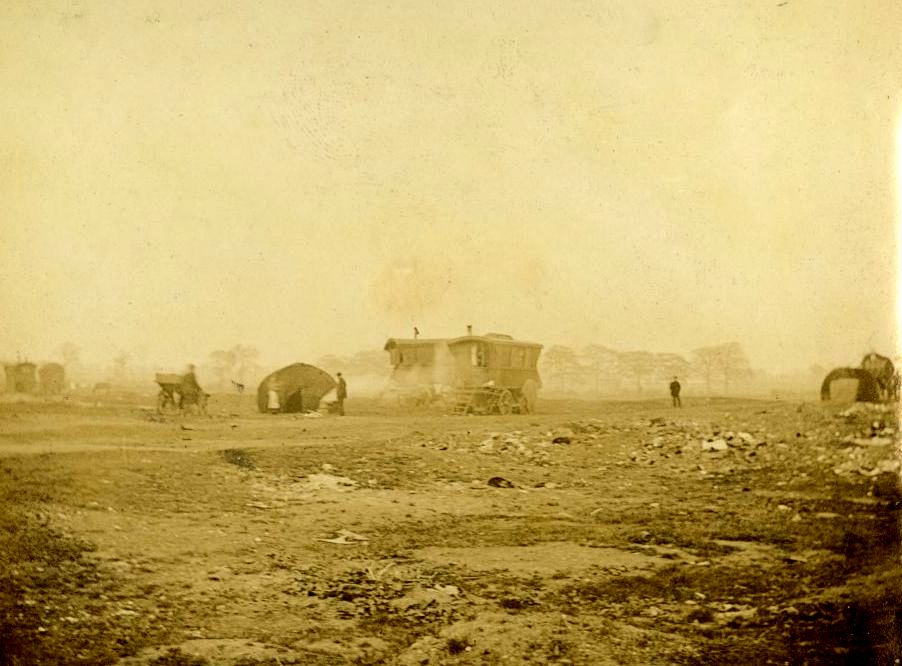
Hale Moss was a large area of common land, made boggy by springs and the water of the surrounding high ground, which used to drain into it. The vast area was used by local people for the grazing of animals and geese and collecting kindling and gorse for fuel. There were several brickworks and a gasworks, Horse racing and occasional circuses were also held on the land.
The Earl of Stamford tried to sell it off for housing development from the late 1840s but there was strong local opposition. Eventually from the 1880s, it was gradually developed by the Earl of Stamford for Stamford Park, extensive housing with gardens in tree-lined streets and light industry such as the Bannerman’s clothing factory.
In the mid-1890s, when this photograph was taken, large parts of Hale Moss still remained open land and continued to be used by travelling gypsies as a resting place.
(From the K. S. Whittaker Album)
Llanfairpwll, Anglesey: The Anglesey Column, early 1860s
(Helmuth Petschler)
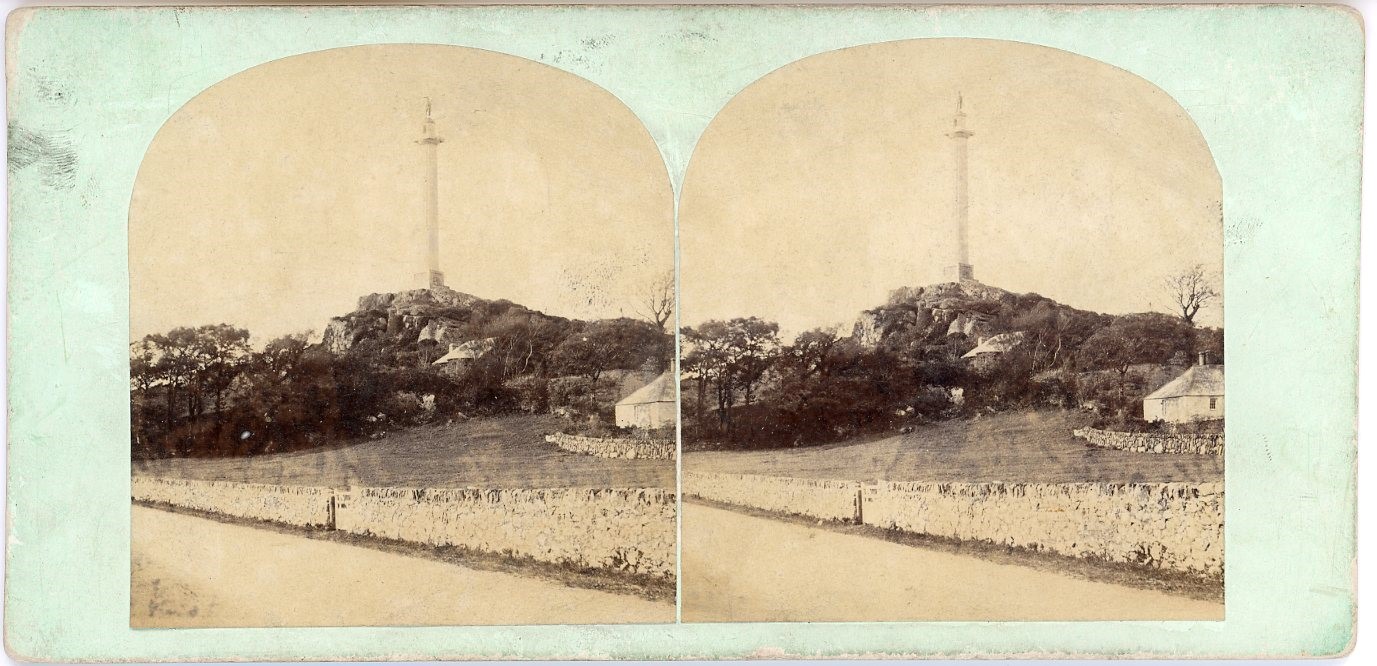
The Twr Marcwis monument is a Doric column made of limestone, built near the Menai Strait to honour Henry William Paget, the first Marquess of Anglesey. It commemorates his military achievements in the Napoleonic Wars. It was erected in 1816-17, close to his country house at Plas Newydd. The bronze figure was added in 1860, just before this photograph was taken.
The monument stands on an outcrop of blueschist rock which is amongst the oldest known in the world.
(Stereoview card by Helmuth Petschler, H. Petschler and Company)
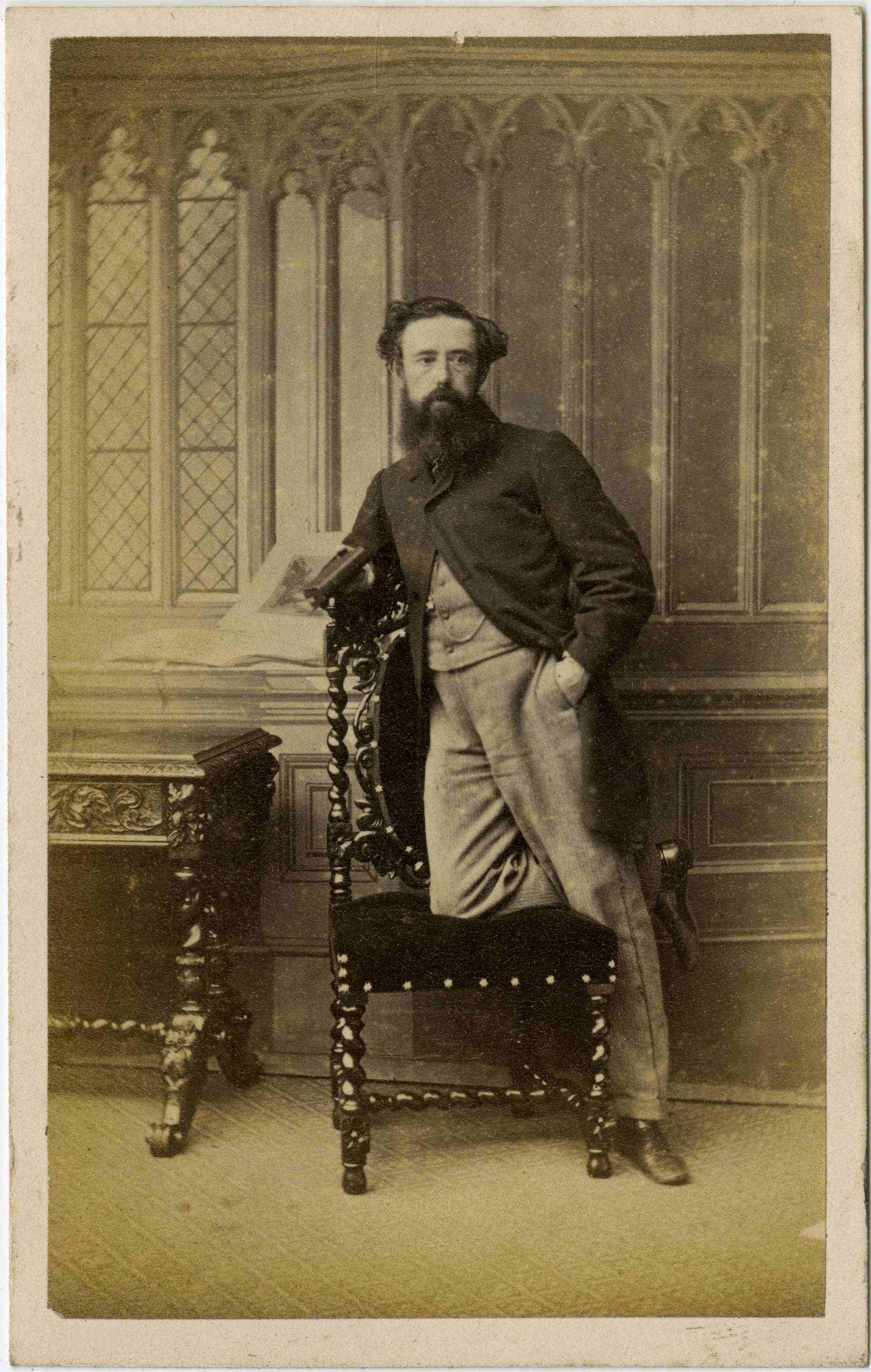
Manchester: Self-portrait photo of James Mudd, early 1860s
(James Mudd)
Whilst he was still a pattern designer for calico printers, James Mudd was a founder member of the innovative Manchester Photographic Society in 1855. He was very quick to see the practical benefits that the new medium would bring to industry and architecture and had set up a business by 1859, taking photographic copies of plans and drawings, as well as photographing in very high quality, manufactured goods such as steam engines. Artistic photography of romantic landscapes and ancient buildings was also his passion. An example can be seen in the background.
In 1862, he added a carte-de-visite studio to his 10 Saint Ann’s Square Studio, where this self-portrait was taken. He had moved to 1 Richmond Hill in Bowdon, by 1864 and lived there all his life.
(Carte-de-visite portrait by James Mudd)
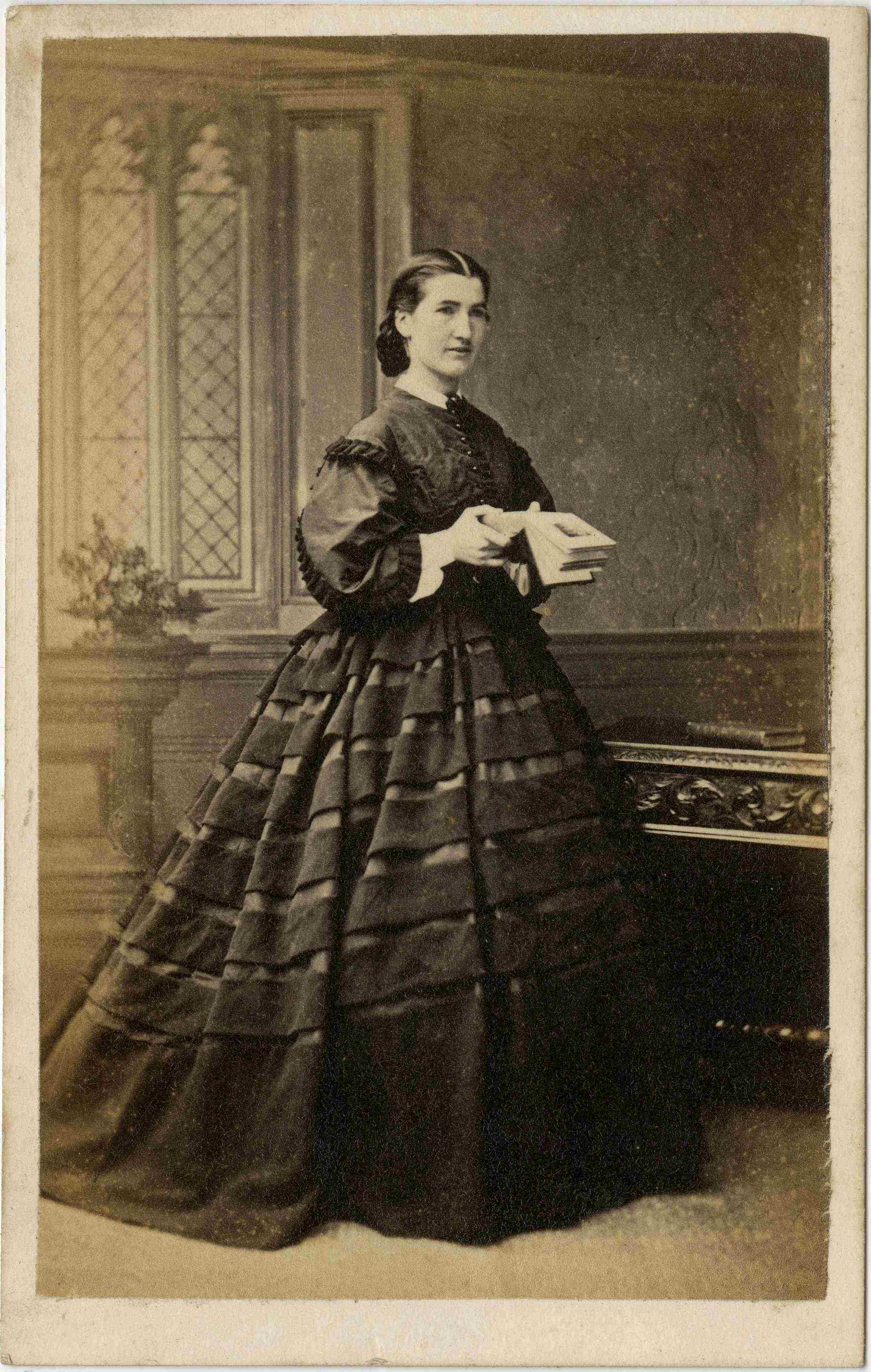
Manchester: Woman holding a photograph album, early 1860s
(James Mudd)
When James Mudd first started advertising the new branch to his studio for taking cartes-de-visite portraits in May 1862, he stated that, ‘Ladies are requested to dress in black silk or other dark-coloured materials.’ This woman wears the fashion of the time, being very full skirt worn over a cage crinoline, consisting of a petticoat over a frame of steel hoops. Her hair is centrally parted and smooth, with a bun at the back. She holds a photo album, a stock of which James Mudd held, along with photographic apparatus for professionals and amateurs.
(Carte-de-visite portrait by James Mudd)
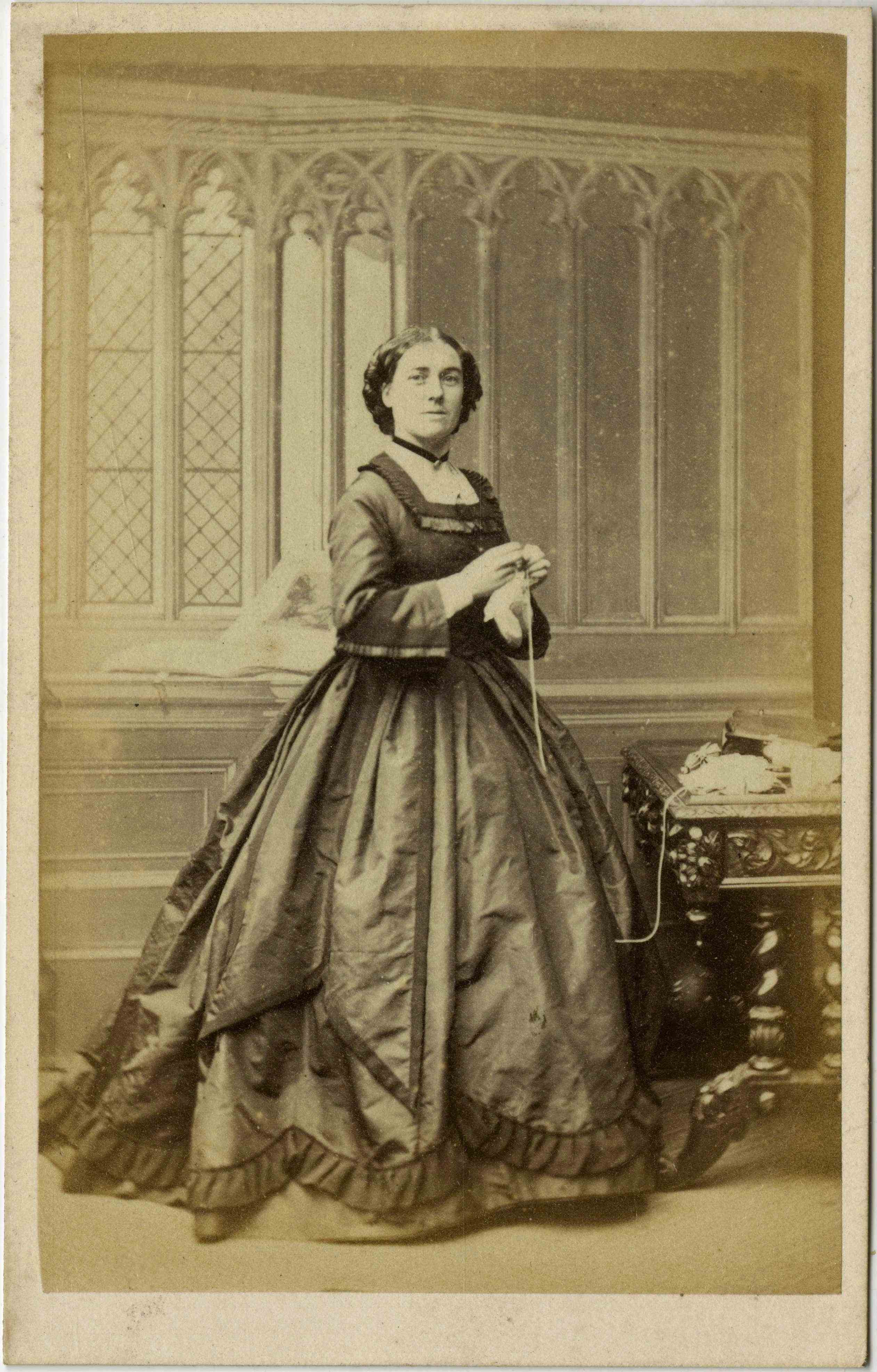
Manchester: Woman crocheting, early 1860s
(James Mudd)
The same background of gothic windows and panelling, with a heavily carved table, giving the impression of being in an ancient country house, was used in James Mudd’s self-portrait and the woman holding a photo album. The prop for this woman however, is her crocheting.
(Carte-de-visite portrait by James Mudd)
Manchester: Young girl with a metal hoop, late 1860s
(James Mudd)
This young girl with ringlets, wears an off-the shoulder dress, reflecting fashions of the time. The metal rolling hoop and stick are likely to be studio props. It was taken in the studio at 10 St Anne’s Square of James Mudd.
(Carte-de-visite by James Mudd)
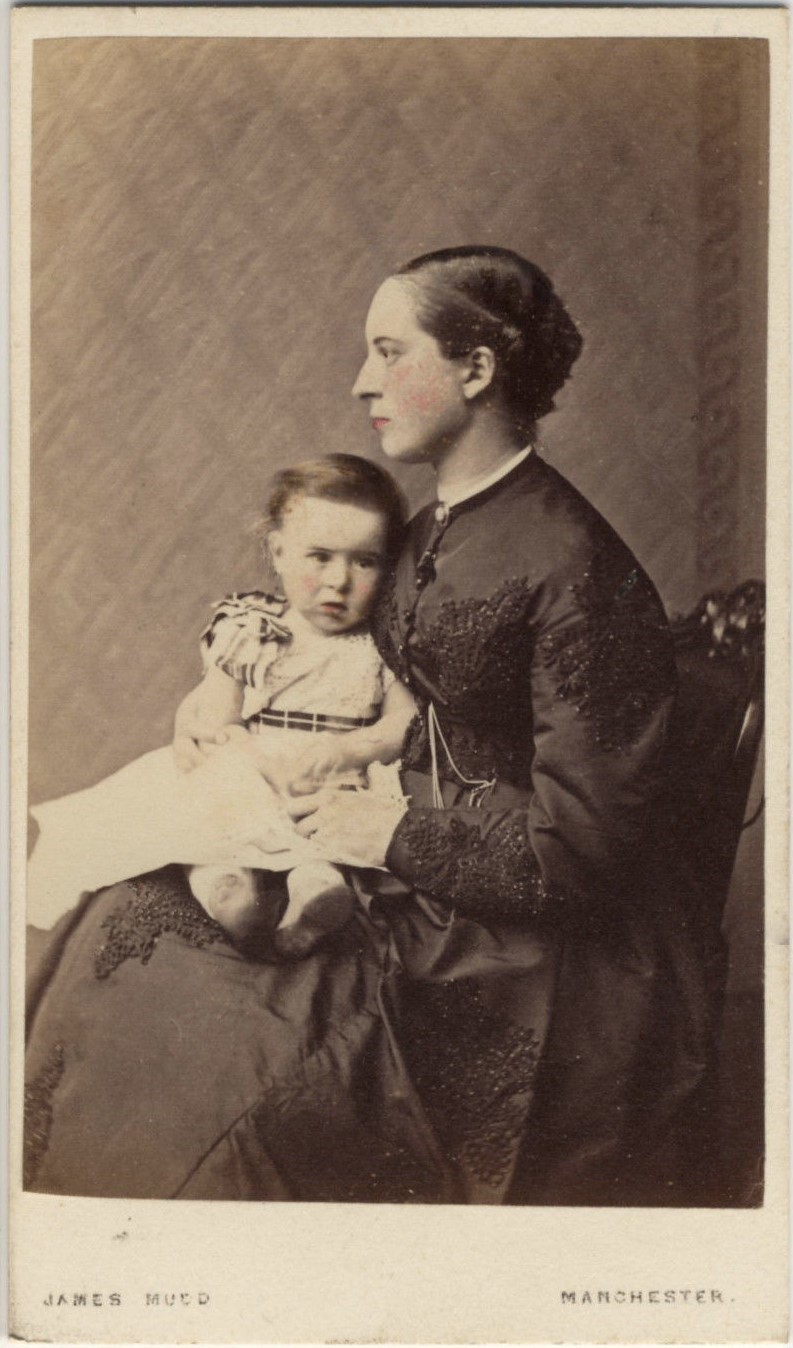
Manchester: A mother and her small child, late 1860s
(James Mudd)
This is an unusual profile shot of a woman, holding her young child. It is perhaps a mourning portrait, as the child’s outfit is trimmed in black. Both sitters have their lips and cheeks tinted in pink.
The back of the card has the engraving of the sun over waves with text woven into them, which was the trademark introduced by James Mudd in March 1865.
(Carte-de-visite by James Mudd)
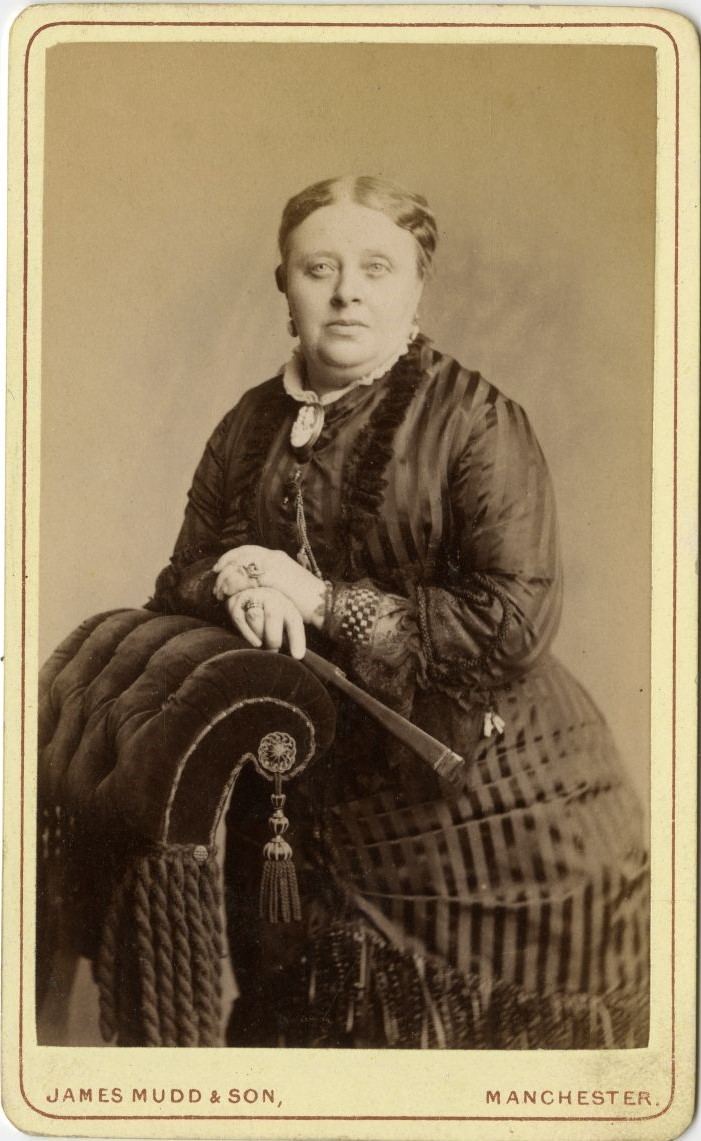
Manchester: Portly woman with a fan, early 1870s
(James Mudd)
Resplendent with her large cameo brooch and chunky finger rings, this woman’s head was kept still for the length of the exposure, by the posture stand, glimpsed behind her right ear. By the 1870s, the full length portrait had given way to three-quarter or half-length shots taken with a higher quality camera, with the closer-in view of the sitter showing more detail.
(Carte-de-visite portrait by James Mudd, James Mudd and Son)
Manchester: A mother and her three children, mid-1870s
(James Mudd and Son)
By 1871, when the larger cabinet card format had taken over from the carte-de-visite, James Mudd’s son of the same name had joined him the business at 10 Saint Ann’s Square. They both continued to live at 1 Richmond Hill, Bowdon, until their deaths.
In this group shot, the sitters are wearing outdoor clothing, with the females wearing leather gloves. The daughter to the left seems to have rummaged through the studio’s dressing up box, choosing to add an ermine shrug cape and over-sized, fur-trimmed hat. The mother also wears a cape, made of elaborately trimmed satin, which may have also been provided by the studio. The child to the right in plainer clothes, may have been a boy, not yet ‘breeched’. The elaborate fashion of both the mother and daughter shows that the fuller and simpler skirt of the 1860s, had given way to a slimmer overskirt decorated with ruching, with a heavily pleated underskirt. The mother is likely to have had a draped bustle to the rear.
The setting gives the impression of being in the grounds of a country house, with its painted backdrop of an arbour, picturesque studio props and loads of long grass.
The mother and older boy remained still and in focus, whereas the two younger children moved and so became out of focus.
(Cabinet card by James Mudd, James Mudd and Son)
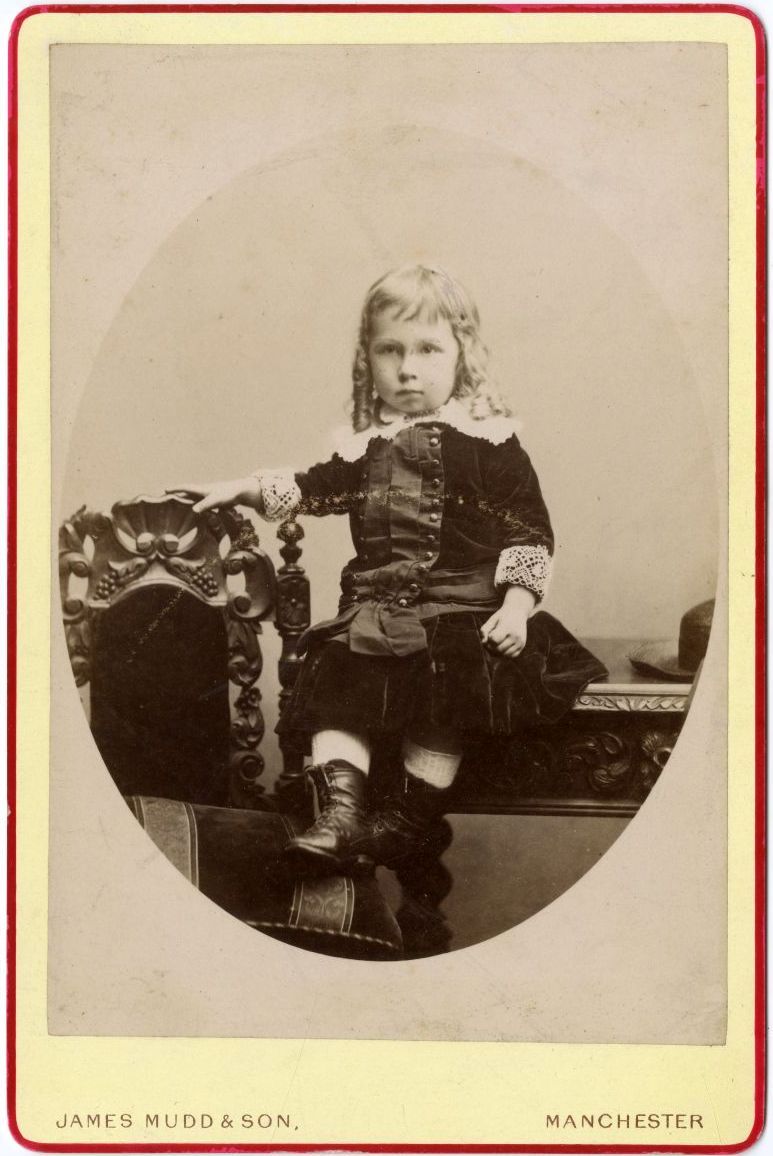
Manchester: Unbreeched boy, 1870s
(James Mudd and Son)
This photograph shows an ‘unbreeched’ toddler perched on the portrait studio furniture. He sports ringlets and a velvet and satin dress trimmed with lace. However, his hair has a fringe and the neckline of the dress is high, which indicates this is a boy rather than a girl. Dresses were worn for toilet training purposes and also to allow for growth. By this time, it would be at the age of around 3 that boys would progress to long shorts before moving on to long trousers.
James Mudd junior joined his father in the business in the 1870s.
(Cabinet photo by James Mudd and Son)
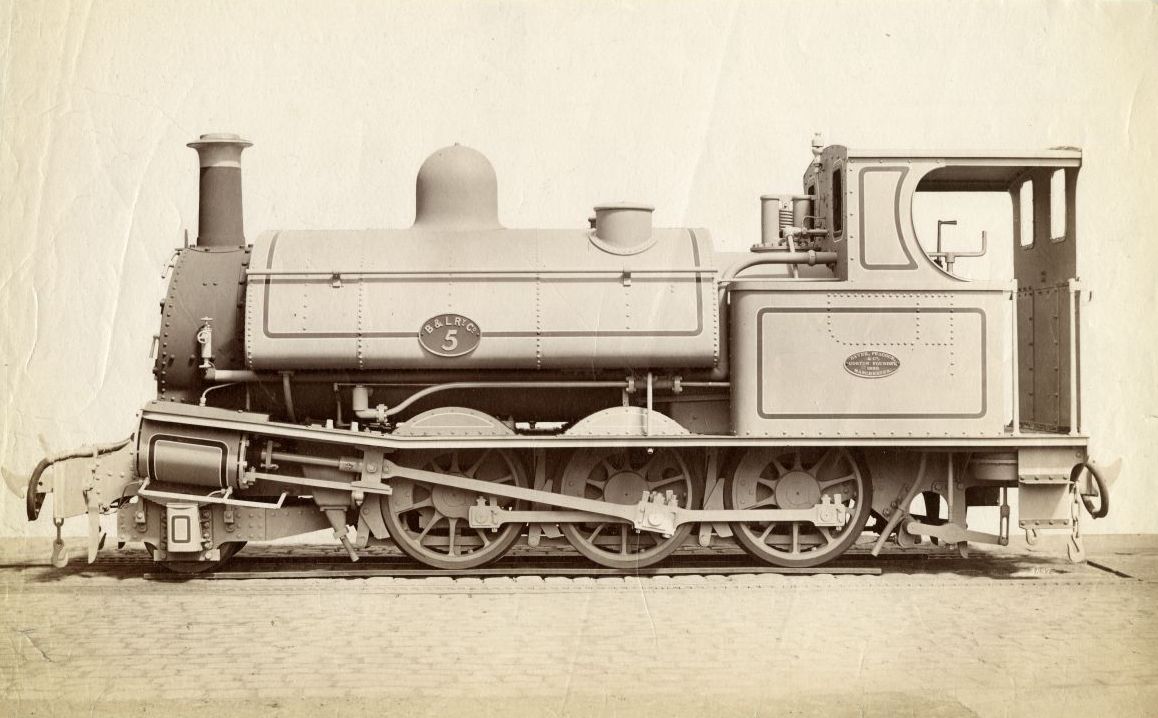
Manchester (Gorton): Bolton and Leigh Railway Company’s steam locomotive no. 5
(James Mudd)
The Bolton and Leigh Railway (B & L) is thought to be the first public railway used in Lancashire. It was built as a mineral line to link the coal pits belonging to William Hulton west of his estate at Over Hulton and the Fletcher collieries at Atherton. It opened in 1828.
This engine was built in 1880 by Beyer, Peacock and Company. From 1854 until it closed in 1966, the company built over 8,000 locomotives at is Gorton foundry. Entering the business of trade photography in the early 1860s, James Mudd was regularly commissioned to photograph the engines before they were sent away to the customer.
(Albumen print by James Mudd)
Manchester: Self-portrait by Helmuth Petschler, 1863
(Helmuth Petschler)
The members of the innovative Manchester Photographic Society founded in 1855, created a set of carte-de-visite portraits of themselves for an album.
In this one, there is a photo of a woman on the table who could well be Helmuth Petschler’s wife and fellow photographer, Alice Hadfield Petschler (nee Bennett). After the couple moved out of Manchester to Altrincham in 1869, Helmuth died soon afterwards. Alice continued her husband’s photographic business, only to be put in Parkside pauper lunatic asylum in 1871 by her sister, who considered the work unsuitable for a woman.
(Carte-de-visite by Helmuth Petsclher, held by Manchester Libraries, Information and Archives, Manchester City Council)
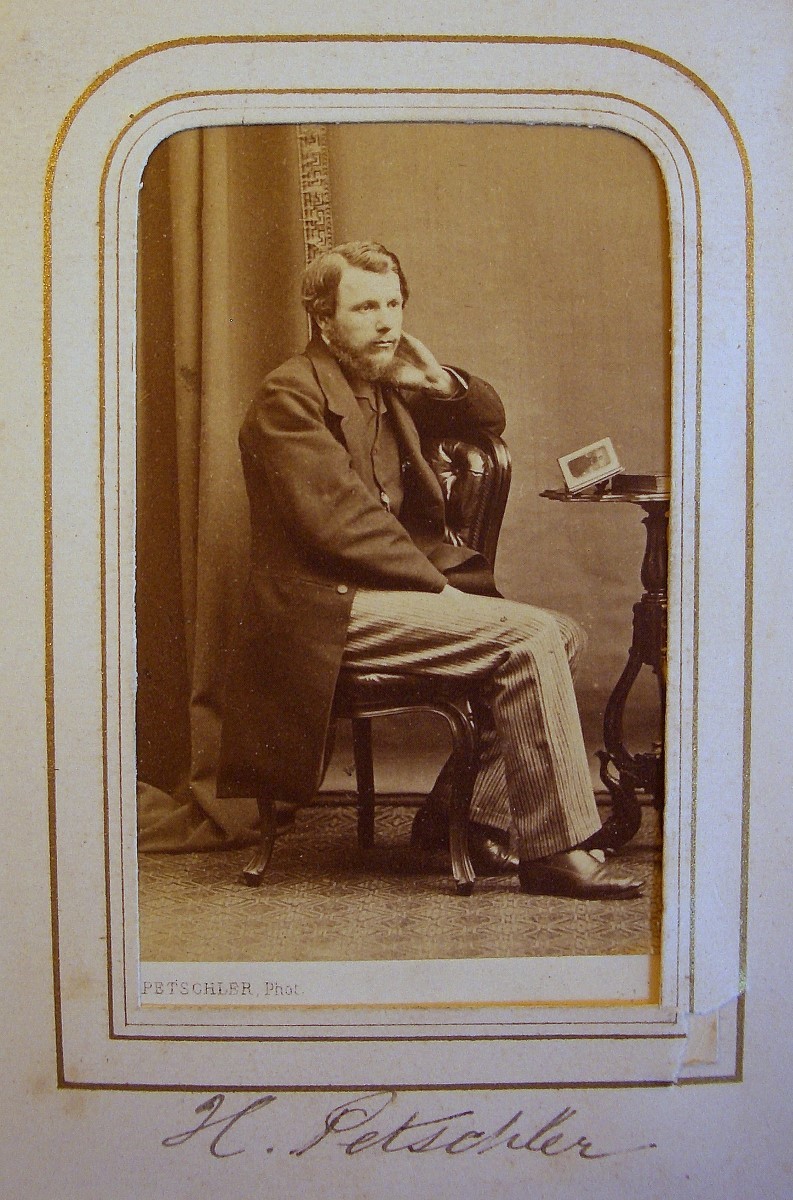
Manchester: Man with a boy, early 1860s
(Helmuth Petschler)
This is another carte-de-visite portrait by Helmuth Petschler taken in the early 1860s. As with many 19th century photographs, the identity and relationship of the sitters is unknown.
Like other examples of his work, the background and props are modest and in this case, the curtain in the background poorly arranged. Helmuth Petschler’s travelled extensively in England, Wales and Ireland taking artistic photographs of landscapes and buildings. It seems that this is where his interests and talents really lay.
(Carte-de-visite by Helmuth Petschler, H. Petschler & Company)
Manchester: Lady sat upon a chair, early 1860s
(Helmuth Petschler)
Operating as H. Petschler and Company, German-born Helmuth Petschler, took carte de visite portraits at a cost of 20 for 20 shillings in his newly constructed gallery at 84 Market Street in Manchester from 1862. He was aided by his wife Alice, descended from the entrepreneurial Bennett and Hadfield manufacturing families of Glossop.
Unlike the painted canvas backdrops with elaborate furniture and props, which were provided by his fellow professional photographer James Mudd, the background here is a simple roll of paper, the bottom of which can be partly seen behind the sitter, because she is off-centre of the photo.
(Carte de visite by Helmuth Petschler, H. Petschler & Company)
Manchester: The Assize Courts, mid-1860s
(Helmuth Petschler)
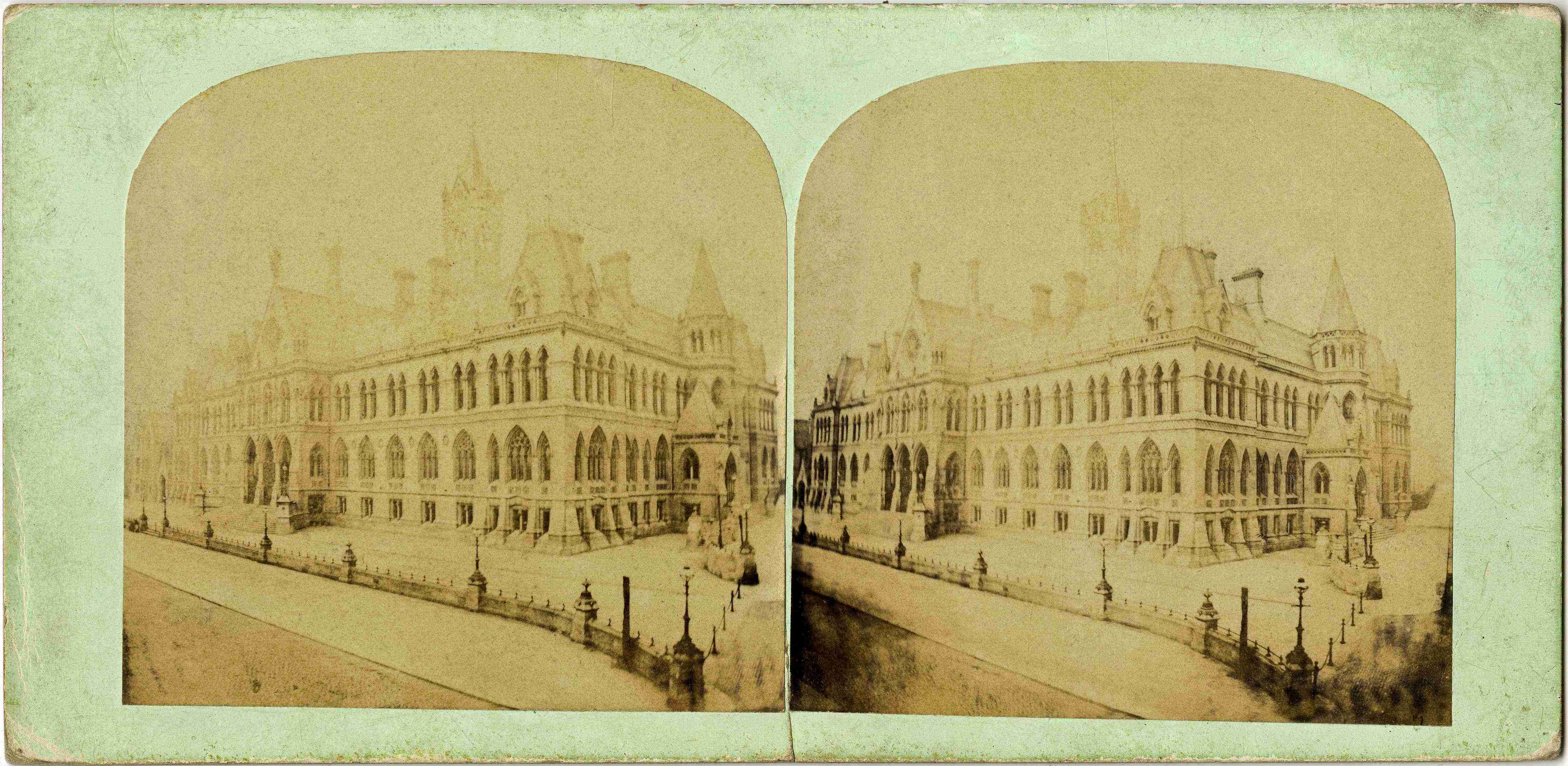
This imposing building on Great Dulcie Street, housed the law courts. The Builder described it as the most important building outside of Whitehall. After winning a competition held in 1858, Alfred Waterhouse designed it in an eclectic style between Early English and Decorated, with some florid Venetian elements. Despite its backward looking style, the building was celebrated for being spacious and well laid out, as well as being full of light and well ventilated, via the shaft, in the form of a campanile. It was completed in 1864 and Helmuth Petschler captured it the year afterwards on a set of stereoview cards. The building was damaged during the Manchester Blitz of 1940 and 1941 and it was demolished in 1957, after the abolition of the assize court.
(Stereoview card by Helmuth Petschler, Manchester Photographic Company Limited)
Manchester: Entrance to the Assize Courts, mid-1860s
(Helmuth Petschler)
This was the main entrance to the assize courts reached by 28 steps in two flights, covered in part by the triple-width and spacious entrance porch. It meant that the up to 800 people who were in the building at any one time, could pass freely. The shafts of the columns were made of Dalbeattie grey granite, on massive bases with capitals consisting of decorative foliage. The carving externally was by Messrs O’Shea and Whelan.
Above the porch were eight life sized statues of English lawgivers, such as Alfred the Great, Edward the First, Henry the Second and Sir Thomas More. Sculptor Thomas Woolner won the tender in 1862 and commenced work in his studio April 1863. It can be seen in this photograph, that there is a statue of a bearded king holding a sword but that other niches are yet to be filled.
In June 1864, there was a strike of bricklayers, joiners and labourers working on the building. In order for it to be ready on the fixed opening of the assize, other workmen were bought in from a distance. Because the striking union men ‘molested and threatened the newcomers’, they had to sleep in the building, which they could not leave. Extra policemen and constables were brought in for the entrances and area generally.
(Detail from a Stereoview card by Helmuth Petschler, Manchester Photographic Company Limited)
Nant Ffrancon, near Bethesda: The Falls of The Ogwen, early 1860s
(Helmuth Petschler)
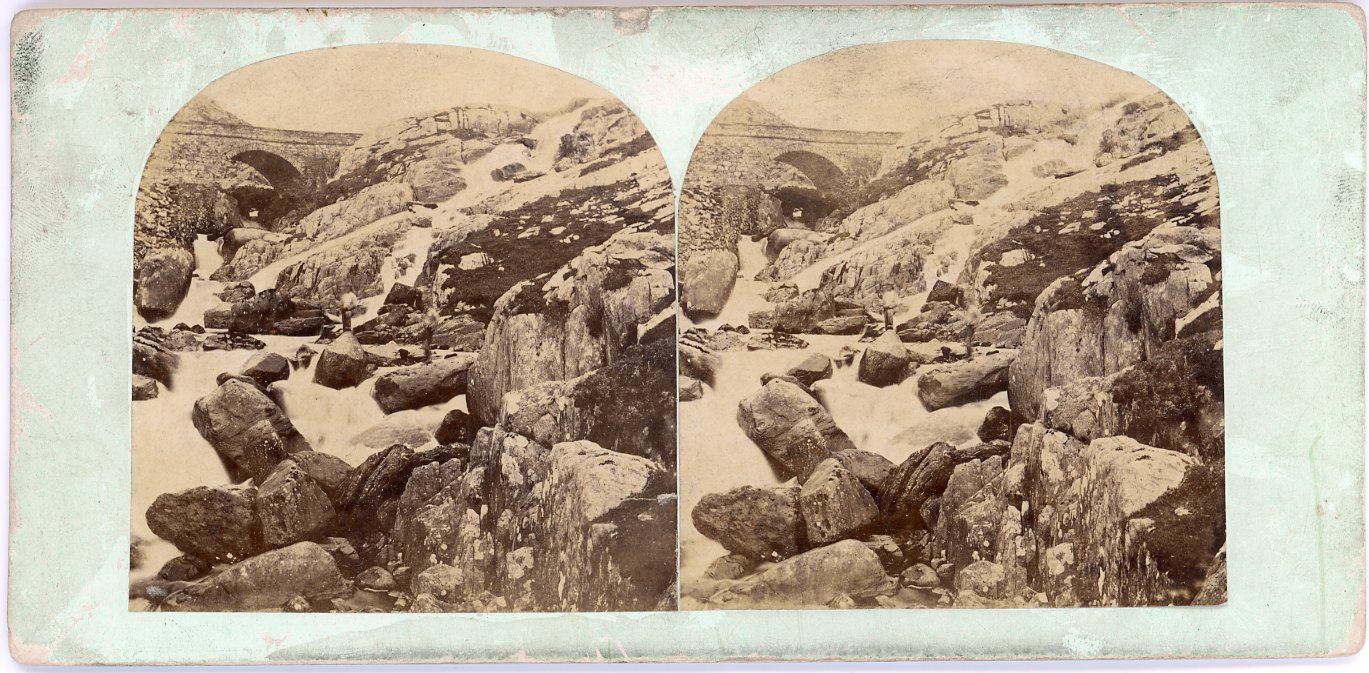
Helmuth Petschler’s photographs of picturesque landscapes, rustic features and buildings of the north of England, Wales and Ireland were used extensively on the company’s stereoscopic views, cartes de visite and prints.
Known in Welsh as Rhaeadr Ogwen, these dramatic falls are where the Ogwen River emerges from Llyn Ogwen, at the head of the rugged glacial valley of Nant Francon. Note the two men perched precariously on the rocks. The scenic river eventually reaches the sea at the Menai Strait to the east of Bangor.
This is still a popular subject for photographers today, with the stone arched Pont Pen-y-benglog providing a backdrop.
(Stereoview card by Helmuth Petschler, H. Petschler and Company)
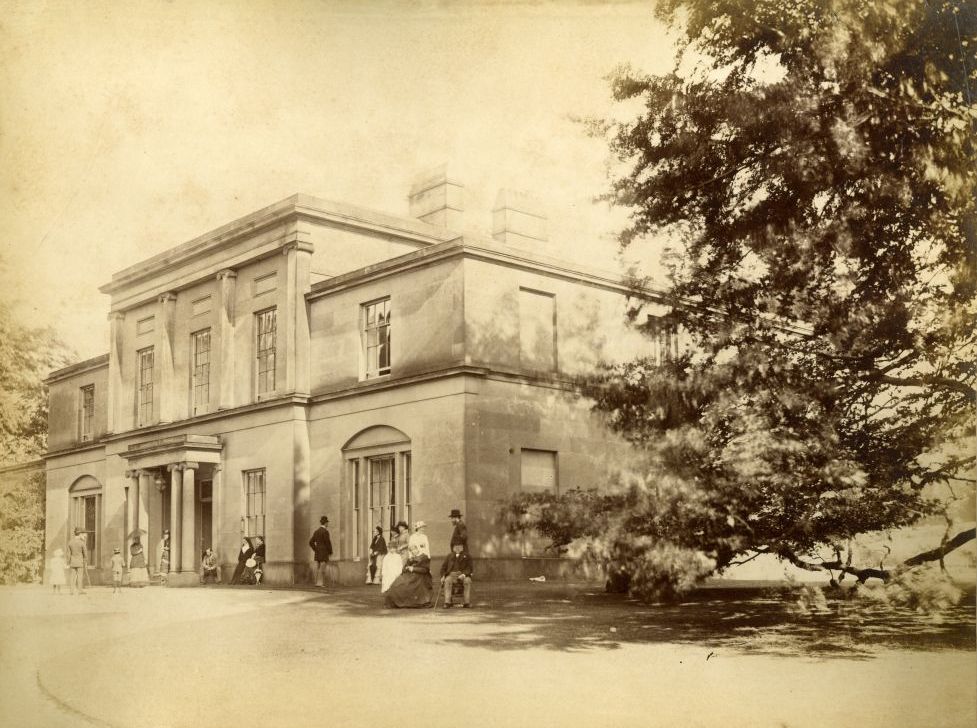
Oldfield: Oldfield Hall at the time of the Allen family, 5th June 1883
(Unknown)
This is one of a set of photographs taken of Oldfield Hall with the then residents, retired Manchester silk merchant John Allen J.P. and his wife Ellen, with their large family who were visiting.
The previous occupant was barrister, Magistrate and local benefactor Edward Jeremiah Lloyd Esquire and his wife Elizabeth, daughter of the previous owner William Rigby, High Sheriff of Cheshire in 1801. He had rebuilt the 17th century country house in stone in around 1815. Widowed in 1850, Elizabeth Lloyd stayed on at the Hall until her death in 1859. John Allen and his wife took it on in 1860.
John Allen died in 1892 and the next owner was the brewer, James Grimble Groves, Mayor of Altrincham 1897-8 and Conservative M.P. for Salford South in 1900-6. He departed the Hall because of the rapid industrialisation at Broadheath, which was moving closer to what had once been a country house.
The Hall was handed over for demolition by the ‘house-breakers’ in 1915, after remaining empty for several years. In 1917, the land was bought by wealthy cotton mill owner John Leigh who donated it to the District Council to be kept ‘as an open space forever’. It was named after him and became the tranquil and undulating green space with mature trees, that it still is today. The Friends of John Leigh Park have written a fascinating booklet on the history of the hall and its occupants.
(Unknown photographer)
Oldfield: John Allen and his family at Oldfield Hall, 5th June 1883
(Unknown)
Retired silk merchant John Allen is at the centre with a top hat and his wife Ellen is to his left. They are joined by their family.
John Allen at first worked with his father who was a silk merchant but at the early age of 22, he started his own business as a silk broker in York Street in Manchester. He later became a silk merchant based for many years at 79 King Street. He was a Police Commissioner before the Incorporation and an ardent supporter of the old Whig and later Conservative Party. In 1869, John Allen had the honour of being elected a Feoffee of Chetham’s College and Library. He took a special interest in the restoration of Chetham’s Chapel and the tower of the Cathedral.
His wife Ellen, was the daughter of Bulkeley Price, Bouroughreeve of Manchester in 1829-30.
For the 1841 Census, the family were living at ‘Beach’ in Lytham, Lancashire but by the time of the 1851 Census, they were in a large house in Wilton Polygon, Crumpsall Hill in Manchester. They moved to Oldfield Hall in 1860, with some of their adult children. For the Census in 1881, the family had left home leaving John and Ellen with a household of servants described as a butler, footman, cook, two housemaids, kitchen maid and a dairymaid.
(Unknown photographer)
Oldfield: John Allen and his family at Oldfield Hall, 5th June 1883
(Unknown)
For this shot of the family, some of the grandchildren had joined the group but the blurring showed that they were not willing to still for very long during the exposure of the photographic plate. A young woman in a more modest and pale dress has also joined the party and was perhaps the children’s governess.
(Photographer unknown)
Oldfield: John Allen and his family in the grounds of Oldfield Hall, 5th June 1883
(Unknown)
The family took to the long bench in the extensive grounds of Oldfield Hall for another photograph.
It is likely that the Allen’s daughter Catherine, who was a Sister of Mercy, is the seated nun in the photo.
The Allen’s sons, the Reverend Dr John Allen, D.D. Vicar of Lancaster; Bulkeley Allen J.P. , retired silk merchant and gentleman living at West Lynn on the Dunham Road in Dunham Massey and Vernon Allen, also a merchant and gentleman who had moved away from the area, are also likely to be there. They were executors to John Allen’s Will, after he died in 1892 aged 86 at Oldfield Hall. His Estate was worth £351,376 8s 3d. Two large, memorial windows to him were installed by his son Bulkeley in nearby St Margaret’s Church but he is buried with his wife Ellen who died in 1888, in Bowdon Churchyard.
Note the extensive pleats and flounces of the skirts of three of the women, the height of fashion at this time.
(Photographer unknown)
Ringway: Ringway pub, pond and church, 12th May 1892
(Unknown)
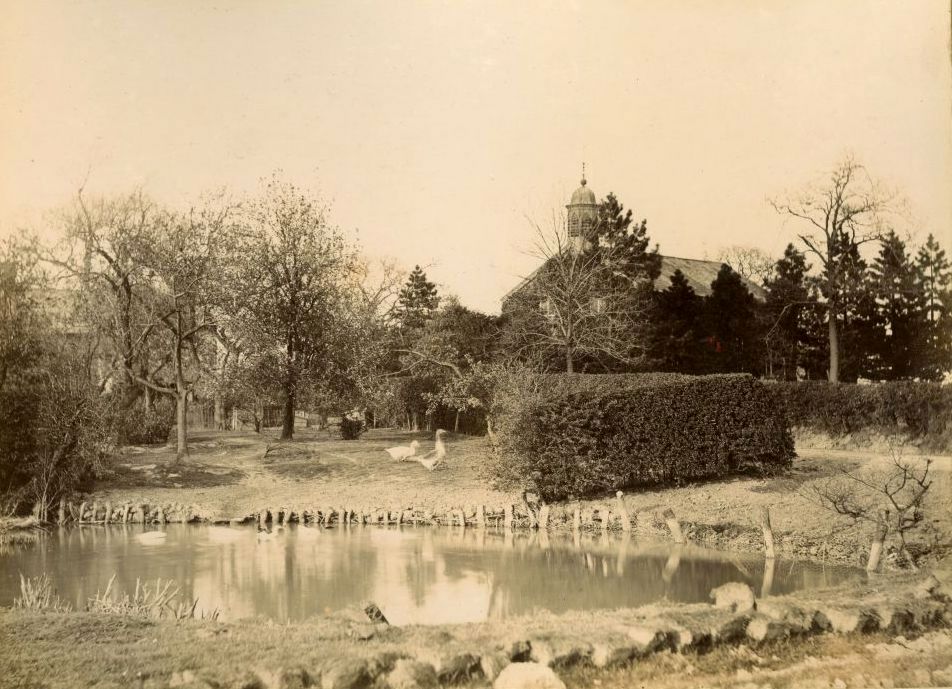
To the left behind the trees is the Red Lion pub, later known as The Romper either because it was a lion ‘rampant’ or else because a depiction of a very tame lion on the pub sign who looked more like a ‘romping’ kitten.
To the right is Ringway church built soon after 1723, when its predecessor, a Chapel of Ease to Bowdon Church, was demolished. In 1863, it became a Church in its own right for the new Parish of Ringway, known as All Saints. This building in turn was demolished two years after this photograph was taken and replaced with the brick building which still stands today. The latter was deconsecrated in 1970 when a new Church was built in Hale Barns. It was restored in 1997.
This calm and rural scene was situated by the original main road between Hale Barns and Wilmslow. Today the area is adjacent to the vast Manchester Airport complex.
(Unknown photographer, Album of 1890s Photographs)
Rostherne Mere: The Boat House, mid-1860s
(Helmuth Petschler)
Rostherne Mere is the largest natural lake in Cheshire, filling a great hollow. It is very deep in places and drains into the Bollin River, which flows to the Mersey. This photo recorded a winter walk with a view of one of two boat houses, just north of Rostherne Parish church. It is one of several stock photos taken by Helmuth Petschler of the Rostherne, Dunham and Bowdon area popular with walkers, for use as stereoviews or lantern slides.
(Stock photograph by Helmuth Petschler, Manchester Photographic Company Limited)
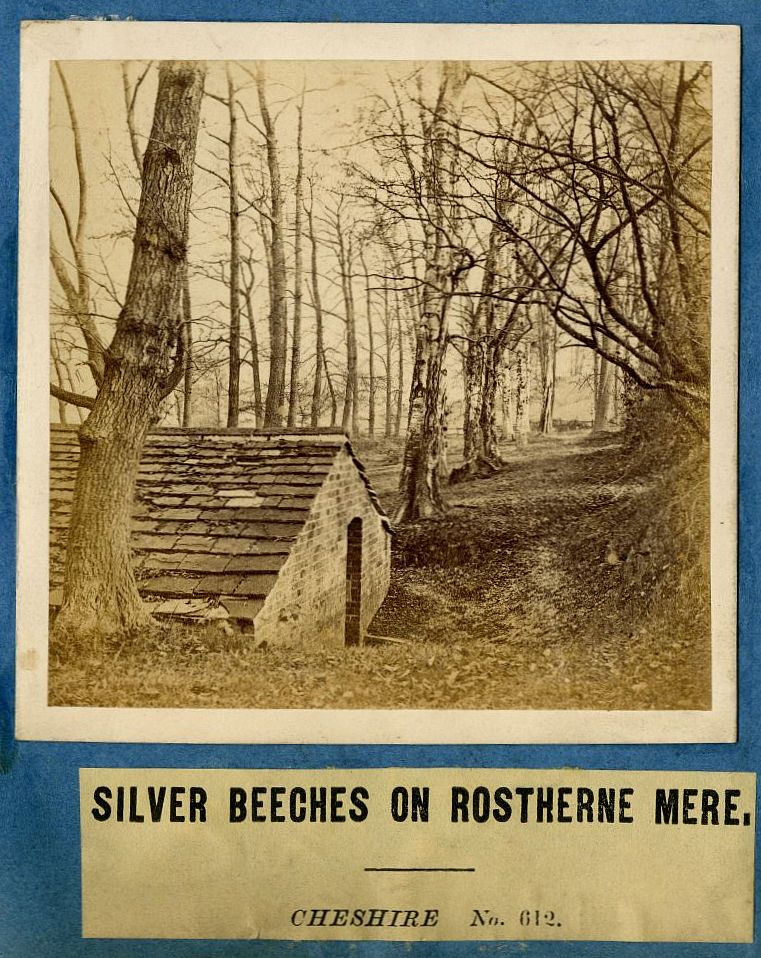
Rostherne: Silver Beeches on Rostherne Mere, mid-1860s
(Helmuth Petschler)
This was the title given to the photograph by Petschler who appreciated the beauty of the silver beech trees on this path. The ancient boathouse, with is graduated stone tiles, was one of those on the south of Rostherne Mere, just north of the parish church.
This is one of many photographs featured in Helmuth Petschler’s company’s stock book, which were in a square format suitable for stereoviews and slides. He also sold the stereoviewers, carte de visite albums and photographic apparatus for both professionals and amateurs.
(Stock photograph by Helmuth Petschler, Manchester Photographic Company Limited)
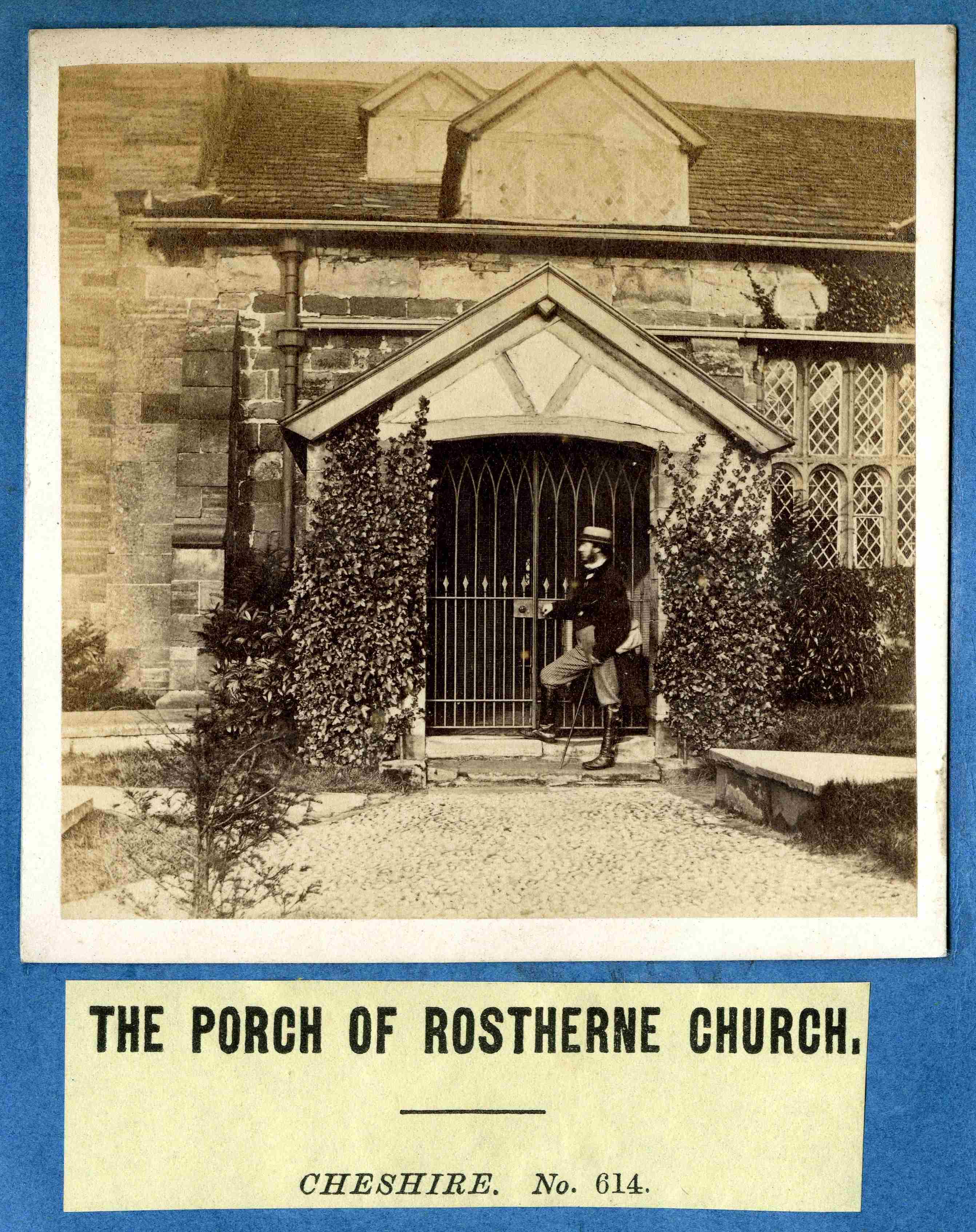
Rostherne: The church porch, mid-1860s
(Helmuth Petschler)
Rostherne, with its picturesque and ancient sandstone church overlooking the tranquil Mere, became part of the walking circuit for visitors to the Altrincham, Bowdon and Dunham Park area. They arrived first by canal boat, then by train, tram and bus. It later formed part of a popular cycling circuit.
This photograph shows the church to have had even more dormers in the roof, than the current single upper row. Helmuth Petschler may be the gentleman standing at the entrance, with the camera operated by his wife Alice, who sometimes accompanied him on some of his photographic excursions.
(Stock photograph by Helmuth Petschler, Manchester Photographic Company)
Rostherne: Church of Saint Mary’s, 6th May 1891
(Unknown)
The sandstone church of Saint Mary’s at Rostherne seen in the distance, dates from 1640. However, it is the succession of shrubs and silhouettes of trees leading the eye into the distance, that seems to have captured the eye of this unknown photographer.
(Unknown Photographer, Album of 1890s Photographs)
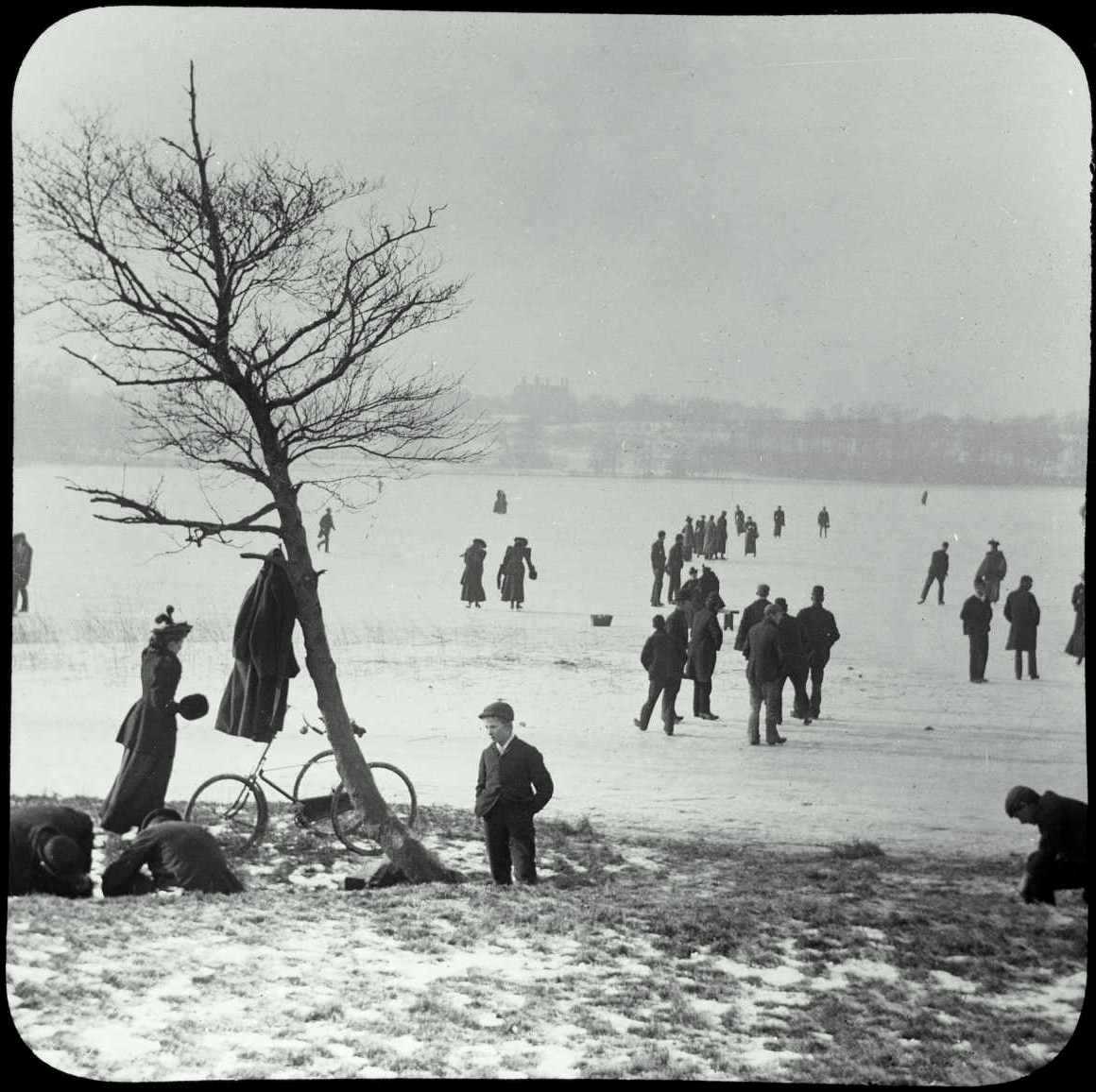
Rostherne Mere: Skating, 1895
(Unknown)
The ‘Great Freeze’ of 1895 saw the sea at Blackpool freeze and ice floes on the Mersey River. Rostherne Mere became a skating rink for locals and visitors. Note that one of the skaters arrived there by tricycle.
(Lantern slide by an unknown photographer)
Photographers of the 19th century living in the Altrincham Area
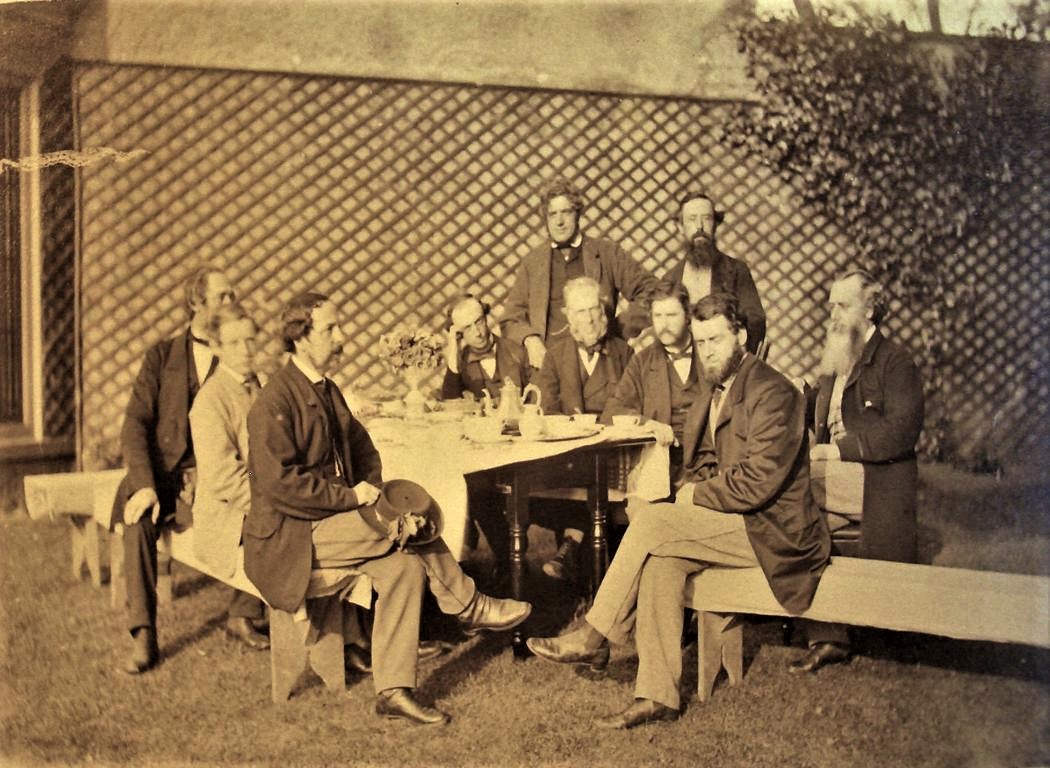
Outing of the pioneering Manchester Photographic Society, of which local residents James Mudd, Joseph Sidebotham and Helmuth Petschler were members.
The most successful member of the Manchester Photographic Society was professional photographer and artist, James Mudd senior (1821 – 1910*). By 1864, he was living as a widower at 1 Richmond Hill (now Richmond Road), with his son James Mudd junior (1848 – 1912) and other family members. They were there until their deaths and buried in nearby Bowdon churchyard.
Previously a designer to calico printers, along with his brother Robert, by 1859 James Mudd senior had moved his photographic studio and photographic apparatus shop from 94 Cross Street to Wilton Chambers at 10 Saint Ann’s Square in Manchester. He advertised himself as a photographer of houses, ‘‘manufactories’’, machinery, landscapes, architecture and monuments. His trade photography, which included hundreds of locomotives, was of extremely high quality and printed large scale. The landscape photographs, especially romantic ruins and wild areas of Wales, were also large, making them works of art to be framed.
A service was provided to copy paintings and architectural or mechanical drawings and he also gave instruction and lectures for amateurs, which included topics such as the artistic arrangement of photographic landscapes.
In addition, the business sold the apparatus and chemicals for photography. Working with others in the Manchester Photographic Society founded in 1855, James Mudd worked endlessly on experimental techniques of photography, making improvements to outdoor methods and the quality of the prints.
In 1860, the carte de visite portrait format was introduced from France, whereby multiple prints could be made and pasted onto small cards. These were shared and swapped with friends and family and collected in albums, which the photographers also sold. In 1862, James Mudd added a branch in his studio for cartes de visite and other portraits. At first the backs of the cards were had his name and address in simple type but in 1865 he introduced his distinctive trademark of a sunset over the waves. By 1871, having moved onto the larger format of cabinet cards, he was joined in his high-quality portrait studio by his son, James. His name was added to the trademark, along with several medals the company had won in exhibitions for both pictorial landscapes and trade photographs. The studio bore the Mudd name until the early 1900s. In later life, James Mudd senior painted oils and large watercolours of atmospheric landscapes, coastal scenes and historic buildings, showing nature in her many moods.
From 1867, calico printer, naturalist and polymath Joseph Sidebotham (1824 – 1885) lived with his family at The Beeches on Woodville Road, at that time in Dunham Massey. By 1879, they had moved to the grand stone mansion called Erlesdene on Green Walk, Bowdon. Although he described himself as ‘‘an amateur photographer’’, he was a founder member of the Manchester Photographic Society and worked with his friend James Mudd, experimenting extensively with the Calotype and collodion-albumen processes, making improvements to both. Like Mudd, he took and exhibited large ‘‘pictorial’’ photographs of ruins and landscapes but also recorded informal family life at home and on holiday, with the simple prints made in his workshop and pasted into a ‘Family Diary’. Joseph died in 1885 and he and his family are buried in Bowdon churchyard. For more information see the book on Saint Anne’s Home, formerly The Beeches, on the Local History Publications page.
Helmuth Petschler (1831 – 1869) was born into the successful family of goldsmiths of Neubrandenburg in Mecklenburg, Germany. In 1854, he married Glossop-born Alice Hadfield Petschler (nee Bennett) (1830 – 1897) and had his first photographic apparatus and materials business in Manchester. Like Mudd and Sidebotham, Helmuth was also a member of the prominent Manchester Photographic Society. Starting off in business by the early 1860s with Benjamin Consterdine as a photographic printers and warehousemen, by 1862 Helmuth had set up on his own undertaking topographical photography, especially in the form of stereoviews, slides and cartes de viste. Photographic copies of paintings as souvenirs, such as those found in Alton Towers, were also created. Simple portraits taken in the studio at 82 and 84 Market Street, Manchester supplemented the couple’s income. Photographic apparatus, prepared plates for photographic tourists and chemicals were also sold.
Helmuth formed the Manchester Photographic Company in January 1865 but by November 1866, it had failed. The next year, the business with its ‘‘shop, gallery and printing room’’ and large collection of carte and stereo negatives taken from ‘‘almost all parts of the country’’, was put up for sale.
Helmuth’s health was failing and in 1869, the couple moved out of the Manchester area to 28 The Downs, Altrincham. Upon the untimely death of her husband later that year aged 38, as a widowed mother of three daughters, Alice continued the photographic business and planned a move to 1 Osborne Place (behind 28 The Downs), during the second half of 1871.
However, in November 1871, Alice’s mental health had deteriorated, and she was scandalously tricked into entering the newly built Cheshire County Asylum for pauper lunatics called Park Side, in Macclesfield. This was arranged by her sister Harriet Cuffley, who lived nearby in Dunham Massey at North Bank on Saint John’s Road. It was said to be because she considered Alice’s work as a woman in the trade of photography as inappropriate. Her photographic equipment, furniture and some of Helmuth’s scenery negatives, which she had retained, were all sold off. Alice was released 10 months later and in 1873, a newspaper campaign by influential well-wishers, declaring that she was neither a pauper nor a lunatic, eventually went on to inform and change the Lunacy Laws. Alice was buried with her husband Helmuth, in Bowdon Churchyard. See the short biography of the Petschlers, which is one of the fascinating Grave Tales and the book on Alice Hadfield Petschler available at NWAS, both by Joanna M. Williams.
With the arrival of ‘‘Cartomania’’ in 1860, Altrincham also soon had a thriving photographic trade in the carte-de-visite portrait. Charles Bowland (1834 – 1901) appears at 3 George Street in a directory of 1860 as a ‘‘Photo-artist and librarian’’ and in the 1861 Census as a ‘‘musician and photographer’’ but so far, we do not have any examples of his work. Next door was George Martin (1826 – 1890) who was working at 1 George Street by 1864 until at least 1874, before moving with his family to 26 Oakfield Road. He had been born in Tewksbury but had set up as a photographer in Gorton by 1861. ‘‘Photographic artist’’ William Harrison (c.1827 – ?), was also on George Street by 1864 and then moved his studio set up four times, ending up on 22 Oxford Road (formerly British School Road) by 1874 until at least the 1881 Census.
Joseph Binyon Forster (1831 – 1883), a sugar refiner and jam maker, was a wealth and educated Quaker who was very pro-active in promoting freedom of thought and modern ideas. Living with his family at the large house of Spring Bank on Ashley Road south of Altrincham in the 1871 Census, during the mid-1870s they were at Ford Bank on Ashley Road in Hale, near to the road bridge over the Bollin River. He gave the address on the back of his carte-de-visite portraits, of which there are very few examples.
George Bagnall Bradshaw senior (1827 – 1895) started work in London as a silk and satin pattern designer, before setting up a photographic business in Cheetham in Manchester by 1871, aided by his son George Bagnall Bagshaw junior (c.1852 – ? ). Then the family moved to Altrincham, firstly at 37 Oxford road then at Beech House, 45 Oxford Road, by 1881. In the Census for 1891, it is the son who is the head of the household described as a ‘‘photographic artist’’ as is his father living with him. After George senior’s death in 1895 until World War I, the company had a studio at High Bank on Manchester Road, just south of Sandiway. In the Census for 1901, George junior is listed there as ‘‘artist photographer’’, with his wife Elizabeth as the manageress. Mary L. Bacon was living in, as a photographer’s assistant.
In 1886, Decimus Shoosmith (c.1831- 1922) who was born in London, moved to the studio at the top of the new building at 3 The Downs, on the corner with Ashley Road. He described himself as a photographer and portrait painter in the Census for 1891, when he was living with his wife Harriette a Linden Avenue, Altrincham with his daughters Amy Jane and Mable who were listed as his assistants. By 1890, he was followed at 3 The Downs by William Fallows Timperley (1864 – ?). Born in Salford, William had been orphaned and then adopted by his uncle James Fallows and his wife Augusta. In the 1891 Census, they were living at 14 Sandiway Place. Then by 1894, Harry Walker had moved in to the 3 The Downs Studio but we know little of him. By the turn of the century, William Augustus Parsons (1876 – ?), originally from Bideford, Devonshire was there, before moving across the road to 14 The Downs by 1910, continuing his upmarket portrait photography. In 1911 he was living at 23 Broom Road in Hale.
Another ‘‘photo artist’’ based at 32 Bold Street, Altrincham in the late 1890s, was J. H. Ellis. Nothing else is known about them so far, other than they made cabinet card portraits of family groups of modest means, in the setting of picturesque yards.
Halifax-born John Ingham (c.1842 – 1915) had set up his business in 1868 as a stationer, in a shop at 19 Chester Road in Stretford. He soon took to photography and in the mid-1870s was at 65 School Road in Sale. By 1881, he was living at Winton House in Ashton-upon Mersey, which had a studio attached. Over the years, he was joined in the business by his sons Herbert, Frank and Percy and daughter Lily. Around 1909, they had built a large, branch studio called Ashford Lodge at what is now 86 The Downs in Altrincham. The business took studio portraits but also recorded events of the local area, including the Coronation Day celebrations in Altrincham in 1911. John Ingham died in 1915 but through to World War II, his sons continued the business in Altrincham and Manchester. They continued to take high quality photos of the wealthy inhabitants of Bowdon, as well as interiors of their grand houses, when they were put up for sale.
William Peters (c. 1873 – ?) started with his Crown Photographic Company in the Crown Studios in the mid-1890s at 24 Church Street, before moving to purpose-built daylight studio above 19 Railway Street in 1897 until 1905. He was living as a boarder at 16 Sandiway Place for the Census of 1901. From 1905 to 1907, former photographic assistant Ada M. Cavill took over the Crown Studio name, followed by the successful Jessie Barnes and Kate Dunsmuir until World War II, under the business their name of Barnes and Dunsmuir.
(Johan) Franz Baum (1849 – 1923) was another photographer of German origin who was born in Frankfurt am Main but by the age of 11 in 1861, was living with his family in London. He worked over several decades as a high-quality ‘‘Artist and Photographer’’, taking portraits of M.P.s, the nobility and the wealthy gentry, as well as their families. In Manchester, from the early 1870s, he had his studio at 6a Saint Ann’s Square then at Victoria Buildings by 1877, before returning to 22 Saint Ann’s Square from the early 1880s. Finally in 1900, he moved to 84 Deansgate in the Arcade. This had electric light and a lift to go up to the studio. He also had studios in London for his sitters resident there.
From the mid-1870s, he lived in Bowdon with his newly wedded wife Margaret Lydia Hudson (1848 – 1932). Her father was also a photographer called Frederick A. Hudson, who worked in London and specialised in ‘‘spirit’’ photos. In the 1871 Census, Margaret herself was working in Brighton as a photographic artist. Franz also had a studio in Altrincham in the mid-1870s at Stamford Street, opposite the old station but he was living at Sunny Bank, Stamford Road and then by 1878, at Church View on Richmond Hill, both in Bowdon. Having done well for himself, by 1880 until 1907, he had a large studio attached to their newly built home of Winton House on Winton Road in Bowdon. It carried the name Egerton Studios from the previous locations in the area.
In 1904, after 32 years in the business having started with a capital of £50, Franz got into financial difficulty because he had speculated on the stock market. It was reported in 1905, that his wife Margaret loaned him money and took on the equipment, furniture and carried on the business in Bowdon. By the time of the 1911 Census, the family were living in a house called Aldwych, on East Downs Road, also in Bowdon. The couple are buried in Bowdon Churchyard. More details about the family can be found in the biography of Franz Baum by Ann Nosowska.
Also in Bowdon near the church from 1881, in the top floor Polygon Studio with its large, north-facing windows in a building of the same name, the likeness of many locals, as well as tourists visiting the area, were captured. Five photographers occupied the studio until 1921. George Higginson (1839 – ?) there from the start until 1902. He was described as a portrait painter and photographer in Preston in the 1871 Census, with his brother Joseph also there as a photographer. By the 1881 Census, he was living as a lodger with his second wife Emma, who was blind, at 30 Stamford Road, Bowdon in 1881 and then at Mortimer Villas, Spring Road in Hale in 1891.
Arnold Harrop Wolff (1867 – 1948) was a talented amateur photographer, who lived with his wealthy parents and some of his siblings at The Clough and then by 1906 as a farmer, with his wife and children at Ross Mill Farm, both in Hale Barns. He used a high-quality camera with glass plate negatives and recorded the calm, rural character of the area and its inhabitants, including his family, in the face of rapid change and encroaching housing development.
Harry Wilkinson (1870 – 1942), was also photographer of the changing local scene and a collector of historic photos, which he put onto lantern slides for his ‘‘Old Altrincham talk’’. It is sometimes not clear which are his own negatives and prints or else those which he collected but all are of interest.
Anonymous but talented amateurs also skilfully captured the landscapes and buildings of the area and its residents and some of their work found in albums is featured.
For more information and photos, see the well-illustrated book Photographers in the Altrincham Area by the late Douglas Rendell, 2006 available from NWAS or else explore the searchable PDFs in the Historic Publications and Documents and Local History Publications.
* Often cited incorrectly as being 1906, whereas the documentary records and his gravestone at Bowdon, clearly indicate he died in 1910 on 31st January aged 88.
.png)